A journal following the history, design, construction and operation of Bernard Kempinski's O Scale model railroad depicting the U. S. Military Railroad (USMRR) Aquia-Falmouth line in 1863, and other model railroad projects.
©Bernard Kempinski All text and images, except as noted, on this blog are copyrighted by the author and may not be used without permission.
-----------------------------------------------------------------------------------------------------------------------------------------------------------------
Showing posts with label NMRA Achievement. Show all posts

January 27, 2021

Is 3D Printing Scratch Building?

This question has come up on some modeling forums in which I participate.  The immediate follow up question is, "who cares?" Well, some people do, especially when it comes to contests for model builders.  The NMRA is not alone in hosting modeling contests. In fact my impression is that plastic scale model builders and figure painters are even more focused on contests and awards than the NMRA.

A similar question arose when digital photography became available. At first the film advocates argued against digital photography in contests. Now, 15 years later, film is dead and no one thinks twice about digital photography. I suspect the same will happen in model building.

The NMRA has addressed the subject of 3D printing in its requirements for Achievement Program judging.  From the NMRA website

The term "scratchbuilt" carries the implication that the builder alone has accomplished all of the necessary layout and fabrication which establish the final dimensions, appearance, and operating qualities of the scale model.  This definition does not prevent the use of any tools or jigs as long as the builder alone has done the work necessary for the tool to make the part.  This would include drawings or computer files to control CNC, automatic lathes, laser cutting machines, 3-D printers, and other tools.  If a third party changes the builder's inputs, then the parts are not considered to be scratch built. 

Meanwhile, other modeling contests have taken a different approach. For example, The rules for the  Bandai Hobby Open, a modeling contest for models made using parts from Bandai kits, says, "a part which is made by 3D printer or 3rd party resin will be not judged." Now this may be because they are trying to promote the use of their own kits, though they will allow, "scratch built parts." So clearly they lump 3D printing in  the non-scratch built category.

If you frequent modeling forums you will see a split opinion on whether 3D printed parts can considered be scratch built. For example, one fellow made an interesting point that it is much easier to make a perfectly symmetrical part when 3D drafting and printing, so called additive machining, than by traditional subtractive machining. OK, that might be true. So what. Use the right tool for the job I say.

I view 3D printers, laser cutters, CNC milling machines, computer controlled paper cutters simply as additional tools in the model building arsenal. If you start with raw materials, you do the design work,  and it becomes a part, then it's scratch built. If you buy a 3D printed part, or you download a stl file to print on a 3D printer, then that is not scratch building any more than buying a commercial injection molded or cast part would be.  That pretty much is in line with the NMRA guidelines.  

I suppose one gray area might involve a person that designs a part, but has a commercial house, such as Shapeways, do the printing. That might not meet the NMRA guidelines.  I know from my own experience that printing the parts on your own machine can take a fair amount of experience and skill. 

3D scanner in action
I am not sure how 3D scanners fit in this category, as those seem to be more like a copying process. But, I suspect there is a lot of art and skill involved in making a useful 3D scan that can become a 3D printed part, so I will remain open minded on that. I read that the new iPhones can do 3D scans, so the technology is becoming more and more available.

Kit bashing is a gray area that lies between scratch building and not.   The NMRA allocates a variable number of points for scratch built content in contest or judged models, so they recognize there is a continuum is this area. Furthermore, the NMRA did adapt their AP requirements to allow super-detailing, especially diesel models, as an acceptable way for a model to gain points in their scoring system.  

In conclusion, this is not an question that I get too worked up about. I do find it an interesting subject and thought it worth some discussion.  I am not a big advocate of model contests in general due to the great amount of subjectivity it involves. I think the NMRA merit system is actually a pretty  good approach. 


April 29, 2020

Master Blaster?

Well, not quite, I only had 6 jumps as a US Army paratrooper. But a master of a different sort. Today I learned that the NMRA has accepted my Master Model Railroader (MMR)Statement of Qualifications. Mat Thompson, who mentored me through the process, sent me a note that they updated their website with my name on the list on MMRs. Given the quarantine, my certificate and other official paraphernalia will come at a later date.


My MMR number is 654, which is divisible by 2, 3 and 109.   Only 3 factors since 109 is prime.  It is the Pantone code for a dark navy blue, appropriate for a Union railroad. 654 is also the pill code for an antihistamine based sleep aid. Somehow that seems appropriate too.  So, all in all a good number.

Meanwhile, I continued work on the Belle Air farm house. My plan is to build a core with laser cut 1/16th inch MDF (see the photo) and then cover the exterior walls with basswood scribed clapboard siding.

The chimney was a little tricky as the stepped bricks required some trim and putty to get right. The building will need two chimneys, but only one is fully visible on the exterior.

I want the farm to act as a view block for the turn back curve at the far end of the layout. This test photo shows that it will work pretty well in this regard. Once I detail the rest of the scene with trees and hedges, it should work out nicely.

October 14, 2019

Liberty Bell Special 2019

This weekend I attended the Liberty Bell Special, the 2019 annual convention of the Mid-Atlantic Region of the NMRA. The convention was held in King of Prussia, PA, near Valley Forge. I drove up on Friday. After registering for the convention and submitting 4 models to be judged for NMRA Achievement Program purposes, I took a short ride to visit Valley Forge National Historic Park.

Replicas depict a few of the 1,000 log huts built at Valley Forge

This home served as General Washington's HQ during the encampment 

Valley Forge was the site of the 1777-78 winter encampment of the Continental Army. With 3,500-acres of monuments, meadows, and woodlands the park is much bigger and hilly than I expected. I had a chance to tour some of the replica huts that the soldiers spent the winter.  I also had a chance to visit the stone home that was Washington's headquarters for several months.

Back at the convention, I attended some clinics and visited some layouts.  I also presented a talk on the USMRR Aquia Line, which seemed to be well received.


The interior of Washington's HQ is set up as it might have looked in the
winter of 1777-1778
Ted McLean stands near Sand Patch on his layout
 Ted McLean's N scale layout was very impressive. He models the B&O and WM lines up the Sandpatch Grade in the early 1990s. The scenery, structures and overall look of the layout is spot on. It is beautiful layout.

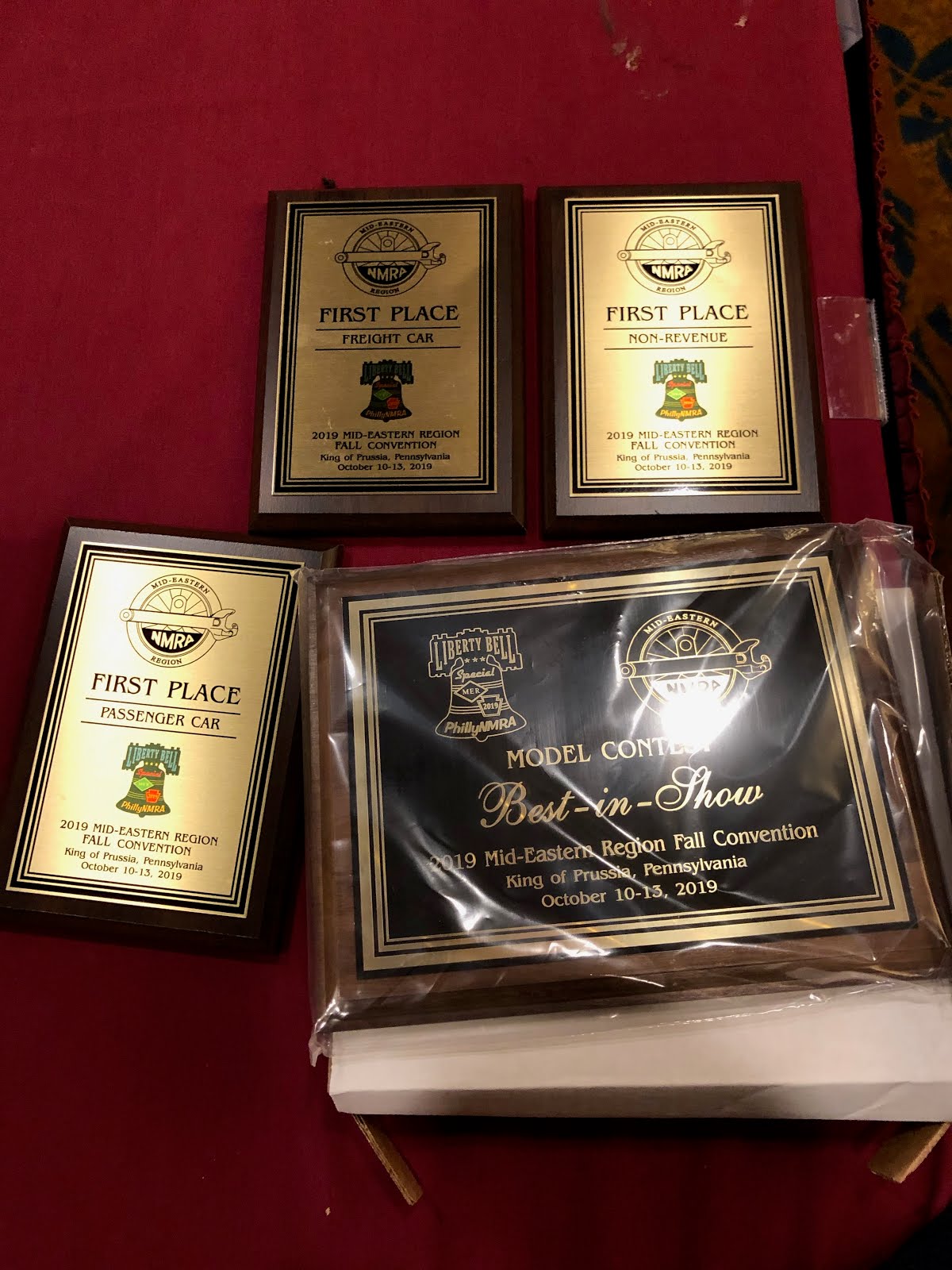
My models did well in the contests. All four models received AP Merit Awards. The judges awarded me three first place plaques for  Passenger Car,  Freight Car and Non-Revenue Car. They picked my model of  the Lee-Brooke gun as the best in show. 

With this recent spate of travel over, I hope to finally get some work done on my layout.

The judges selected my models for these awards..


July 25, 2019

Stage 2 Flood Recovery: Making lemonade


My niece Katrina and her son, Nile. He loves Uncle Bern's trains!


I will be hosting the last op session on PoLA at 1300 on Sunday, 28 July. After the session, we will begin to box up the freight cars for storage and or sale. Once the cars are removed, I will prep the layout for removal. A local guy is planning on buying the PoLA layout for use in his basement.  He may backdate it and change it to Philly or Baltimore to better suit his rolling stock. But it will survive, which is a good thing.

We will not operate the Aquia Line this time as we are still doing recovery from the flood. Here is an update on that.

We have not been able to find a contractor that is willing to work under the Aquia Line benchwork to install tile. They don’t want the liability of damaging an “irreplaceable asset.” However, we did find a painter that is willing to paint the floor and walls. So we plan to have them paint the floor, walls and baseboards. Then we will use area rugs for accents. In my workbench area we will install foam floor tiles that can be removed if they get wet or stained.  If I wanted to have a contractor tile the whole basement, I would have had to remove all the layouts.  I may want to start over on building a layout at some point, but not under these conditions.  So I am going with paint

There must be no shortage of work for contractors in this area, because we also tried to get contractors to do some remodeling work upstairs with no luck. They show up, look at the job, and never call back.

In the process of clearing out flood damage, we removed the teak veneer book shelves from my office. Without the bookshelves, the room feels much bigger. It makes the possibility of layout expansion into the office more feasible. The opportunity to expand the Aquia Line into the crew lounge and perhaps the office is very tempting. I also purged about 15 linear feet of books and magazines from my collection. My garbage pick up this week was quite full, even after a trip to the dump.
My nephews both have "jobs" that need attention. Kevin
is a music composer and producer for Hollywood, while Nick
is a HVAC engineer and salesman.  I call it, "taking a break."
They were a BIG Help! Thanks guys.

The past two weeks have been very demoralizing as we try to sort through the aftermath of  the flood. I was lucky that my niece and nephews were visiting the past few days. They were a big help, plus we got to play with my grand-nephew, Nile. He is an adorable toddler, who loved Uncle Bern’s trains.  My niece is an interior decorator and she gave us some good ideas for colors etc.

Amongst the chaos, Mat Thompson, Pete LaGuardia, and John Paganoni came over on Tuesday to judge the layouts for NMRA AP certificates. I wanted them to look at certain parts of PoLA for the Electrical AP. But, when I did the paperwork, I realized I had all the requirements covered with items on the Aquia Line. So the three of them looked at the layouts and examined my paperwork. All was in order so that I should be getting the civil, electrical and scenery AP Achievement Awards. Mat advised me to pursue the Car and Prototype AP certificates next and that should complete my Master Model Railroader certification.

Thanks to family and good friends, we are making lemonade from the unwelcome lemons.

April 24, 2019

Is HO too easy and other random thoughts

Scene from war game last week
Activity on the Aquia Line has been slow lately as many other projects and demands have taken my time. A death in the family, my wife's uncle, required a short notice trip to Kentucky. Then we had other family obligations for the Easter weekend.  Nonetheless, in between those events we managed to get in another Bolt Action Game in the crew lounge and Mat Thompson visited me to help get my NMRA Achievement Program paperwork going.

A few months ago. Mat had asked me if I was willing to go through judging and complete the paperwork for the NMRA Achievement program. He assured  me that my current layout would probably meet most of the Master Model Railroader requirements and I just need to get the models judged and the paperwork submitted.

I have thought about this in the past, and even did some tabulations of the requirements I could satisfy. On occasion, I entered models for judging at NMRA meets, so I do have a few NMRA Merit Awards already. That's about as far as I got, as I decided that it wasn't''t worth the effort to submit the paperwork. Anyone that knows me knows that I hate boring meetings and useless paperwork.  Mat assured that the paperwork won't be too bad, and he would help, also known as holding my hand through the process. So I agreed to reinitiate the effort to get the Master Model Railroader certification.

Mat helped me get the Statement of Qualifications (SoQ) done for two categories, volunteer and author. Over the years I have presented dozens of clinics at NMRA events and others too.  At these events, the hosts usually presented me with some type of certificate, most of which I kept in a note book. So it was easy to document them. I also participated in many modular model railroad set-ups at NMRA events. For example, at the Madison NMRA National Convention, my steel mill module was awarded Best Module in Show. Many  of those meets were documented in the NVNTRAK NTRAK newsletter, which I published at one point. So, even though I never held a position on any NMRA board (see my comment about boring meetings above), I had more than enough "points" to meet the NMRA standards for volunteer.

The author SoQ was also relatively easy for me to document. Mat selected one of my books. The word count in the book, along with photos and diagrams met the requirement for author.  You have to submit a copy of the work, so Mat took a copy of my "Model Railroads Go to War" book to submit with the SoQ.  Turns out, writing  a blog would also qualify for the Author category. Since this blog has 973 posts, and more pictures and diagrams, I probably could have used it too. But it wasn't needed.

With those two SoQs done, Mat walked me through the other categories I would need.  We went over the layout pointing out what things need to be judged to met the various SoQ.  We concluded I would qualify for  Car, Civil, Structures, Scenery, Electrical and Dispatcher.  I need to do some paperwork for this and get the judges to visit. But it can be done without me having to build anything special just for SoQs.

The Dispatcher SoQ is a bit tricky as you need two NMRA officials to verify that you were at an operation session. I do keep a log of all layouts I visit and operate. (At this point, I have operated on 106 different layouts for a total of 154 sessions not counting my own operating sessions.) But I never got two people to verify I was there. However, Mat pointed out that my own operating sessions would count and they are documented on my blog, so two NMRA officials could verify them. Thus, I probably could qualify for Dispatcher category if I wanted to. But, I wouldn't need it, as I would have enough categories with Volunteer, Author, Car, Civil, Structures, Scenery, and Electrical.


Overall scenery and battle report

How our mind's eye envisions these games
My wargame buddies, John Drye, Mark Franke, and Bill Rutherford came over last  week for a war game  that I hosted. I should point out that all three of these guys are also model railroaders. We all had NTRAK modules at one point.

The scenario depicted the battle for La Fiere Causeway on 6 June 1944. This was D-Day, but the action involved the 82nd Airborne and elements of the 101st Airborne Division trying to capture the small bridge over the Merderet River about 3 miles from Utah Beach. I built the terrain board including some custom stone buildings with interior spaces.

The game was a lot of fun. John played the small  Germans force holding the stone manoir (farm) while Mark and Bill attacked with US paratroopers. I initially was the judge, and then ran the German counterattack up the causeway.  It is interesting that the game progressed similarly to the actual battle, even though we used Bolt Action, which is a very simplified, but elegant gaming system.

Running a wargame is a bit like hosting a model railroad op session. None of us are particularly interested in "winning." Many of the players that engaged in Bolt Action spend inordinate amounts of time tweaking their force list to have the ultimate "winning" formula based on an arbitrary points system.  That can result in some very unusual and ahistorical force mixes on a table.  They use these in competitive tournaments.

Our little gaming group couldn't care less about that. We devise our scenarios on historical situations and go from there. We might look at the points to ensure that the scenario is balanced, but we don't worry about it much. We really are playing for two reasons. One it gives as a reason to research and learn about WWII. And two, we get to build cool models and then play with them as opposed to putting them on a shelf.  And we have a grand time doing it.

After the game was over, John pulled out a Broadway Limited  PRR 2-10-0. I fired up that layout and we test ran it on PoLA. It did run nice and sound great, though it needs a keep-alive to run on my dead frogs.

John said to me, "You are right, HO is too easy. I went to Timonium last weekend and bought just about everything I need to build the HO layout."

John was referring to a flippant comment I made a few months ago when I said I was taking down PoLA because, "HO is too easy. You can buy everything you need."   For some, that is a good thing. But for me, I like to scratch build stuff. So I prefer the challenge of an odd ball scale and subject.


Now John is converting his N Scale layout  (see video above) to HO. In a fit of madness about 10 years ago, he decided to model the 4-Track Pennsy Horseshoe Curve region from Altoona to Cresson in N Scale. This was a highly complex layout. For example, he had more turnouts in his Altoona yard throat than I have in both of my layouts. The complexity meant slow progress. To his and helpers' credit, they did get a lot of track and scenery done. I helped a little too. Mostly with backdrop and rock carving. But during test sessions, the layout wasn't operating up to John's desires. Also, he was finding it hard to see the wheels and track. So he decided to convert the layout to HO scale. He will use the same benchwork, but build a PRR branch line using Kato Unitrak.