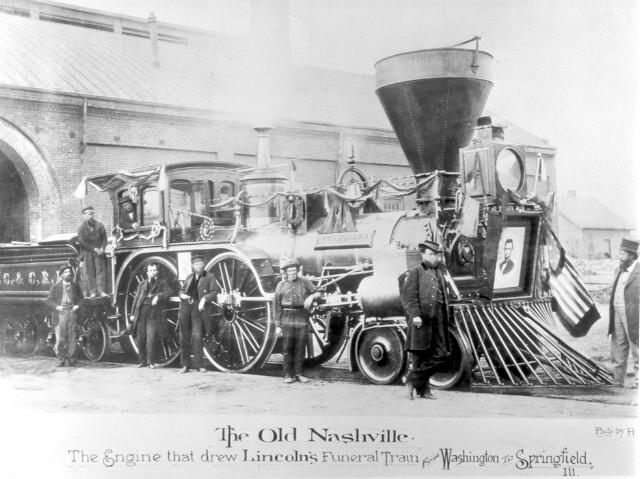
The B&O Museum had a special event this weekend to commemorate Lincoln's Funeral. I did not attend the event, but this link
had an article about it. The article did mention the model I built.
The photo at the left shows one of the B&O's locomotives decorated as one of the locomotives that hauled the funeral train.
A journal following the history, design, construction and operation of Bernard Kempinski's O Scale model railroad depicting the U. S. Military Railroad (USMRR) Aquia-Falmouth line in 1863, and other model projects.
©Bernard Kempinski All text and images, except as noted, on this blog are copyrighted by the author and may not be used without permission.
-----------------------------------------------------------------------------------------------------------------------------------------------------------------
Showing posts with label Funeral Train. Show all posts
April 19, 2015
January 14, 2015
Lincoln Train is on its way
Dan Toomey from the B&O RR Museum stopped by last night and took delivery of the Lincoln car model. It will be part of the War Came By Train exhibit at the B&O Museum, which will open soon. They have had over a million visitors already. If you haven't seen it yet, this is the last year for the exhibit. In April they plan to reenact the Lincoln Funeral visit to Baltimore in 1865.
This was a very difficult model to build, especially given the large scale. I am glad it is done and Dan was happy with it.
With that project done, I will have time to get cracking on Aquia Landing, the next major phase of my layout. Well, actually,...I am wrapping up another book for Kalmbach, but I will start on Aquia after that.
January 3, 2015
President Lincoln's Coffin and Veteran Reserve Guard
The last part of the Lincoln Funeral Train project was to make a model of Lincoln's coffin and one of the Veteran Reserve Guards. References indicate that the coffin was only 6' 6" long, a tight fit for the 6'4" President.
The coffin is black with laser engraved details. It was hard to get a decent photo of it. I placed the coffin on a small platform that is cover with black drapes.
The soldier measures about 6 feet tall. The figure started as a Monarch Miniatures Gunner. I added the belts, epaulettes and other details to depict a Veteran Reserve Guard.
The platform and the figure are on a small section of wooden floor. I did not have any photos of the coffin on display in Baltimore, so I kept this simple.
The coffin is black with laser engraved details. It was hard to get a decent photo of it. I placed the coffin on a small platform that is cover with black drapes. The soldier measures about 6 feet tall. The figure started as a Monarch Miniatures Gunner. I added the belts, epaulettes and other details to depict a Veteran Reserve Guard.
The platform and the figure are on a small section of wooden floor. I did not have any photos of the coffin on display in Baltimore, so I kept this simple.
December 28, 2014
Gauge 1 Lincoln Funeral Car Finished
November 17, 2014
Lincoln Presidential Car Work In Progress
Finally, some ACW era modeling. Here are some shots of the work-in-progress Presidential Passenger Car. The model is 1/32nd scale. I posed it on McCook's Landing to have a nice background, even though the car is the wrong scale. The O scale boxcar next to it gives a sense of how big the Presidential Car is.This car had a unique style of truck. The drawings we have are incomplete, so we had to imagineer some aspects of it. The model has working swing arm suspension and brakes. But I tied it all down since this will be a static model.
The model will be decorated in its funeral configuration with black bunting and one end having the railings removed to allow removal of the coffin. I also will build a coffin and Veteran Reserve on guard.
July 27, 2014
Trucks for the Presidential Car
I am just about done with the design of the trucks for the Presidential Car, United States. It took more than seven iterations to get the design right. I still need to add the brake linkage, the bottom bar under the pedestals. Once I have two trucks complete I will work on the trundle truss that connects the two trucks. I went with black and gold paint scheme, as red wheels that some others have used seemed out of place on a funeral car.
July 21, 2014
The United States - Lincoln's Funeral Car in 1/32nd scale
![]() |
| The United States with black bunting during Lincoln's Funeral |
This model will go on display in th B&O Museum as part of their last year of the "War Came by Train" series.
The car no longer exists, and no official plans for the car survived. The best period description of the car construction was in Railroad Car Journal (Volume III, December 1893, Page 395) by W.H. Price. This source provides a sketch of the unique double truck arrangement used by the car. However, the drawing cannot be correct in all details as the angled truss element as shown would interfere with the interior brake beams of the trucks. The drawing also is not to scale as the overall wheelbase in the diagram is much greater than shown in photos.
Model Railroader published a set of plans for the car about a dozen years ago. The plans were largely based on research by Dr. Wayne Wesolowski. Wayne is a well known to model railroaders and others as a custom model builder. He has built 3 copies of the United States, and several copies of the engine Nashville in 1/12th scale. They are on display at museums across the United States.
I got to know Wayne about 12 years ago when we jointly participated in an exhibit of civil war railroad models at the Lyceum, Alexandria's City History Museum. He has graciously been providing me with information and plans for the United States. Wayne has spent many years chasing down surviving pieces of the car. He also worked with historic railroad experts to develop plans for the construction details based on best practice at the time. Based on information he has provided, I am working on the 1/32nd scale model.
Using the Model Railroader plan as a base, I drew this plan in color. This plan will be used to develop the laser cut parts I intend to make.
I started construction with the trucks as I reasoned they would be the trickiest part of the project, but the decorative trim is also going to be very challenging. The trucks are a swing motion design. If you are not familiar with swing motion design, this page has a good description. There are elliptical springs both transverse for the swing arm and lateral inside the pedestal. The pedestals have a very intricate design. Even the journal cap has decorative flourish that appears to be a man on horseback, or perhaps a rearing lion.
The two trucks are connected via a truss beam to a central drum called a trundle. The trundle is the pivot point that connects to the usual bolster. Price's description mentions a Ward patent bolster. Drawings of that are available, but it will be largely hidden when the car is assembled.
The trucks have pins that connect to the car that ride in curved slots, similar to the way a pony truck rides under the firebox of more modern steam engines. Wayne's plans for the truss show a single wood beam with iron truss rods providing stiffness.
The image at the left is the second test model at designing the laser-cut bolster. The main frame is 1/8th basswood. Wayne's plans called for 3 inch members, but they looked too flimsy to me when I made the first test model. So I bumped up to 4" (1/8th inch basswood) for the main members.
To simplify construction I am incorporating some details integral to the laser cut assemblies. For example the transverse elliptical springs are integral to the bolster instead of making them as separate parts. The pillow blocks on the truck bolster beams are integral to the beam. Even with these compromises, the truck suspension will function almost as originally designed - a moot point as this is a static model.
I ordered additional wheel sets from NWSL. In the meantime, I am using the one wheel set I have on hand to test fit, etc. Note the actual car had compromise wheels to allow running on different gauge track. Thus I ordered the 236 wide wheel treads from NWSL. The set shown here has 172 tread.
The pedestals are three layers. The bottom layer is integral to the truck side frame. This is the same design I use on my HO and O scale trucks. On this truck, the top layer is laser engravable plastic with a thin layer of gold over black. It is normally used to cut name plates and similar items for trophies etc. It can be very tricky to cut fine detail in it. You have to experiment with the laser settings to get the right power, speed and frequency without melting the parts. Even in 1/32 scale the engraving on the trucks is so fine that it almost disappears. The laser dot size is about 0.005 inches, so any detail smaller than that is hard to capture.
Next step is to add the brake details and all the truss rods and NBWs.
July 13, 2014
Dog Days of Summer
The hot steamy weather has descended on Virginia with a vengeance. Usually this is perfect weather to escape to the cool basement and work on the layout. Alas, many other demands on my time have prevented much work on the layout. But there is some news to report, some of it even ACW related.
To escape the heat, we headed to Park City, Utah for a long July 4th weekend of golf and R&R. I managed to sneak in an op session at Rob Spangler's gorgeous HO Western Pacific layout in Syracuse, UT. This is Rob's third layout, and possibly his biggest yet. The layout has a great operations scheme, single track, time table and train order operation with telephone communication to the dispatcher. While Rob's layout is very well done in all respects, he is really famous for his backdrop painting and scenery.
I also visited the Heber Valley Railroad after a round of golf at the Homestead course in Midway, UT. The RR runs regular excursions down Provo Canyon. They have two diesel engines in current service and steam engines under restoration that are due to be ready next year.
Back in Virginny, I am building some custom models for clients. The first is the Thurmond coal dock in HO scale. I built one last year for a client in NJ. Now, a second model is underway for a client in Michigan. I also plan to offer this as a limited run Alkem Scale Models kit. It is nearly ready but I need to get the instruction manual complete. Believe it or not, making the instruction manual is about as time consuming as designing the kit.
I am also in the process of building a model of the Chattanooga Train shed in HO. That project is on hold awaiting some feedback from the client.
Another major project is scratch building a model of the Lincoln Funeral Passenger car in 1/32nd scale. This will be for the B&O Museum for their 2015 The War Came by Train display.
On the USMRR Aquia Line, I have had a couple groups of visitors in the past month. Dale Lantham and his regular operations group stopped by for a look at the layout. Dale has a fantastic HO layout that was featured in Great Model Railroads a few years back. Afterwards, Ron Schmidt, one of the visitors, offered to give me a telegraph sounder. I had mentioned to them my plan to add telegraph to the layout and he generously offered it. More on that later.
Yesterday, Rich Kohr escorted a group of 4 other Gettysburg Licensed Battlefield Guides to see the layout. They had a great time and stayed for several hours, even though they did not want to try running the trains. I think some of them were inspired to try some ACW modeling on their own. That would be great.
Mike Kanazawich has a book about stories relating to the Lincoln's assassination. You can order it here.

Today, I was in southern PA and had a chance to visit the Steam into History train in New Freedom, PA. I arrived there in time to catch the 11:00AM train. Alas, it was annulled. The next train was due to leave in 2 hours, but I could not hang around for that. So I got a couple snapshots of the train in its pen and headed home.
I drove along a parallel road to the tracks on my way into town. The terrain that the railroad runs through is very pretty but heavily forested and hilly. It looks like it would be hard to find decent spots in summertime to get good shots of the train in motion due to the trees.
Since I do not plan to have an operator position on the layout, the dispatcher would carry a hand written copy of the message to the appropriate station on the railroad.
I hadn't quite figured out the OS side, as I didn’t think I wanted the conductors typing messages, a job that the operator would normally do. One oddity on my layout is that all trains stop at all stations to check for orders. They did not use train order boards in my time period.
| Example of Rob's Backdrop Painting |
To escape the heat, we headed to Park City, Utah for a long July 4th weekend of golf and R&R. I managed to sneak in an op session at Rob Spangler's gorgeous HO Western Pacific layout in Syracuse, UT. This is Rob's third layout, and possibly his biggest yet. The layout has a great operations scheme, single track, time table and train order operation with telephone communication to the dispatcher. While Rob's layout is very well done in all respects, he is really famous for his backdrop painting and scenery.
I also visited the Heber Valley Railroad after a round of golf at the Homestead course in Midway, UT. The RR runs regular excursions down Provo Canyon. They have two diesel engines in current service and steam engines under restoration that are due to be ready next year.
| This engine will not run again, but the Heber Valley RR uses it as a "billboard." |
Back in Virginny, I am building some custom models for clients. The first is the Thurmond coal dock in HO scale. I built one last year for a client in NJ. Now, a second model is underway for a client in Michigan. I also plan to offer this as a limited run Alkem Scale Models kit. It is nearly ready but I need to get the instruction manual complete. Believe it or not, making the instruction manual is about as time consuming as designing the kit.
I am also in the process of building a model of the Chattanooga Train shed in HO. That project is on hold awaiting some feedback from the client.
Another major project is scratch building a model of the Lincoln Funeral Passenger car in 1/32nd scale. This will be for the B&O Museum for their 2015 The War Came by Train display.
| Dale's Group |
| Mike Kanazawich, Dave Donahue, Bob Kise, Rich Kohr and Bob Etchberger (L to R) |
Today, I was in southern PA and had a chance to visit the Steam into History train in New Freedom, PA. I arrived there in time to catch the 11:00AM train. Alas, it was annulled. The next train was due to leave in 2 hours, but I could not hang around for that. So I got a couple snapshots of the train in its pen and headed home.
I drove along a parallel road to the tracks on my way into town. The terrain that the railroad runs through is very pretty but heavily forested and hilly. It looks like it would be hard to find decent spots in summertime to get good shots of the train in motion due to the trees.
Telegraph System
I have been thinking about adding telegraph communications to the layout. I was unsure how to do it. My thinking was that the telegraph would just be a sound effect. I recently acquired a railroad morse sounder from Ron Schmidt. I was planning on using it to create sounds of the actual messages that the dispatcher wrote. The dispatcher would type the messages into a computer that would translate it to railroad morse code. The sounder would play the message.| Ron's Telegraph Sounder |
I hadn't quite figured out the OS side, as I didn’t think I wanted the conductors typing messages, a job that the operator would normally do. One oddity on my layout is that all trains stop at all stations to check for orders. They did not use train order boards in my time period.
However, thanks to an interesting on-line discussion with Trevor Marshall and his friend Skip Luke, I learned about the simplified US Military Telegraph Dot Code. You can learn more about dot code at this web site. Armed with this information, I think a simplified telegraph system and code can be used to send OS messages.
The telegraph OS will help keep the conductor/brakeman busy. I need two man crews for my short trains as the brakeman needs two hands to operate the link and pin couplers, while the engineer operates the throttle and whistle (there are a lot of whistle signals). The conductor/barkeman will also handle the couplers, TT&TO, switch lists and telegraph dispatching. More on this as it develops.
November 2, 2010
A Halloween Story....
Here is a short three minute story to help you celebrate Halloween. It is done in the style of an old time radio show so there is no video, just audio. Let your imagination take over. Click the link below. Enjoy.
Errata: That should be Springfield, Illinois, not Ohio.
Subscribe to:
Posts (Atom)