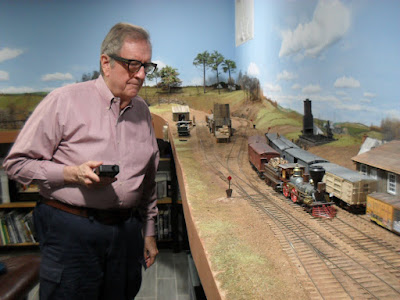
A journal following the history, design, construction and operation of Bernard Kempinski's O Scale model railroad depicting the U. S. Military Railroad (USMRR) Aquia-Falmouth line in 1863, and other model projects.
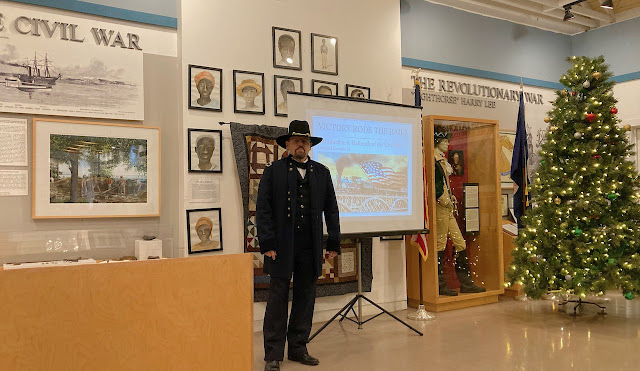
I donned my ACW Generals uniform to present my talk at Leesyylvania State Park
It was a busy week for sharing the word of Civil War era model railroading.
It started last week when my son and his family were in town for the holidays and a conference. On two evenings we ran trains for the entertainment of my granddaughter, Ruka, and her parents. She seemed to be fascinated with the trains despite just turning one year old on Monday.
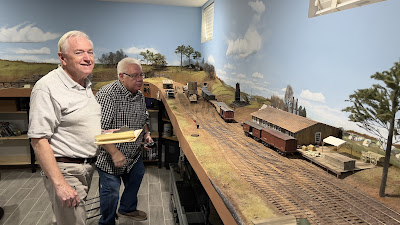
The visitors continued on Friday when Jack Brown, his wife and their friend John Carroll visited the Aquia Line as part of a weekend trip to the Washington, DC area. It was Jack and John's second visit but the first for his wife. We had a nice visit.
On Saturday morning I presented a talk on Railroads of the Civil War to a group of 15 people at the Leesylvania State Park visitor center. The visitor center has a nice museum with lots of information about the history of the land that comprises the park. It was a pleasant surprise as I did not know that there was a museum there.
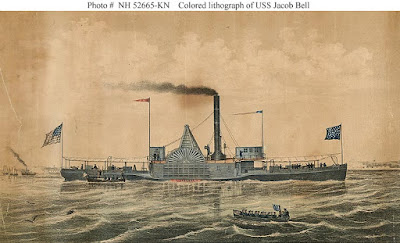
I learned from their exhibits that the Union gunboat Jacob Bell was involved in a small skirmish at Freestone Point. It remained in the Potomac River for much of the war. It would be a good candidate for a model of one of the gunboats that protected Aquia Landing. It was about 141 feet long, so not too big. Perhaps I will replace the Passaic with the Jacob Bell.
On Sunday I hosted an open house for the Aquia Line Railroad. I had 25 people sign the guest list. Five of the guests completed the scavenger hunt check list. I think that was popular with the wives as they all tried it. One couple stayed the whole afternoon looking for every last item.
Thanks to Bill Mosteller and John Steitz who ran the trains during the open house.
Alicia made cookies, which appeared to be a bit hit as none were left at the end of the day. Bill also brought some cookies.
Jack Thompson (blue shirt on right) wearing his very authentic kepi. Ron Prillaman (in green striped shirt) and Jack were both long time civil war reenactors.
I hosted an open house for the NMRA Potomac Division this afternoon. About 35 people came by including some of my wargaming friends.
Charlie and his parents
Leonard White and Jack Thompson volunteered to run trains. They were assisted by Charlie Fastoso. He is a nine year old boy who was visiting for the first time. He ran trains for quite while and ended up making 3 round trips cross the layout. He quickly picked up the idea and was operating the turnouts and turn table on his own. I think he would have stayed but his parents had to leave.
I didn't see too many problems. Most of the issues came from folks forgetting to set turnouts to the correct route. Stub turnouts are basically derails when set to the wrong route.
I was pleased to see that the intermittent shorts in Whiton's tender truck were not occurring. I added insulating washers to each axle to help avoid the shorts and they seem to have worked. I noticed Haupt was a bit balky at the start, but ran well. Perhaps it need some lube.
After everyone left, I test ran the General some. It runs really well. I discovered it needs several ounces of weight in the tender to pull 9 cars. I will take care of that as there is room in the tender for extra weight.
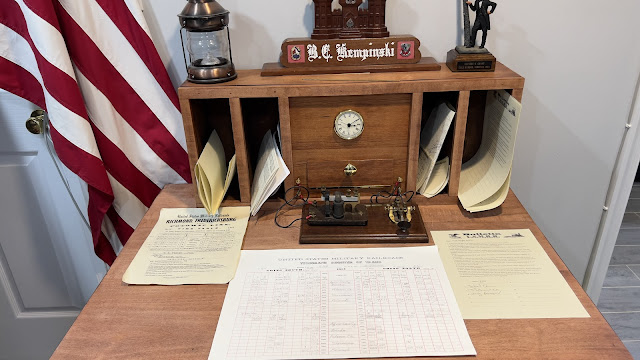
Dispatcher Office ready to go. You can se the schedule, train sheets and bulletin.
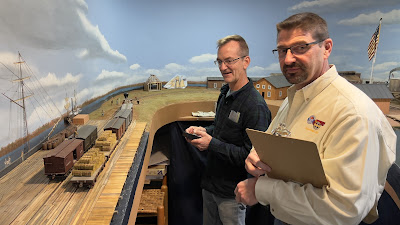
I hosted an operation session on Friday for visitors from New Jersey. Tom Piccirillo, Andy Brusgard, Tom Schmeider and Mike Quinn arrived at the house for an afternoon session.
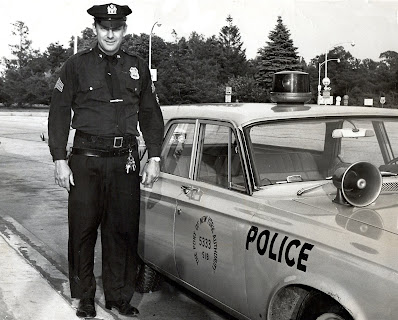
My father at Kennedy Airport
I found it interesting that 3 of the 4 operators were retired police officers. Andy retired after 52 years of service. My dad was a a police officer for the Port of New York Authority, so I feel a kinship with policemen.
Op Session
Tom P. and Andy arrived early so I assigned them train 8 from Falmouth with engine Haupt. We operated under the rule that trains originating from Falmouth with scheduled meets at Brooke are limited to 8 cars maximum. So they left Falmouth with 8 cars.
Later Tom S and Mike are arrived. They took Train 7 as soon as they read the bulletin. To their credit, they had read the advanced paperwork and pretty much knew what to do as soon as they arrived despite being first time operators on the Aquia Line.
Train 8 arrived at Brooke for the scheduled meet before 7. Being the train in an inferior direction, they had to wait for 8 to arrive. It was interesting that 7 needed to pick up a car at Brooke and 8 had a car to drop. So, the crews coordinated their actions to expeditiously do the job.
Andy and Tom P - both had operated here before
Train 8 continued on but forgot to drop off two cars for Stoneman's. They decided to take the cars to Falmouth, vice flagging and backing up to Stoneman's, and then back haul them to Stoneman's when they departed Falmouth. This is not ideal because now the drop required a facing point move and they had to use the extended couplers on the nose of the engine. The extended links are more difficult to use than the regular link and pins, but they got it done.
Meanwhile, train 7 arrived at Aquia Landing. Unfortunately, at that point engine Haupt started to malfunction despite running fine beforehand. After some unsuccessful debugging, we switched engines McCallum for Haupt, and they attempted to finish their run. They assembled the train 9, but never did run it as they ran out of time as they had to leave to check into the hotel.
Mike and Tom S.
The dispatcher annulled train 9, but Tom S. and Mike wanted to stay and finish their run with train 10. I have noticed in the past few sessions that the longer trains that we now run take a lot longer to work. I may need to adjust the schedule if we continue to find that the scheduled times are insufficient. The link and pin couplers definitely slow down the process, especially for new crews.
The random events procedure worked well. The crews pulled three cards. Two were minor events with no operational effect. The third card for crew of 10 required them to stop at Potomac Creek for 10 minutes to load troops whose enlistments were expiring.
Other than the Haupt issue, the ops session went well.
Mat Thompson hosted a group dinner at his house on Friday night. The group dinner is always a highlight of the NJ-DMV Interchange weekend. Mat's layout is also a nice treat to see too.
Greg Viggiano observes John Steitz running trains during the open house
Open House
On Saturday I hosted an open house for the NJ-DMV folks plus local friends. About 15 folks arrived to se the layout. John Steitz, Mike Spoor and Amby Nangeroni ran trains while the guests looked around and asked questions.
Alicia made chocolate brownies which were all gone by the end of the open house
Problems
We discovered that Whiton, one of my Mason engines with battery power was sparking on the tender trucks. The engine continued to run despite the sparks. The shorts on the tender trucks is a common problem with the Masons from SMR Trains. It may be due to the insulating paint wearing off the brass parts as the engines operate. Charlie Taylor also reports similar problems with his SMR Masons. I need to add insulation washers to all the Mason engines. I am also thinking about making make new 3D printed resin trucks for these engines. The resin will help eliminate some of these intermittent electrical shorts. Also, Engine Oscela has a broken wire to the front truck that I need to repair.
John Steitz reported that the passenger car was picking frogs when he was running. It had not been doing that when I ran it, so I need to check it out.
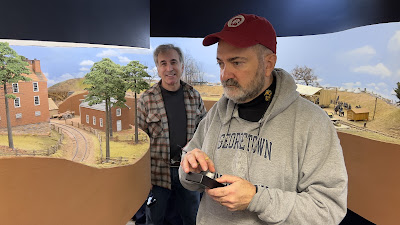
Members of the Rockville Model Railroad Society stopped by to see the USMRR Aquia Line today. They included Tom Matty, Greg Cassidy, Deane Mellander, Jim Novaco, Roger Andes, Ben Sullivan, Kelly Regan, Fritz Fahlin and Joe Ney. I had not run the layout in quite some time, so I was pleased to see that it operated without problems during their visit. It was a fun time. Ben Sullivan mentioned that he has a blog on the layout he is building. His layout is based on the Georgetown Branch of the B&O. The Georgetown waterfront scene has always been a favorite of mine. After seeing my layout, the group headed to Paul Dolkos's house to see his layout.
The visitors seemed as interested in the wargame board I am building as they were in the layout. A few of them said that they too did wargames. This game board is going to be used in the Northern Virginia Gamers Group (NOVAG) Game Day in Chantilly, VA on 26 January. John Drye and Mark Franke are helping me host the game.
Kent Smiley runs a train while Steve Bird (I think - his handwriting was hard to read)
Marty holding forth on civil war naval guns
The O scale National Convention is underway this weekend in Rockville, MD. I hosted an open house for the attendees. About 30 of them arrived to see the layout. Kent Smiley, Marty McGuirk, Brad Trencamp, Doug Gurin, Jeff and Christian Peck helped run trains while I answered questions from the guests.
On Saturday I will be presenting two talks at the convention.
Yes, Marty has a padded room in his house.
Hmm, is this ruler straight?
One of my modules in the Honda CRV
On the module front, one of my modules made its first road trip to Marty's house so he can catch up on constructing his module. Next weekend we'll get the track down and then my two modules will return home so I can finish all the track.
Wow, what a day! We never had more fun with the layout. Even Alicia was down in the basement enjoying the visit. Today we hosted an open house for a pack of cub scouts and the neighbor hood children. Derek Trunkey organized the cub scouts, while Sean Heather organized the local kids. Mike Spoor, an experienced model railroader, was visiting and he helped out. We planned the event in three waves. First was the cub scouts, then the neighborhood girls, and last the neighborhood boys. There were a total of 19 children.
Each wave entailed watching a 6-minute video describing the layout and background, then the kids took turns running trains and doing a scavenger hunt.
The scavenger hunt was a YUUUUGE HIT! The children and their parents had a great time looking for the items. Some of the items were obvious, some needed a little explanation, and a few were well hidden, like the penguin hiding in the first image, or Gumby hiding in the tunnel. Turns out, most of the kids did not know who Gumby was!
The kids kept their scavenger sheets as souvenirs. Some of the children had a hard time seeing the layout details because they were too short, but I had hidden a few items that they would have a better view of seeing compared to taller people.
Every kid from ages 4 to 10 got to run a train. There were several derailments, many due to contraction of the layout due to low humidity (see more below), but the kids didn't mind. Here is gallery of some photos.
The event was so successful, that we are planning a follow-on event where each child will get a chance to assemble a building. I'll design the building kit so it can be assembled without sharp tools and with simple white glue. Some of the children suggested this, so you know it's going to be be effective. They want to learn how to make a model railroad!
The low humidity caused the usual track problems, which manifest in some of the turnouts that become too tight as the wood bases shrink under them. The solution seems to be a whole house humidifier. We plan to upgrade the HVAC in the house, so that will be an add-on to the new HVAC system. We may have to move that up on the priority list.
Engine Haupt wasn't running well, with several stalls. It needed a tune up that was mostly an adjustment of the pick-up wires, and a wheel cleaning. Right at the end of the open house Fury stopped running, though it had sound and the motor was grinding. Something was jamming the drive. I took it apart and discovered that the rear universal popped out and was jammed. It was a simple fix and it was back in operation.
Eight operators showed up today to run trains on the Aquia Line and PoLA. We had two first timers, Wes Morgenstern and Ed Kapuscinski, Sr. Wes has an WM based O scale layout that has some articulated engines that are as long as a whole train onto Aquia line. Ed K. Sr. and I first met over 20 years ago when doing NTRAK. I hadn't seen him in many years.
Returning for duty were John Drye, Eric Payne, Jeff Peck, Ed Kapuscinski Jr., John King, and special surprise operator Phillip Hoffman, who was visiting from Louisiana.
John King and Phillip volunteered for PoLA. John decided to make a second switchlist based on his observations of the cars on the layout. I'm not sure why or what he did, but he seems to be happy in using it. Switching PoLA can be challenging, especially when you forget half your cars in the staging yard. Oh well, they got 'er done without mishap.
We decided to run two 3-man crews on Aquia. John Drye conducted Train 7 out of Aquia with Jeff Peck as brakeman and Wes Morgenstern as engineer. Eric Payne was conductor on Train 8 out of Falmouth, with the Ed K's, junior and senior, as brakeman and engineer. Three man crews work well when we are only running two trains. Things ran very smoothly overall. There is a lot of assimilate when you first try the layout, so we expect operations to go even better as time goes on and the crews gain experience. The more experienced crews really can get the layout running smoothly. Here is a video summary of the day.
At one point, a crew realized they misread the time table and went too far. Luckily there was no cornfield meet. So they flagged the on-coming train and waited it out in a siding. It was a simpler time then.
This was the first session where we switched cars off the car float. There were four cars to pull. Train 7 and train 9 each got to pull two cars. We did not reload the car float during the session. With the car float in operation, we discussed the possibility of having an Aquia Landing wharf switcher that would just handle that job. It will be something we consider as we do more ops sessions.
New shelf at Falmouth
I installed a small shelf in Falmouth for conductors to use based on a recommendation by Eric Payne. Hence, it is now the Eric Payne Memorial Shelf. Alas, the crews seemed to not use it as the aisle to it is blocked when other crew men are standing there. Perhaps with two-man crews the shelf will prove more useful. It is a great place to place a drink.
Phillip got to run the General's special right at the end of the session.
One of the pleasant surprises is how interesting and challenging the operations on the Aquia Line have been, despite the relatively simple track plan and low train density. It was a factor that concerned me as I was building. I am so relieved to see my operators are enjoying it. I love watching the crews interact as they discuss what they will do. The operations really brings the layout alive.
After the op session about a dozen or so visitors showed up for a layout open house. They included Adam, Alexander and Estevan Talaber, Ed Keating, David, Emily, and Moly Mosher, and Emily's boyfriend, Bill, Tom Pierpoint, Mark Andersen, his girlfriend Betty, Doug Gurin, and Paul Dolkos. The children got to run trains on PoLA and Aquia Line, whereupon they did quite well and with enthusiasm.
We can't forget that Alicia made some good snacks for everyone to enjoy. All in all a very fun day.
Here is a short video taken by Phil, for a different take on the day..
The AWCRRHS descended on the layout today to operate the Aquia Line. Nine operators showed up plus Joel Salmons, who was the assistant superintendent. We ran three trains at once. They included 7 and Extra 7 from Aquia Landing and Train 8 from Falmouth.
Train 8 actually was scheduled to depart first at 1:40 and it did. It was under the command of Thom Radice (NJ) as conductor, Mark Richardson (CA) as engineer, and Paul Dobbs (TX) as brakeman. Don Ball (KS) conducted Train 7 with Larry Huber (CA) as brakeman and David Bjorkman (NC) engineer. Extra 7 under the command of DC Cebula (DE), with John Salmons(VA) as brakeman and John Ott (CA) as engineer. Yes, the crews came from all over the Unted States.
This was the first time we ran an extra train. With 3 man crews, it got very crowded in the layout aisles. But, since we had visitors from so far away, we wanted everyone to be doing something and have no one waiting around. Ideally we will use 2-man crews, especially if we run an extra.
Otherwise, the extra worked really well. It gave the conductors a bit more to think about as they ran the trains. When both extras were at Falmouth, the aisle got really crowded, but the crews made it work.
The loaded-empty tokens worked well. But, I think I will have the crews remove the tokens once they record the car to their switch list.
While the ops session was under way several observers stopped by. They included Drew Hyatt (PA), Ray Bracis (OH), Ron, Jon and Lori Flowers (MI). Angela Richardson, Mark's wife was here too. Later Doug Gurin stopped by to pick up his shirt.
Overall, the session was a success. Some brakeman had trouble with the links disappearing in the couplers. I think I will go back to the link design with the central bar. That prevents the links from going in too deep.
All the engines ran great. There were a few derailments, but nothing too serious.
Prior to the session, I modified the schedule to show Clozet Tunnel. (Yes that is the new name for the tunnel. Pronounce it Clow-zay. It a pun on the actual Crozet Tunnel and the closet). That seemed to work well too.
There is a video of the session here. I think everyone had fun as they said they want to come back.
After the session, Joel Salmons went up to the car to get his sawzall. He and the rest of the gang were ready to tear out PoLA and expand the Aquia Line. Luckily, I caught them in time before any damage was done.
Air transportability test of Stryker in 2003 at Bicycle lake, CA
For over 24 years I worked as an defense analyst involved in operational testing of US Army military systems, with a focus on combat vehicles and unmanned aircraft. (I wrote a paper a few years ago for CBO about armored vehicle design which you can find here.) As an operational tester I learned the importance of conducting tests of complex systems with real users under realistic conditions. Today during the open house, the USMRR Aquia Line went through its Operational Test 1 (OT1).
Visitors watch the 6 minute introductory video on the USMRR Aquia Line
Before the steady stream of visitors arrived, a crew of volunteers arrived for pre-test training. One of the key tenets of operational testing is that the equipment users must be representative of the actual intended users in the field. In this case, the test crew list reads like a list of ringers, but they are folks that will eventually be operators on the layout. They included a full assortment of military branches and disciplines.
Crew one was composed of John Barry and Ben Hom. John is a retired US Air Force C-130 pilot with extensive test experience at USAFOTEC. Ben is a retired navy officer currently working as a contractor for the US Navy Operational Staff in the Pentagon. Crew two was composed on JD Drye and Doug Gurin. JD is a senior analyst at SPA working in nuclear weapons security. Doug is the LDSIG guru and former traffic engineer. All have extensive model railroad experience in additional to their profession expertise.
After being fed by our commissary staff, the crews received a briefing on how to operate the layout, notably what switch stands were having trouble. Other than that, they were instructed to "run the layout however you see fit." I attended to guests and left the operators on their own.
The guests filed through and the layout room got quite crowded at several points, but the test crews kept the trains running. Afterwards, they provided me with some feedback.
They reported that both battery powered engines had their batteries eventually draw down during the session. The Whiton lasted about an hour and the Fury about 2. Engine McCallum worked well with its standard DCC sound decoders. Two hours would be OK for an op session, but is not long enough for a 3 hour open house. The next DCC engine conversion will be a sound-DCC with a keep alive circuit. I had cleaned the track before hand but McCallums wheels had not been cleaned in a while.
The crews were unaware of the prohibition in the rule book about using the extended links on the cow catchers. They noted some wheel tracking issues as they pulled and pushed long cuts of cars with the extended links. The problems stem from the fact that the extended links do not have sufficient angular play to handle the tight curves only layout . So they bind and twist the boilers of the tender driven engines. I have not yet tried to build new extended links with more angular tolerance. So I have a rule about using those links only in emergencies. However, I failed to tell the crews about the rule. However, the rules were posted to the blog here and listed below. Note rule 2.6.
Other than those two issues, they did not report any other problems. Overall, it was a successful OT1.
The layout is in a state where operating sessions could begin with just a few weekends of work (the military would call it Initial Operating Condition or IOC) . To make that happen, I would need to make it a higher priority. Alas, there are several other higher priority projects that stand before it. So formal op sessions will have to wait a bit longer.
With regard to the open house, the 6 minute introductory video is proving very useful. We played it five times today at intervals so that most guests got to see it. About 30 guests stopped by including a former colleague and spouse from IDA and a current colleague and his family from CBO.
Instructions for Operators on USMRR Aquia Line Model Railroad
1.General 1.1. Please read this complete document so you understand yours and the other players’ roles. 1.2. If you notice a problem, please bring it to our attention. If you derail a car, please re-rail it carefully. If you are unsure about something, please ask. 1.3. Have fun. 2. Conductor 2.1. You are in charge of the train. You will instruct the engineer and brakeman on what to do. 2.2. Movements on the layout are controlled by early 19th century Time Table and Train Order rules, which are simplified versions of the currently used rules. You will find some train orders and a schedule for the trains in the packet you receive. The train orders will provide any special instructions. You should consult the schedule to understand any meets with other trains or other events you must consider. 2.3. In the packet you will receive a replica copy of the USMRR Conductors Report. Please fill out the top with the names of the operators on the train. This form will act as your switch list. It will tell you how many cars are in your train (probably 4) and where they should be spotted. It will also list cars that you must pick up. You should verify that the cars you are pulling are correctly listed on your sheet. Make any corrections as needed. 2.4. Any cars not listed on the papers but found at the terminal must remain in place though they can be shuffled around if necessary as long as they end up where they started. 2.5. As you work you may mark up the switch list and add notes. When you are done, please turn in the switch list for our records. 2.6. Do not use the extended link on the cow catcher for switching. Make all your switch moves from the rear of the tender. 2.7. Your train should display proper signals. In daylight, white flags for a single scheduled train or red flags if an extra is following. At light, signal lights will be used instead of flags. 3. Engineer 3.1. You are in charge of the locomotive. You will control the throttle, bell, head light whistle and engine servicing. Please familiarize yourself with the throttle and the special functions. 3.2. You do not have to run with the headlight on in daylight, but you may if you wish. 3.3. Ring the bell when passing or near the depot. 3.4. The engine decoders have momentum programmed in, so be aware of that when starting and stopping. 3.5. The brakeman will signal you when to move during switching with hand or verbal signals 3.6.Use the appropriate whistle signals when moving the engine. 1 Short - Apply brakes2 Short – Release brakes3 Short – Backing train4 Short – Call in flagman, 5 Short – Wood up1 Long – Danger. 3.7. To service the engine you must park by the wood rick and water tank to replenish water and fuel. Use the sound effect function to simulate the water filling operation. You do not need to move the hose or lever on the tower. Wood loading is simulated by a 2 minute wait by the wood rick. You do not have to actually load the wood. 3.8. Do not exceed 5 miles per hour when crossing the bridge. Do not use excessive speed when switching. 3.9. You will turn the engine when necessary on the turntable. It is manually operated and aligned. We will handle turning the engine on the fiddle yard cassette. 3.10. Please turn off the throttle and return it to us when you are done. 3.11. If the engine stops running during operation, it could be a dead battery. Please let us know if that happens and do not continue to operate. We have a spare engine in case this happens. 4. Brakeman 4.1. You will couple and un-couple cars, set the switches, and operate the brakes in accordance with instructions from the conductor. You will guide the engineer during these moves with hand or verbal signals. 4.2. The cars use link-and-pin couplers. We use magnetic pins and laser-cut paper links. They will take two hands to operate. You will be given a brake staff to use. It has a rare earth magnet on one end to grab the pin and a taper on the other to help manipulate the link. Use the magnet end to pull and place the pins. If you are careful the magnet will only grab one pin when you go to pull the pin on adjacent cars. If you accidently pull two pins, replace the one you did not wish to pull. 4.3. It may be necessary to use your fingers to set the links. That is OK. Just make sure they don’t get crushed when coupling the cars. 4.4. Place the unused pins and links in the plastic bag we provide. Try not to lose them, but we do have extras. 4.5. You will throw the switches using scale sized switch stands. Do not force them. They should operate smoothly and lock in place. Visually inspect each switch to insure it is properly set. 4.6. Some of the cars have working brakes. Make sure these are all released. We will not use the working brakes in these operation sessions. 4.7. Please make sure you return the brake staff when you are done. We do not have many extras.