A journal following the history, design, construction and operation of Bernard Kempinski's O Scale model railroad depicting the U. S. Military Railroad (USMRR) Aquia-Falmouth line in 1863, and other model railroad projects.
©Bernard Kempinski All text and images, except as noted, on this blog are copyrighted by the author and may not be used without permission.
-----------------------------------------------------------------------------------------------------------------------------------------------------------------
Showing posts with label WWI. Show all posts

November 5, 2019

Recycling The Cambrai Diorama


Night shot on the diorama 


A few weeks ago, Jonathan Goldman, the new curator of the B&O Museum, called me to say that their "First to Fight" WWI exhibit was being redone. They wanted to return the WWI diorama to me. I did not expect to get it back and I don't have any place to store it at my house. So I told them I would stop by the museum and take the diorama apart. I would keep the models, but discard the frame. Here is a brief video showing scenes from the diorama.


Museum crew lift the vitrine off the layout
That is what Alicia and I did last weekend. After golf lessons in Columbia, MD we stopped by the museum. The crew there helped remove the vitrine, which was very heavy. Then I stripped the figures, tanks, structures, railcars and some of the details. The rest of the diorama went in the trash.

L to R Amanda (museum designer), Alicia, and Ana (museum archivist) 
As I examined the models, I was reminded about how nice the W^D  Models WWI figures are. They are some of the nicest sculpted small scale figures I have seen. W^D also makes some great detail stuff for WWI era military modeling.

I don't have any immediate plans for the residual pieces from the WWI diorama. Last year Bachman UK announced the release of a 2-6-2T Baldwin steam engine in OO scale. That would be the correct engine for this era and locale. Perhaps I'll build  a new version of the diorama that is more portable and operates using that Bachman engine for motive power.

However, Bachman USA also announced the 2-6-2T in On30. I happen to have a bunch of On30 stuff that could be used in a WWI themed layout including  brass kit ion a Dick-Kerr gas electric and some military figures. So maybe an On30 layout will be the next WWI project.

Meanwhile, I am working on existing do-list. I have lots of stuff to get done before tackling a new layout.

June 3, 2019

New England Blitz Tour

Morning panorama at Mystic Seaport Museum

Ken Karlewicz's 
This weekend Alicia and I travelled north to Farmington,  Connecticut to attend the New England Railroad Prototype Meet.  Our trip started with a golf lesson in Columbia, Maryland. We then headed north crossing the new Tappan Zee Bridge. That is a very impressive engineering achievement, much improved over the old bridge. We arrived in Farmington late Friday afternoon in time to get dinner and attend a clinic where Ken Kalewicz gave an impassioned plea to include stark side lighting and dark shadows in your model railroad photos.

Neat tug and barge model


The next day I attended several more clinics, got a chance to try weathering with pan pastels on a freight car, and presented a clinic about developments on my railroad.  Some of the clinics I saw were outstanding with excellent modeling on display. Randy Laframboise's clinic on his Rutland railroad was a real standout. He and his life time buddy, Sparky, have built a gorgeous rendition of the Rutland Railroad in HO scale on two decks in his  house.  His layout was featured in MRP a few years ago, and their railroad has gotten better since then. Hopefully, we can get him to present this clinic at MARPM.

Jim Otto's collection of WWII Army vehicles
The NERPM exhibit hall was very full of models and vendors. I heard that they actually had to turn away some displays due to lack of space. I did have a chance to display some of my O scale rolling stock and show some new Alkem Scale Models products.

It was great to chat with friends and meet new folks too. I had a nice chat with Jim Dufour, who is planning on delivering a clinic on his fantastic railroad at MARPM 2019. Both Jim's and Randy's clinics will be "must see" at MARPM 2019.

The sun popped out at noon for some blue sky shots


One of many ship models on display at Mystic Seaport
The Sunday after the show, Alicia and I went to Mystic Seaport. She had never been there, while it had been over 50 years since I was there. It is a great place to visit. The Mystic Sea Port Museum has some new buildings, including the entrance halls and a neat whaling museum with lots of cool ship models.

Very cool seaport diorama at Mystic. Looks to be about N Scale.
Sabino looked to be in good shape 
The recreated town with bank, smith, carpentry shop, churches, stores, newspaper office, etc, was very well done.  The large seaport diorama was also very cool. However, the featured ships seemed to be very worn looking.  The Charles W Morgan looked like it needs a good overhaul. The fishing schooner, Dunton, was missing a mast and almost all its rigging.  Its wood was in desperate need of maintenance, The trawler Roan, and steamer Sabino looked a little better off.
Charming recreation of a 19th century seaport  makes me want to add a town to my layout

There were two special guest ships at the sea port. First was the Mayflower II, which was in the shipyard undergoing extensive repairs. It was hard to see as it was covered by a large plastic tent. But they had a nice exhibit explaining the work they were doing.

The Draken Harald HÃ¥rfagre without its mast
Alicia in the bow of the Draken
Second, in  the water near the Charles W. Morgan was the Draken Harald HÃ¥rfagre. It is a clinker-built Viking longship, a reconstruction of what the Norse Sagas refer to as a “Great Ship.” The volunteer crew had removed the mast, and were doing repairs to the ship. One of the crew said they would have the mast back up in a week. The Draken is staying in Mystic as a base of operations for maintenance and repairs before doing tours to other ports in the United States, though one crew man said the plans were not yet definite.

Viking cooking
Viking soldier
Alicia really got a thrill from seeing the Viking Ship.  She said she had no idea they were as big as this one.

 In addition, the Mystic Sea Port was hosting "Viking Days" that weekend.  So, the central village green was occupied by a Viking camp. The Vikings were living history reeanctors from the US and Canada.  Alicia and I agreed that Viking dress looked very comfortable.

Later we  did a walking tour of the town of Mystic. It is a quaint New England coastal town.  We had a nice seafood lunch overlooking  the harbor. Seeing the charming town got me thinking that I need to include a town on my railroad. Perhaps the Fredericksburg Extension will get another look.

We left Mystic and headed to Havre de Grace in Maryland. We arrived at sunset, but with enough light to enjoy a walk on their waterfront promenade. Havre de Grace was attacked by the British in the War of 1812 and much of the town was destroyed.

We pose by the WWI diorama


On Monday we played golf at Bulle Rock, near Havre de Grace. Then we stopped at the B&O Railroad Museum in Baltimore where we met with Travis Harry, a curator there. We had a tour of the new exhibit on World War I. A big part of the exhibit was the display of the WWI layout that I constructed for my "Model Railroads Go to War" book. They have installed the layout in a vitrine with the town of Fins on display but with the trench side covered. It is a static display as I did not provide any functioning locomotives. It was a thrill for Alicia and I to see my model on display.  This exhibit will remain for a few more months.


Then Travis took us around the rest of the museum and showed us some of the new exhibits in place now that the 2003 storm damage has been fully repaired.


Of special note was Engine 25. It had been renovated and painted in the correct colors for the Civil War era.  They found traces of the original colors when they restored it. They also fabricated a new, correct,  builders plate. This is the one that goes between the drivers. They used the wood part as a master to make a mold and then cast a new plate in brass.

Alas, the crown sheet  did not pass the 15 year safety inspection. So the loco sits in the roundhouse  as a static display. It will stay that way unless they can get funds to pay for repairs. But it is gorgeous, and a treat to see.

Alicia at the throttle an Allegheny 2-6-6-6
All in all a great  weekend.

December 28, 2016

A Farewell to Arms

...or "How Bernie Got His Landing Back. "

A foggy sunrise at the front. One final photo before the WWI layout heads up to the B&O Museum.
The Cambrai diorama safely loaded in Dan's vehicle


Dam Toomey and Travis Harry from the B&O Museum came by today to pick up the Battle of Cambrai WWI railroad diorama. The diorama is fully described in my book, "Model Railroads Go to War."  The diorama will be part of the B&O Museum display on the U.S. participation in WWI. The B&O Museum has one of the French friendship boxcars. Hopefully this diorama will help them enhance their exhibit. I am looking forward to seeing it on display.

Dan and Travis pose by the cleared peninsula
For the past couple of years the diorama occupied the flat portion of the Aquia Landing peninsula. Now that the diorama is on loan, I can start actively planning on building the next phase of the Aquia line.

As I discussed in previous posts, I would like to convert the peninsula to a turn back loop. The problem is that I really need to make the loop  track with as large a radius as possible to accomdate my O Scale locos. While 28 inches is possible, 30 or more is much better both visually and operationally. (O scale modelers of modern standard gauge would be shocked by such a small radius. That is the nice thing about modeling the ACW in O scale. It's really like designing an HO layout.)

Mocking up the loop track. CINCHOUSE thinks this point  is too narrow
and she is much thinner than most of my RR friends.
I took a piece of masonite and mocked up the fascia for a 30 inch loop. If I bump out only the north side of the peninsula, the aisle between the layout and the closet-bathroom has about 21 inch choke point. While the bump out doesn't interfere with the HVAC closet door that opens into the aisle, it does constrict movement. CINCHOUSE (aka Alicia) doesn't like it much.  So we tried a mockup where each side of the peninsula is bumped, but each to a lesser amount. The seems to work much better.

Mock-up with bumps on both sides of the peninsula 
I mocked up a couple pieces of pink foam to create a view block representing the ridge. It looks like it should work. See the concept sketch below.

The main drawback to this layout with the turn back loop and ridge is that to make the Aquia Landing landing fully functional, I would have to take out PoLA and build the Aquia wharf in its place.

However, If I build the landing on the existing peninsula  like in Option 1, then the USMRR and PoLA could coexist.  So if I go with the Option 4 then what to do with PoLA is the next decision. I can foresee three possibilities: sell it off in whole or by parts, convert to a FREMO module set or build as a shelf layout in my office. Hmmm, it's good to have options.

I have a few weeks to think about this as I have to finish up the custom model (which is nearly done and will be delivered this Saturday), and I finish the Borax factory on PoLA. But it is good to start thinking about and start work on the Aquia Line again.

Concept sketch of how the peninsula would look. The ridge is high enough to block my view across it.


January 28, 2016

Night Photo - Battle of Cambrai

This shot is one of my all time favorites model railroad photos. I shot it for my book, "Model Railroads Go to War." Alas, the printed version really does not do it justice since a CMYK print doesn't have the dynamic range to render the dark clouds and shadows properly. But on screen, the image pops.

The loco is a ROD Robinson 2-8-0 that Chris Williams let me borrow for the shoot. The flat cars are Macaw bogey wagons that I scratch built.

To learn more about the story behind the scene, please see my book, "Model Railroads Go to War," available on Amazon  Model Railroads Go to War (Layout Design and Planning) or

 at www.AlkemScaleModels.com for a signed copy.


January 2, 2016

The year ahead.

The Brooke area on the Aquia Line is just about done.


Last year ended on a nice note as my wife and I both made birdies on the last round of golf we played on News Years Eve. Birdies are rare events for us, so we celebrate them when they happen. It was also a good year on the Aquia Line. The layout from Falmouth to Brooke is just about complete. This includes new flooring and skirts in that part of the layout. Just a few scenic details remain, but it's nice to have such a large piece of the layout done. The Model Railroad Video Plus crew visited in October to record it for an upcoming episode.

The next step on the Aquia Line is to begin laying track at Aquia Landing. Much of that track is on a wharf, so a I need to install that before  the track can go in. If I wanted to begin operations before that, I could lay a few tracks at the west end of Aquia Landing, and use it as a fiddle yard. But before doing that I have two major projects to complete, the Antebellum Alexandria Waterfront Diorama for the Alexandria Lyceum, and my next book for Kalmbach on marine terminals, wharves and ships. The Port of Los Angeles layout is for the book.  The PoLA layout is coming along nicely, and is fully operational. I need to wrap it up fairly soon.

I also have some new products for Alkem Scale Models coming out in 2016. The first is the HO Scale chain link fence. These are being etched now and should be available for sale in late January, 2016. Stay tuned for more new stuff from Alkem Scale Models too.

I am also considering a new WWI theme layout, possibly in On30 or O14 scale. The 009 scale Cambrai layout is scheduled to go to the B&O Museum, so that will be off my hands.

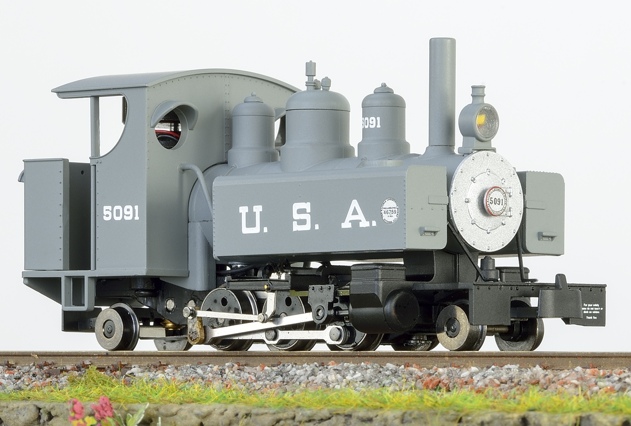
When I was working on the Model Railroads Go to War book, I purchased a few O scale WWI items, in particular an Neil Sayer Baldwin Gas Mechanical (shown at the left) and a bunch of figures from PLM. The gas mechanical was used by the US Army to support operations near the front. The other important engine the US Army used was a Baldwin 2-6-2 Tank Engine. That is not available in O scale. With only the gas mechanical available as an engine for the layout, I am thinking a very small switching layout depicting a front line supply depot might be interesting. Unlike my earlier layout set in Nov, 1917 in Flanders, this one would be set in July or August, 1918 in the Argonne or Vosges. This would allow me to try some more summer scenery, which I think I would enjoy.  There is a French Company that makes RTR freight cars for this era, so a lot of scratch building would not be necessary. The gas mech is an etched kit that I would need to build. Eventually I could scratch build the 2-6-2 if I like how the WWI layout works out (though the Backwoods Miniatures 2-6-2 is close).

Why another layout?  Several reasons, not the least of which is I like building layouts. The WWI layout would be portable and would be taken to shows as part of the 100th year commemoration of the United States involvement in WWI. In particular it would  honor my namesake grandfather, Bernard Kempinski,  who served in the Army in WWI as a stable boy. He enlisted and lied about his age (he was 15). When he arrived at his unit in France, the commanders assigned him to the stables as they did not believe he was old enough to be in combat.

So there is a lot to look forward to in 2016. I hope you all have a prosperous and healthy new year, and that you continue to read and comment on this blog.


December 27, 2015

Back in Ole Virginny

Having spent the past week zipping around the country, it is good to be back in Ole Virginny. While I didn't get to work on the layout over the Christmas break, several interesting other things happened.

The first happened in Rochester, Minnesota. My wife and I where wandering through the underground walkways that connect most of the downtown buildings in Rochester. Strangely enough, they call these underground walkways the "skyway." (OK, there are some elevated parts, but it seems to mostly be underground.)  I wandered into an art shop while AW was looking at a woman's clothes shop. I noticed a book on the counter that was about the 1st Minnesota Regiment, a unit that needs no introduction to students of the civil war.

The woman who ran the shop, Ms Sharon Krom, told me that she and her husband, Richard, wrote the book based on 218 letters Edward H. Bassett sent home during his three year enlistment. This got my attention. Lately I have been reading as much original civil war material and memoirs as I can find. Having read a good number of summaries and strategic analyses, I am finding the original material much more interesting and rewarding to read.

So I opened the 719 page book to a random place and started reading. The first letter I saw was written from Falmouth, April 1863. Just the time that I am modeling. A quick flick through the pages showed dozens of letters from this period. I knew I had to get the book, despite not knowing if it would fit in my luggage.

As I headed to the cash register, Richard Krom, Mrs. Krom's husband arrived. We had a very pleasant chat about the book and their efforts to collect the letters. It seems that the letters were scattered across the country and the couple had to spend considerable effort to gather them. The letters have been transcribed to printed text for ease in reading. There is a small amount of text written by the Kroms placed between the letters to put the letters in context. As I purchased the book, Richard, Sharon and their son James, signed my copy.


I am not quite finished reading the book, but I am really enjoying reading it.  It reminds me a lot of Leander Stillwell's memoirs and Wilbur Fisk's Letters from "Hard Marching Every Day." I will do a full review when I finish the book, but based on what I read so far, I highly recommend it.




I also read another interesting book over the break called the "Tugboats of New York," by George Matteson.  This book is a richly illustrated history of New York tugboat activity. Although the book has dozens of fine art quality black and white prints, the text is quite good and very informative.  There is a fascinating chapter on tugs in the civil war.  I borrowed this copy from the library, but I plan to get a copy for my personal library.


When I got back to Virginia, the test samples of my photo etched stainless steel HO scale chain link fences with barbed wire and gates were waiting for me. The test etches look great and I will be offering these for sale in January via Alkem Scale Models.


Finally, I noticed tonight that Minitrains (in Germany) has announced a Baldwin 2-6-2 HOn2 (they call it HOe and OO9). I have not seen the loco for sale anywhere. I wonder what its status is? They are also offering American box cars, flat cars, and gondolas, all with Pershing trucks. With this loco and freight cars. and the forthcoming 4-6-0 from Bachmann, a WWI narrow gauge RR is more easily modeled. I may have to reconsider my next project. Hmmmm......


May 9, 2015

Battle of Chunuk Bair Diorama

Peter Jackson of WETA Workshops fame has been involved in a massive historical figure modeling project depicting the Battle of Chunuk Bair in WWI in 1/32nd scale. Check this blog for more of the interesting story about how a major movie studio and hundreds of figure painting volunteers collaborated to build this massive 3D diorama.

http://anzacdiorama.blogspot.com

Many of the figures for the WWI diorama were sculpted by the Perry Bros of Perry Miniatures. I have many of their ACW figures on my layout.
Some Perry 28mm ACW figures on my layout.