
Showing posts with label D-Day. Show all posts
Showing posts with label D-Day. Show all posts
July 11, 2024

July 9, 2024
Train Busters Diorama

We have completed the Train Busters diorama. Mark delivered the truck today with 3 soldiers. We set them up to depict the truck as if it was abandoned by the crew after being strafed. One soldier carries his wounded buddy to safety, but another soldier, Hans, decided, perhaps foolishly, to fight back. One MP-42 SMG versus a flight of P-47's each with eight 0.50 caliber MGs.
 |
Hans, don't be a hero! |
I added the flaming smoke. I used an LED tea candle for the light with poly-fiber painted black and orange for the smoke.
As a final touch I added a cutout to the backdrop of a photo of a P-47 looping around to make a second pass on the train and bridge


July 4, 2024
Operation Chattanooga Choo Choo Diorama
 |
| Test photo of work in progress |
Operation Chattanooga Choo Choo was part of the Allied Transportation Plan leading up to D-Day. According to "The Army Air Forces in World War II, III Europe:Argument to V-E Day,"
"The most sensational attacks were the CHATTANOOGA CHOO-CHOO missions, the first of which took place on 21 May when 763 AEAF fighters swept over the northern half of France and 500 Eighth Air Force fighters ranged over Germany firing and bombing at trains. Another occurred on 25 May when three Ninth Air Force fighter groups operated over the Rhineland and northern France and more than 600 Eighth Air Force fighters shot up trains in Belgium and France. Other outstanding CHATTANOOGA missions were carried out by 571 Eighth Air Force fighters in eastern Germany and Poland on 29 May and by the Ninth Air Force in France on 2, 3, and 4 June. These operations furnished good practice for fighter pilots in attacking ground targets, a skill they were to develop to a high degree after the invasion, and they brought about enormous disruption to enemy traffic and ruin to equipment while producing important psychological effects on railroad personnel. French train crews deserted in large numbers, especially after fighters began to drop belly tanks on stalled trains and to set them afire by strafing. This situation caused the Germans to employ crews of their own nationality on the more hazardous runs, and after 26 May railway operations in daylight were sharply reduced even in cases where the lines were unbroken.
The battle against enemy transportation was a splendid success on the eve of D-day. It "opened the door for the invasion," as Spaatz later informed Arnold.94 British-American aircraft had dropped a total of 76,200 tons (on rail centers 71,000, bridges 4,400, and open lines 800) and would aim 78,000 tons more at transportation targets before France was free of the German. Railway traffic in France fell off dramatically between 19 May -- when the Allies were somewhat discouraged about the transportation bombings and 9 June 1944, the index dropping from 69 to 38 (based on 100 for January and February 1944). By mid-July the index would be only 23, and traffic in northern France would be practically at a standstill. Von Rundstedt had been unable to move effective reinforcements into the Seine-Loire triangle at the time of the invasion, and his forces had been committed piecemeal and could not even be deployed as units. Thus, the Allies had won their premier objective in the transportation campaign: they were able to build up their forces in Normandy from across the Channel faster than the Germans could reinforce theirs from adjacent areas in France."

This diorama is a group build by the Tailgate Modelers. The group includes Dan Pierce, Rob Kempinski and David Keene from Florida, and Mark Franke and I from Virginia. Our name is derived from the Dan's business where he sells model kits at hobby shows, and sometimes from the back of his truck.
I proposed the idea for diorama last summer when we got back from the IPMS Nationals in Texas. The concept was to build a diorama showing US P-47s attacking German trains. We initially planned to set the diorama in Italy. But we relocated the site of the diorama to France when we learned that the theme for the 2024 IPMS Nationals was D-Day.
We divide the work as follows Dan built the locomotive. Rob built the 1/72nd scale P-47, David built 2 1/144the scale P-47s, Mark built a truck, and I did the diorama box, bridge, railcars, and all the scenery. We were assisted by Jennifer and Rob in making some of the trees.
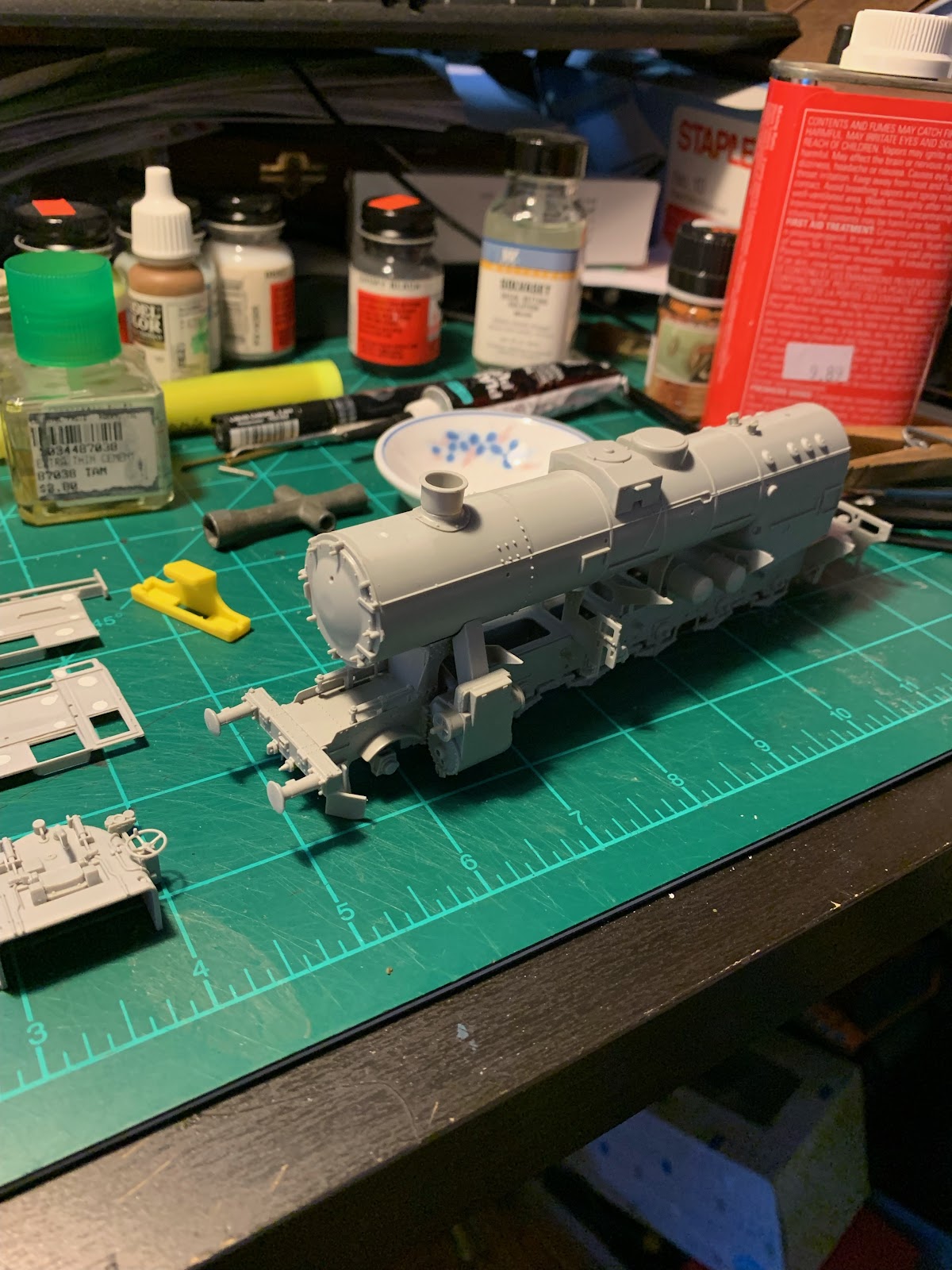
Dan built the Kreigslokomotive. It is a 1/72nd scale model by Hobby Boss. This was the second model Dan built for the diorama. The first was a Revell 1/87th scale kit of a German Kreigslokomotive. He did a nice job on that, but the kit was too basic. So, we upped the scale the trains to 1/72nd. This kit is much better detailed. Rob delivered the locomotive to Virginia on one of his visits.
The drawback of doing the trains in 1/72nd scale was that there are no German railcars available in that scale. So I had to make some on my 3D printer. I was able to find some files, but they needed some work.
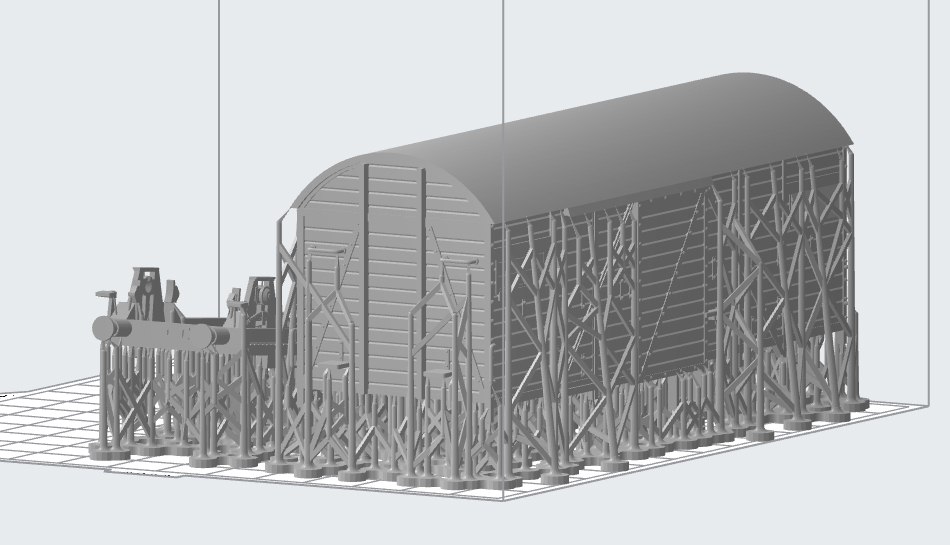
I also had to make custom decals as none were available.

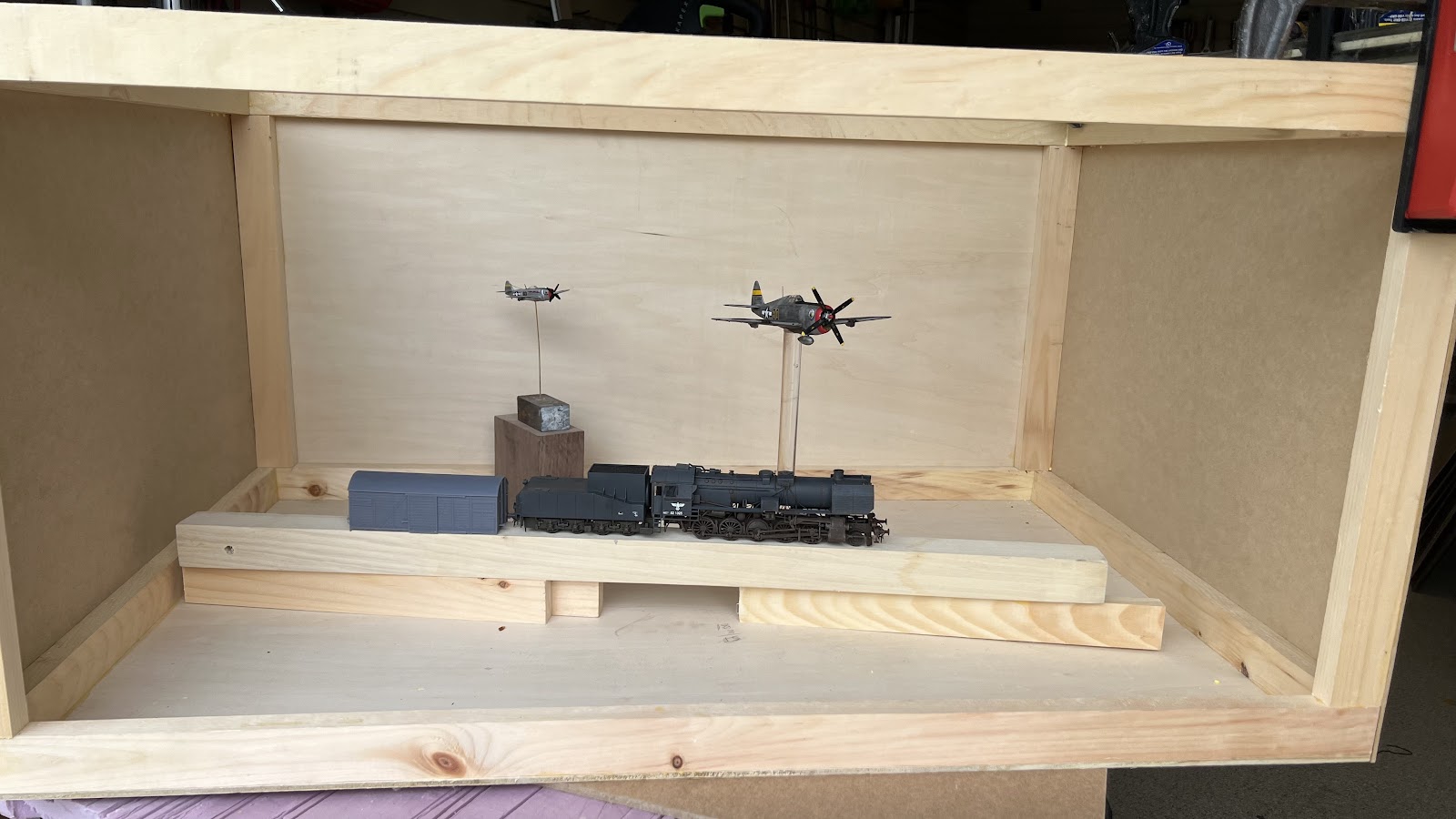
Rob built three 1/72nd scale P-47s for the project. The first two were bare metal finish P-47s for fighter groups that fought in Italy. He agreed to build one more painted in Overlord invasion stripes once the diorama was moved to depict France. I used one of the silver planes as a stand in during construction to mockup the layout. That way the plane with the invasion stripes place was not damaged.
David built two 1/144th scale P-47s. We will only need one. It will be located toward the back for forced perspective.
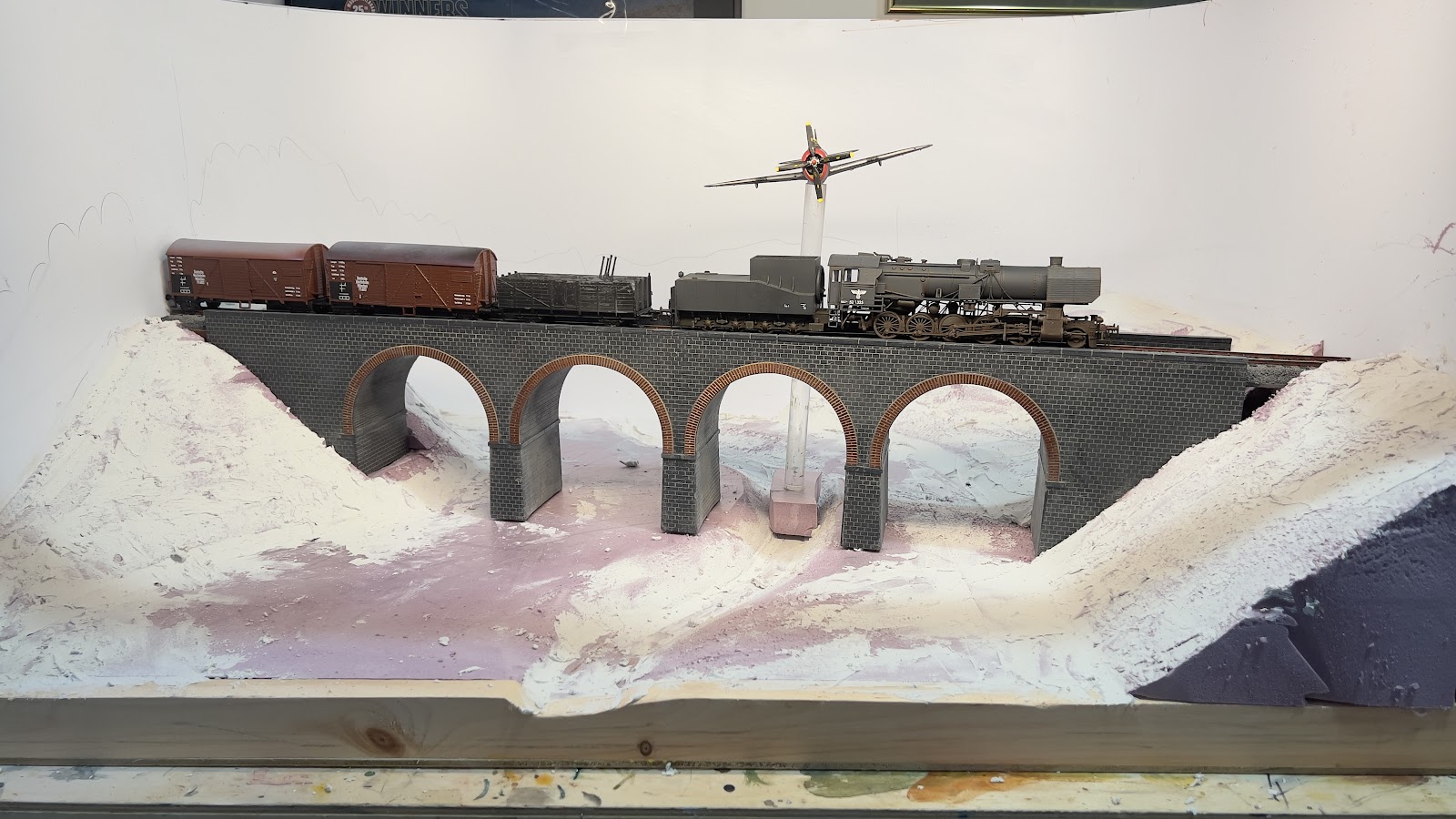
I scratch built the bridge based on a photo of a an actual bridge in Normandy, France. Once the bridge was built, I added and shaped the terrain using foam and putty.

I flocked the trees and installed them over the course of 3 days. Then it was time to add the ground texture.
The diorama is almost done. It's good thing as it has to be ready to go by 15 July. We started this last year but work on it was diverted to making the D-Day diorama for Keith Rocco.
June 28, 2024
The Last Piece of the Exhibit


We finished the last piece of the Omaha Beach Diorama this week. Mark Franke constructed a 1/350th scale model of the USS Frankford. That was one of the US Navy destroyers that provided direct gun fire support to the troops pinned down on Omaha Beach. By many accounts, that gunfire was crucial to helping the Allies break through the German beach defenses.

Mark used a ship model from Dragon with a set of photo etched parts from Gold Medal Models. Mark said that he did not anticipate how difficult assembling the tiny etched parts would be. As a result it took him several months to finish the kit.

I cut the foam on my chop saw. Then I used a small blow torch to create the wave troughs. I used the bottom of the ship model hull to create a space in the water to house the model.

Then I used the same toilet paper mache technique as before to add texture to the waves. Various shades of dark blue paint and several coats of acrylic gloss finished off the waves. I set the model in the hole in the base and used heavy acrylic gloss gel to tape the waves along the hull.

The final touch was some puffs of smoke from the 5-inch guns.
The back drop is a section from a painting from the US Navy collection painted by an eyewitness at Omaha Beach. We installed the diorama at the Museum on Friday.

 |
| D-Day Diorama Team Members installing the last diorama at the WW2 Experience Museum L-R Rob Kempinski, John Drye, Bernard Kempinski, Mark Franke |
May 29, 2024
LCT Hit by Mortar


May 28, 2024
Get to the Choppa!
The punch list on the diorama is shrinking. On Saturday, Jeff Hammer stopped by and installed most of the remaining barbed wire sections.

Meanwhile, I started scratch building the Landing Craft Tank Mk 5 (LCT) number 2227.
I decided to use styrene parts applied to an acrylic base. I cut the acrylic base on my laser. I also used the laser to cut some of the larger styrene parts. However, the laser cannot cut small parts ins styrene, especially those with sharp angles. So, it was time to...
GET TO THE CHOPPA!
 |
| LCT almost ready for paint |

One of these days I need to upgrade to the Ultimation Slicer. It is a great tool. Some of my friends have the Slicer and say it very handy.

I have the Ulimation Sander and Repeater shown at the left. That is an excellent tool for working with styrene and wood. I use the Ultimation Sander to clean up cuts. The miter table is very precise. The gap between the sander and the disk is very small, making it easy to use on small parts. You spin it by hand, so it doesn't melt plastic and it doesn't shoot dust everywhere.
I used to have a small Proxxon disk sander for modeling. It was cheaply built primarily with plastic. It broke when it fell on my floor. The miter table it came with was toy like. It could not do small parts due to the gap in the table and the disk, and it was very loud with a shop vacuum attached.
When using the laser to cut styrene it seems best to have the laser make slashing cuts that extend beyond the part you wish to cut. For example, to make a right angle you would make a X-shaped cut instead of an L- shape. That seems to minimize the time the laser is in contact with the styrene at the vulnerable sharp corner, as the laser will speed by the spot where the corner will be, giving the plastic some time to cool
thus minimizing melting. Or course, this technique doesn't work on parts with interior corners, like a window frame. The other technique one can try on styrene is multiple light passes with a lower power setting that does't cut through fully.
For the LCT model, I used some photo-etched stanchions and 0.015 inch phosphor bronze wire that I had on hand to make the hand rails. They are very sturdy with just CAA. I had a set of stairs and some plastic ladders in my spare box that worked.
I printed some additional parts such as the life raft, watertight doors, bollards, and vents. I added lots of punched styrene disks and other small plastic parts.
The LCT lost its ramp during the fighting due to a mortar strike after the tanks unloaded. It became beached in the shallow water for quite a while. Its anchor also malfunctioned. While it was stranded, it received numerous hits from small arms fire and fragments, some which created holes. But none of the crew were injured, as they stayed in the armored part of the hull until they could get moving again.
 |
| LCT 2227 loaded with trucks probably before D-Day |
 |
| Nice color photo of a different LCT in Italy. It shows extensive weathering and provides some detailing ideas. |
May 24, 2024
Almost Done

We had an extended 2 day work session to finish up the D-Day Diorama Phase 2 - Vierville Draw.
 |
| Keith painting the cliffs |

After dinner, John Drye, John Kephart and Sean Barrett arrived. JD worked on the boat people, Kep painted the remaining buildings, and Sean did the tanks. There were 2 duplex drive tanks and 3 deep water fording tanks with snorkels. One of the fording tanks had a dozer blade. I worked on finishing the LCAs. Keith began applying scenery after I gave him a brief instruction on how I do it. It was amazing how the diorama transformed in that one night.
The next morning I continued with finishing the LCAs and tanks. Keith started adding the figures, obstacles and explosions. Once the boats and tanks were done, I started with scenic details such as groynes (jetties), concertina fences, and touch up painting.
We still have some work to do, but the diorama is almost complete.
 |
| Soldiers from D Company, 116th Infantry Regiment suffer casualties as they exit the landing craft |
 |
| Overview of German Bunkers along the beach. Naval gunfire rips into the hills above while numerous American casualties lie on the beach. It is a true hellscape. |
May 18, 2024
Making Waves

We had our first group work session for D-Day Diorama Phase 2 - Vierville Draw. John Drye, Tom Karstens and Jeff Hammer joined me today for a long work session. I have been working on this diorama for about 3 weeks, though we had house guests one of those weeks so I didn't get much done in that period. The group got a lot done today.

JD painted the "boat people" figures. These are figures intended to be US soldiers riding in landing craft. However, many of those will be converted to casualties. He is doing this by sanding the figures so they would lie flat on front or back. He marked the side that should face the ground with red paint - so the red is not supposed to represent blood. However, this diorama will have a lot of casualties, over 100. So there will be some blood visible.


Jeff painted infantry figures on land and obstacles. He will bring the finished figures later this week.

Tom prepped all the LCAs and tanks for paint. That involved removing marks from the 3D print supports. He them primed them. Next he airbrushed the boats after I gave him a short block of instruction on using an airbrush. It was his first chance at using an airbrush. We said, "I'm sold on airbrushing now." It didn't hurt that he was using a Harder Steenbeck Infinity airbrush. One of the finest on the market.

I worked on the ocean waves and the seawall. I had previously made the wooden base and terrain using foam in a manner similar to Phase 1. However, this terrain has more bluffs and a small village.
April 11, 2024
D-Day and the Civil War
 |
 |
| Merritt opens her B-Day present- Brio trains |
 |
| Ruka watching a metro train |

While we were gone, RMC published an article I wrote about the Aquia Line in their April 2024 issue. They also used one of my photos on the cover. I received a lot of nice feedback from folks about this article. Above is a set of possible cover photos that I submitted to RMC. Which one do you like the best?
BTW, Otto Vondrak came up with the title on the cover. I think it is a clever pun, definitely not something that I would have thought up.
Before heading to Alabama, I went to the RPM East in Malvern, PA. It was a good meet and well attended. I had the chance to visit Ron Hoes and Greg Wiggins's layouts. I also presented a talk about the Aquia Line to a packed auditorium.
 |
| Phase 1 of the D-Day dioramas is on exhibit at the Army Navy Club in Washington, DC. |
We plan to start work on Phase 2 of the D-Day dioramas next week. Meanwhile, check out this interesting article relating D-Day to the Civil War.
March 11, 2024
Phase 1 D-Day Diorama Is Complete
 |
| German View of the Invasion. This is opposite the view that most visitors to the diorama will see. |
We wrapped up work on the D-Day diorama today. Keith arrived today with the shipping crate in his van. He had about 30 figures to install according to the narrative he has designed for the diorama. Most of the other work was done earlier in the week.

Jeff Hammer and John Drye stopped by Wednesday night to work on punch list items. JD installed most of the German infantry and remaining weapons. Jeff worked on scenic details such as barbed wire and log piles. The fences really added a nice touch to the diorama.
I worked on the remaining punch list items such as installing boats, painting fascia and adding flickering LEDs to the burning LCM.


Mike and Linda Pierce arrived on Sunday morning for a visit. Kieth put them to work prepping and touch up painting figures. I didn't have much to do today, so I got the camera ready for a photo session and waited to load it all.
Keith and Ted, a friend of Keith's that is a woodworker, built the carrying cases that will also serve as a table for the diorama. The diorama comes apart in 2 sections. Each section slides into the case.
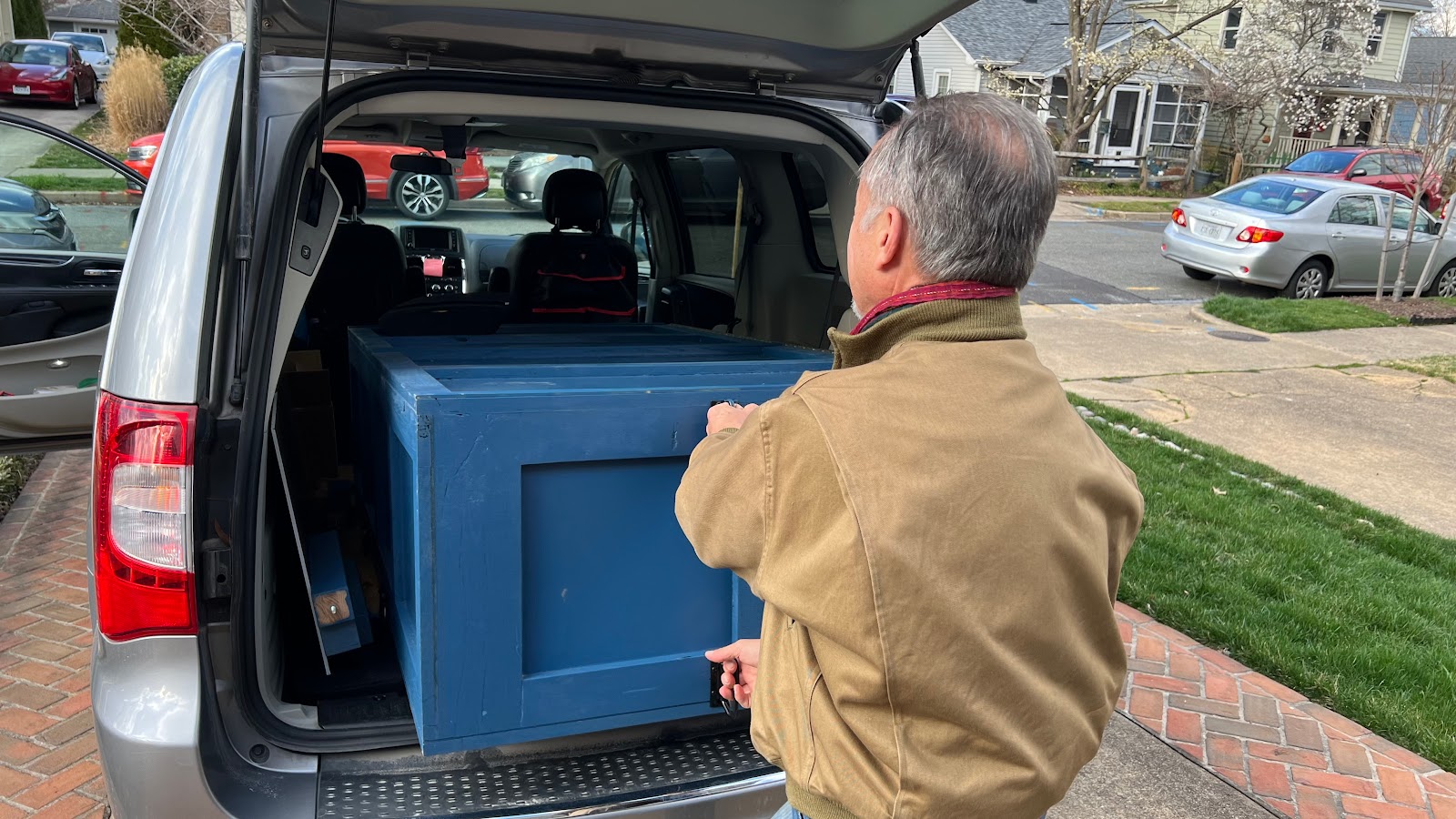
The case is quite heavy. Keith says it weighs about 100 pounds, though it didn't feel that heavy to me when I was helping move it. The case has it space for the legs. The saw horses in the picture are only to help load it.

One aspect I like about this diorama is its broad scope. Many folks have built dioramas with a this theme before, but I don't know too many that show the actions with this scope. Keith has woven in numerous historically accurate vignettes and story elements in the diorama. But I think it is the overall spectacle that makes this one work.
Thanks again to everyone that helped.


Subscribe to:
Posts (Atom)