A journal following the history, design, construction and operation of Bernard Kempinski's O Scale model railroad depicting the U. S. Military Railroad (USMRR) Aquia-Falmouth line in 1863, and other model railroad projects.
©Bernard Kempinski All text and images, except as noted, on this blog are copyrighted by the author and may not be used without permission.
-----------------------------------------------------------------------------------------------------------------------------------------------------------------
Showing posts with label Brooke. Show all posts

October 3, 2022

New Soldiers at Brooke

A new photo angle of Brooke


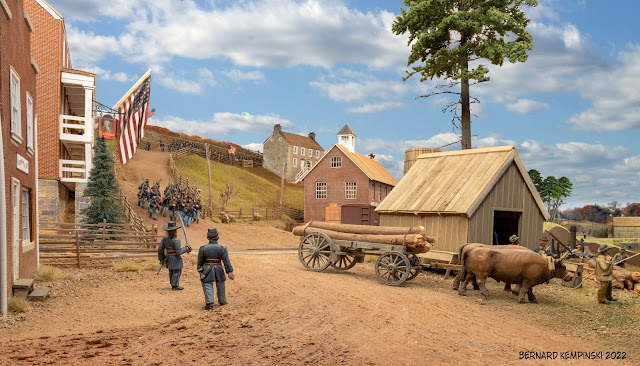
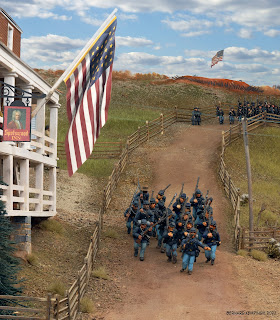
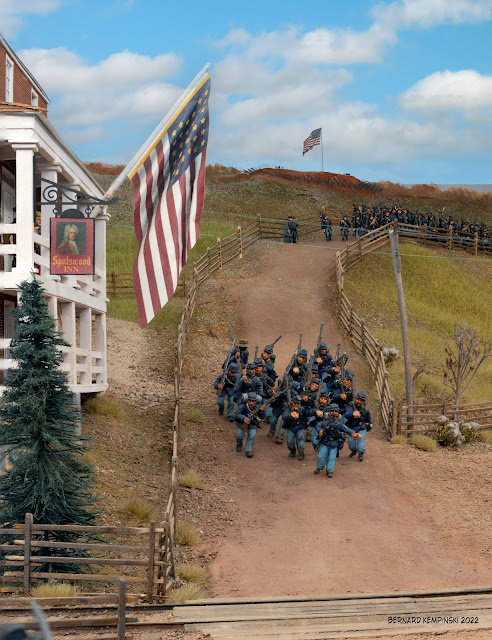
Jack Thompson painted some soldiers for me a few weeks ago. I installed them on the layout and took some pictures tonight. The left file of soldiers and the officer with the sword are the figures  that Jack painted.

I used my new camera to try some new photo angles at Brooke. I like how the lead photo came out. The water mill at Accokeek Creek is visible in the far right distance. It's about 15 feet away from the camera. I used focus stacking and sky replacement to get the shot.

Meanwhile, I am making trees for the layout. They are quite time consuming to make.


June 11, 2022

The Op Session that Wasn't


For months I have been scheduled to host an op session on 11 June. Alas, the layout wasn't ready and I had to cancel the session. There have been too many other commitments that have kept me from working on the layout. But, I have made some progress on the layout in that I added a base layer of scenery to the terrain extension near Brooke.  If you recall I added about 4 inches between the track and the fascia as I described here

The first step was that I painted the fascia. The textured paint I used in the past that was produced under the Ralph Lauren brand is not longer available. So I had Home Depot color match it as best they could with flat paint. The good news is the color match is nearly perfect. Furthermore, the missing texture is not really that obvious. I was going to make my own texture by mixing in some sand, but this looks good enough to leave as is.

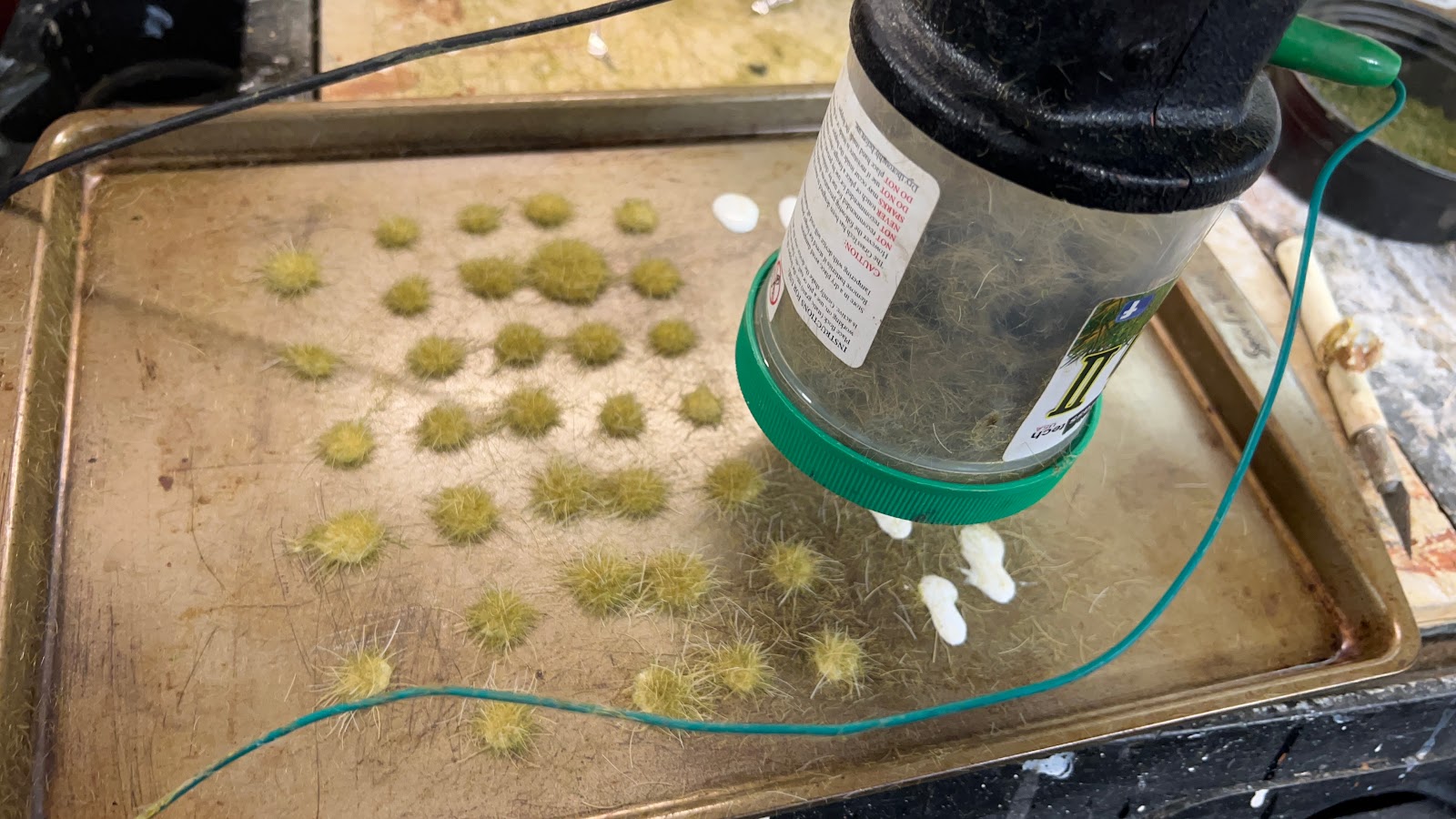
Next I added the base scenery. I used dirt, ground foam, and static grass. I find that static grass looks better when it is clumpy as opposed to being applied in a large uniform patch. You can buy static grass clumps from commercial sources, but they tend to be expensive. Fortunately, it isn't hard to make your own. I use a cookie sheet as the base. I put dots of matte mod-podge on the pan. Then I apply the static grass with my Grasstech machine. I use a mix of lengths and colors. Once the clumps dry overnight they can embellish the static grass applied in the larger areas. 

I did not add static grass across from the storage warehouse as I plan to install a structure there. But that won't happen for a few more months.  

I have been working on some other projects which I will describe at a later date. Meanwhile, we are off to the North Carolina mountains for brief vacation.


March 10, 2022

Spun Casting

 Blair Mielnik visited the Aquia Line today to take possession of my spin caster set up. Since I got the 3D printer I haven't used the spin caster. It was taking up valuable garage space. Blair has plans to use it in casting narrow gauge cars and miniature soldiers. 

While he was here, he got a brief tour of the railroad. I was in the middle of adding the base scenery to Brooke. 

After he left I installed the foam and then covered it with some plaster impregnated gauze. Once that is dry tomorrow, I will paint the fascia and
the terrain.


I also used one of the warehouses from Aquia Landing to mock up the building that will go in the new space.  Hmm, perhaps two smaller two smaller buildings instead of one larger one might be better. The prototype image of Culpepper might provide some inspiration.


Mock up a a warehouse 


Prototype image of Culpepper during the ACW

The extension adds a fair amount of real estate to exploit


March 9, 2022

Attention to Orders

 Amby stopped by this morning to see if he could figure out why the telegraph system only works when all the stations are plugged in and turned on. He, Steve, and Seth think it is something to do with the ground not being at the proper voltage.  Before he worked on that I presented him with his official appointment as Chief Signal Officer of the USMRR Aquia Line. Amby, in true Hermann Haupt tradition, asked if he could refuse the appointment, but so far he hasn't declined it. He wasn't able to solve the problem, but at least it all works when plugged in. 


Cracked fascia at Brooke.

Meanwhile, I have been working on repairing the fascia by Brooke. It was damaged when the contractors were doing the  flood repairs and they jacked up the layout. 


Room for the telegraph 

I had extended the fascia in the area by the rock cut south of Brooke. That piece of fascia cracked along the seam and became loose when they jacked up the layout. Unfortunately, there was no easy way for me to access it from below to securely repair it. So I took this opportunity to extend the fascia about 3.5 inches. 

This achieves three objectives. First, it will allow me to fix the crack, second, creates a nice secure place to mount the telegraph station at Brooke, and third,  extends the scenery.

I plan to add a large foundry building between the tracks and the aisles. This will create a "urban canyon" for the tracks in Brooke.  I was inspired by the foundry in Fredericksburg that the USMRR used to repair rolling stock in 1862 and the iron works rolling mill on Thom Radice's layout.  The interior of the foundry will have full detail. I haven't decided if I will leave a wall open so one can see the detail, or to make it a fully enclosed building. 

The telegraph is resting where the new foundry building will go.


January 2, 2016

The year ahead.

The Brooke area on the Aquia Line is just about done.


Last year ended on a nice note as my wife and I both made birdies on the last round of golf we played on News Years Eve. Birdies are rare events for us, so we celebrate them when they happen. It was also a good year on the Aquia Line. The layout from Falmouth to Brooke is just about complete. This includes new flooring and skirts in that part of the layout. Just a few scenic details remain, but it's nice to have such a large piece of the layout done. The Model Railroad Video Plus crew visited in October to record it for an upcoming episode.

The next step on the Aquia Line is to begin laying track at Aquia Landing. Much of that track is on a wharf, so a I need to install that before  the track can go in. If I wanted to begin operations before that, I could lay a few tracks at the west end of Aquia Landing, and use it as a fiddle yard. But before doing that I have two major projects to complete, the Antebellum Alexandria Waterfront Diorama for the Alexandria Lyceum, and my next book for Kalmbach on marine terminals, wharves and ships. The Port of Los Angeles layout is for the book.  The PoLA layout is coming along nicely, and is fully operational. I need to wrap it up fairly soon.

I also have some new products for Alkem Scale Models coming out in 2016. The first is the HO Scale chain link fence. These are being etched now and should be available for sale in late January, 2016. Stay tuned for more new stuff from Alkem Scale Models too.

I am also considering a new WWI theme layout, possibly in On30 or O14 scale. The 009 scale Cambrai layout is scheduled to go to the B&O Museum, so that will be off my hands.

When I was working on the Model Railroads Go to War book, I purchased a few O scale WWI items, in particular an Neil Sayer Baldwin Gas Mechanical (shown at the left) and a bunch of figures from PLM. The gas mechanical was used by the US Army to support operations near the front. The other important engine the US Army used was a Baldwin 2-6-2 Tank Engine. That is not available in O scale. With only the gas mechanical available as an engine for the layout, I am thinking a very small switching layout depicting a front line supply depot might be interesting. Unlike my earlier layout set in Nov, 1917 in Flanders, this one would be set in July or August, 1918 in the Argonne or Vosges. This would allow me to try some more summer scenery, which I think I would enjoy.  There is a French Company that makes RTR freight cars for this era, so a lot of scratch building would not be necessary. The gas mech is an etched kit that I would need to build. Eventually I could scratch build the 2-6-2 if I like how the WWI layout works out (though the Backwoods Miniatures 2-6-2 is close).

Why another layout?  Several reasons, not the least of which is I like building layouts. The WWI layout would be portable and would be taken to shows as part of the 100th year commemoration of the United States involvement in WWI. In particular it would  honor my namesake grandfather, Bernard Kempinski,  who served in the Army in WWI as a stable boy. He enlisted and lied about his age (he was 15). When he arrived at his unit in France, the commanders assigned him to the stables as they did not believe he was old enough to be in combat.

So there is a lot to look forward to in 2016. I hope you all have a prosperous and healthy new year, and that you continue to read and comment on this blog.

September 17, 2015

September 15, 2015

"Don't spill paint on it"

iPhone panorama of the new station signs, floor and skirts
I spent the past few days working on layout room infrastructure, mostly adding a new floor surface and skirts. But before I could do those tasks, I spent a good part of an afternoon sorting through the boxes of tools and stuff under the layout. After purging about half of what was there, I proceeded to add the new floor.

Allure planks have self stick edges making installation simple
I used Allure Laminate flooring, the same as in the rest of the basement. It is water resistant and fairly easy to install. The toughest part was having to jack up the layout one leg at a time to allow clearance to slide the laminate planks under the legs. Each leg had small sections of the old flooring under them that I removed when I jacked up the legs. So the change in height due to the new flooring material was minimal. It did take some courage to pump the hydraulic jack, fearing that the layout would spring apart. But it all seemed to go well. No real apparent damage occurred except for some ominous groans and creaks.

Close up of the nearly finished Brooke station
I am using the  layout skirting from McCooks Landing. Since I only have 12 linear feet of the panels with the bunting, I need to get my mom to sew some new ones, once her leg heals.

CINCHOUSE (Alicia) likes the new look, though she did admonish me to, "don't spill paint on it."

When I started building this layout, I told her to not worry about some of the closet space that I was removing. I said, "There will be infinite storage under the layout." Well I was right. With the purge and shelves under the layout, I only need half of the square footage under the benchwork for storage.

With this addition, the layout from Brooke to Falmouth is nearly complete. All that remains is detailing. No new structures are needed, though I do need to make a conductors car turned into a telegraph shack for Stonemans Station.


September 10, 2015

Happy accident


This week we had two accidents. One was not too happy. It ended up with 26 stitches in my mom's knee. She is recovering about as well as can be expected and is in good spirits.

War-time Atlanta - note mosts signs have black letters on light backgrounds.
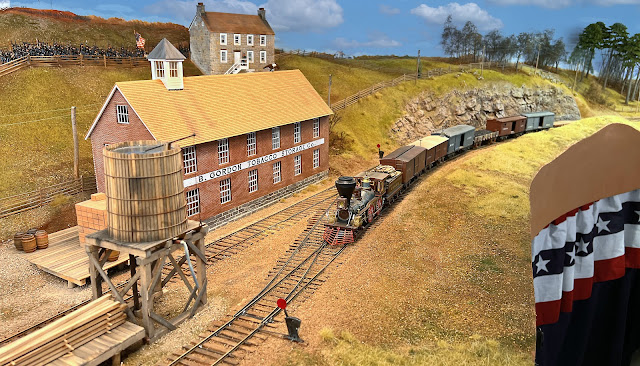
The other was not as serious and fortunately ended up with a happy outcome. I painted the sign on the Tobacco Prizery using a white background with black letters. A survey of antebellum and ACW era photos shows this was the most common style of painted signs on buildings.  I used a laser-cut stencil with two sided tape. As I was peeling back the laser-cut stencil, some of the white acrylic paint background came off. The effect was that of peeling paint. It looked authentic, so I did not touch up the peeled spots. A happy accident!

I did a little research to find a typical name. I went with B. Gordon Tobacco Storage Co.  Bazil Gordon, had factories and warehouses in Falmouth VA where he exported tobacco and cotton. According to Wikipedia, "In 1847, Bazil Gordon had died: At the end of his life, when he had finally finished accumulating wealth, his net worth was estimated in the millions, which, for the time, was large. By 1847, no other American had recorded a financial worth over a million dollars; it is for this reasoning that Gordon is believed and known for being the first millionaire in America."


September 9, 2015

Test Photos at Brooke

Engine Fury takes water at Brooke.
I added the loading platforms to the Tobacco Prizery tonight. I also made some station signs for the fascia.

I thought I would take a few test photos with my DLSR to see how the scene looks. It is almost done.


Engine McCallum is working the siding at Brooke

The saw mill is very close to the edge of the layout

Close up of the boiler. Not the engraved rivet detail on the backhead.

New station signs on the fascia- they are laser engraved and cut.
The next question is, should I paint a sign on the factory similar to this one in Danville, VA?

September 8, 2015

Draining the swamp

The saw mill is immediately in the foreground at Brooke

It's tough to remember you came to drain the swamp when you are up to your neck in alligators. A open house in a few weeks, and a tentative future visit next month by Kalmbach Video Plus to video record my layout made me decide to rearrange some priorities. At the top of the new list was to get some more work done on Brooke.

I completed a bunch of tasks in pursuit of that objective over the three-day weekend. The highlights include nearly finishing the  Tobacco Prizery, installing the saw mill and scratch built steam engine, installing the sawyers's work shed, installing the water tower, touching up most of the figures to fix damage from handling, adding grass and scenery to the area near the tunnel portal, finishing installing the split rail fences, and making a sign for the Spotswood Inn.

The steam engine is  skid-mounted with an external drive wheel. I based it on a photo of a similar engine shown in one of Andrew Russell's photos in Alexandria. I believe the tank on top is for water. Most of the parts were laser cut except for the steam dome. The dome I turned on my lathe. I could not spot a governor on the engine in the photo, and I forgot to add the valve control rod, but otherwise I am pleased with how it came out.

The saw mill is recycled from McCooks Landing. Since it was inside a background building on that layout , it was not very detailed. I need to add some of the pulleys and other controls for the slide now that it is in the foreground. Haupt mentions in his memoirs installing a saw mill to cut lumber for the bridges, but he did not specify where the saw mill was located. I put it at Brooke as it was the place where I had the most level ground other than at Aquia Landing.

The Inn is named after Alexander Spotswood, a prominent Governor of Virginia.  He was a very interesting person involved in military operations, establishing iron works and building the Virginia Colonial mansion at Williamsburg. He died in 1740. I made the sign on my laser and used a picture of Governor Spotswood off Wikipedia

The flag is another McCooks recycled item. I added it to the Inn via a hole drilled in the center column.

 This shot shows some of the scenery installed near the tunnel portal. The tall trees help block the view across this portion of the layout.  I installed the pine tress and added roots with Miliput. I added a lot of static grass and other scenery items to embellish the open fields near the inn. The dried looking flowers are Silfor autumn golden rod. Some of the new fencing is visible in this shot.

The brick mill is a Tobacco Prizery. It is based on a similar building in Brooklyn, Va,  a tobacco factory in a rural location. I added the cupola and weathervane to jazz it up a little bit. It still needs to be installed in its site and have loading docks added to it.

The water tower also came from McCook's Landing. I love how it fits in that spot.


The oxen are recycled from McCooks. I swapped out the boiler on the wagon with some logs for the saw mill.  The saw mill is in the foreground. I may need to install a plexiglass shield to protect it against wayward elbows and sleeves.

April 20, 2014

Toxic Spills and other Calamities

I am just about done with the Accokeek Creek area. To finish off the scene I built 4 wire trees and several smaller bushes from Supertrees and Sedum flower heads. I installed them on the slope above the creek in front of the simpler weed based trees.The wire trees and underbrush provide enough of a view block to help disguise the simpler trees behind. Together with the trees painted on the backdrop, the overall scene seems to work well.
I used Elmers water based wood putty and Liquidtex
Stucco Gesso to add bark texture to the trees.

The next step was to add water to Accokeek Creek. I added a layer of Magic Water to the Creek bed. For various reasons that seemed good at the time, I decided to tint the water with some brown laquer based paint. I ended up adding too much paint and the water came out too dark. I also had some resin leaking at the dam on the front edge where I used masking tape to seal the gap. I caught it before it made a big mess.

 I am not worried about the color as once the water is cured, I can fix it probably by painting it and adding a new layer of water.

Painting base coat on the wire trees
While I had the Magic Water out, I poured the water in Potomac Creek too. That tape dam did not leak.  I did not tint this water. Once the resin is cured on both streams, I will evaluate what else needs to be done.


The cows are  trying out some of the static grass. 


The paint tinting the water made it look like a toxic waste spill


Storage shed at Brooke Siding

While the resin was curing, I started building a storage shed at Brooke. This structure is 17 inches long and 6 inches deep. The slope of the hill prevented me from making it deeper.

Magic Water in Potomac Creek.


I used my DSLR for the three shots of finished Accokeek Creek. The others are handheld  iPhone shots. With my DSLR I used RAW and custom white balance settings. This results in photos with accurate color rendition on my monitor. In looking at static grass photos around the web,  I have noticed that static grass is hard to photograph  as its glossy texture tends to over saturate colors with most digital camera. It takes retouching with destaurate tools and levels/curves to make the static grass look correct.


March 31, 2014

A Fence Post

Redoubt No. 2 painted on backdrop. Better make
sure the flags blow the same way. The figures
are still on their temporary bases.
Is this a post about fences?

With a vey rainy weekend, it was time to do some scenery at Brooke.

I finally painted the last section of backdrop. This area is mostly a bare hill dominated by Redoubt Number 2.  That completes all the backdrops, though I may have some touch up to do in Aquia when I get there.

Supertree Copse
 The deep scene is nice, but the problem with deep scenes is that they are....deep.  It was very difficult to paint on the wall as the scene is very far back and hard to access. I knew this was coming, perhaps thats why I put it off so long.  But it came out nice in the end.


I decided to add a copse of trees where the backdrop bumps out to avoid a plumbing pipe. The trees help soften the visual impact of the protrusion. I used Supertree twigs attached to small sticks for trunks. I wanted the trees in this area to be smaller for some forced perspective so I didn't make wire armature trees.
Fences run all along the main line from Accokeek to Broke.

One of the key scenic features in this area are the fences. Since the terrain is mostly open, the fences add a nice detail.


The story is that the Union has a large herd of beeves here. So they installed or repaired the existing fences to make sure the cattle stay put.  There is about 36 feet (actual) of fence so far, with plans for abut 10 more feet.

I have a pack of Woodland scenics cows, but I probably could use more. 


October 28, 2012

Meanwhile, back on the layout...

Hurricane Sandy is bearing down on the Mid-Atlantic and we are all standing by hoping it will spare us. With our storm preparations complete, I thought I would do a blog post to catch up some loose ends.


Last month I did a quick scratch build of a simple cook house for the tavern scene. The idea for the cook house came from some books I borrowed from Gerry Fitzgerald about vernacular architecture. In particular the book, Back of the Big House: The Architecture of Plantation Slavery (Fred W. Morrison Series in Southern Studies) was very handy. I based my building on a similar structure from this book. This building houses a kitchen and servants quarters. The servants were likely slaves before the Union Army arrived. The building is now being used by the Army as a kitchen and Quartermaster office.

I used Tichy windows and scribed siding. The roof shingles are laser cut red cedar with self-stick adhesive. The chimney is a simple scratchbuild from sheets of brick paper over a wood core. Due to the steep hillside, I had to install the building on wooden pilings.
The cook house uphill from the tavern

To complete the tavern scene I will also add a well house, cold cellar, hitching post and other details. I started adding some fencing, but more of these will be required. I also need to paint the backdrop in this area.

Edwin Alexander's figures
A photo from Alexander's book showing some of these
figures on his layout.
Yesterday I received in the mail and package from John Brazaitis containing 6 O scale figures. He purchased these figures from Edwin Alexander near forty years ago.

This is a real treat for me, because about 20 years ago I purchased a copy of Alexander's book, "Civil War Railroads and Models." I saw it on the discount table at Crown Books (now defunct) and purchased it.  Since then I  have studied and examined this book endless times so that the binding is worn out and the pages are coming loose.  In large part it was my inspiration to try some Civil War Railroad modeling. So I am very grateful to John for sending me these figures. I look forward to painting them and adding them to a prominent place on the layout.

Lets hope we have a home and layout to come back to after the storm passes over.