A journal following the history, design, construction and operation of Bernard Kempinski's O Scale model railroad depicting the U. S. Military Railroad (USMRR) Aquia-Falmouth line in 1863, and other model projects.
©Bernard Kempinski All text and images, except as noted, on this blog are copyrighted by the author and may not be used without permission.
-----------------------------------------------------------------------------------------------------------------------------------------------------------------

January 16, 2012

Shelob's Lair.

In a long awaited move, I finally painted the base scenery and fascia from Brooke to Accokeek. Only a 6-foot section to go and all the fascia and scenery will be painted the base color. I am using Ralph Lauren Adirondack Bark. It is a textured paint and does a great job making the fascia and the layout visually blend together. The base coat of paint makes a big difference. The layout takes on a much more finished appearance even though there is still lots to do.

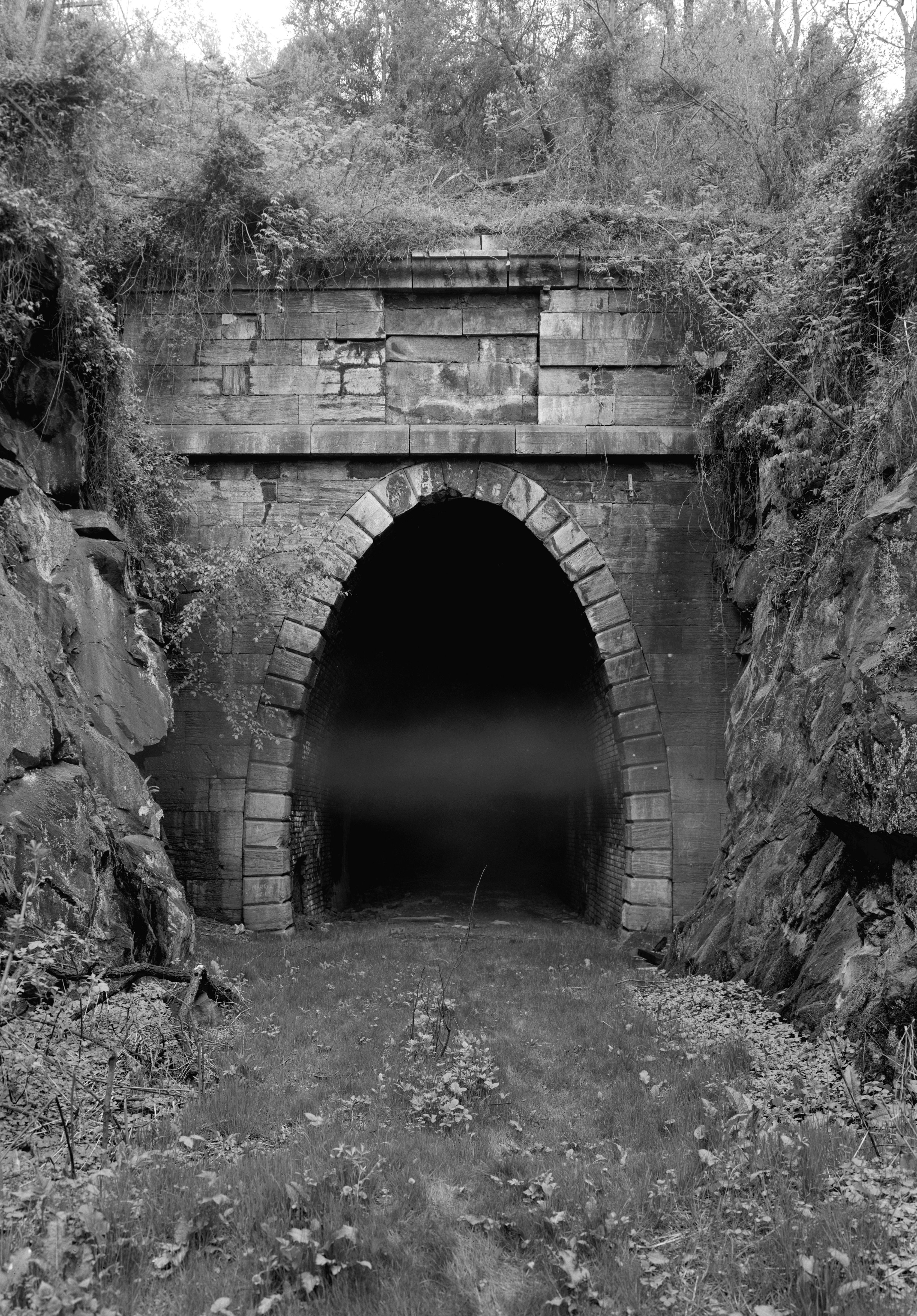
Shelob's Lair?

The prototype Crozet Tunnel, the prototype
for my tunnel. Note how narrow the
rock cut is.
I painted the tunnel rock cuts leading up to the tunnel portal. Then I added a base layer of scenic material. That helped reduce some of the darker shadows so that it doesn't look so much like the entrance to Shelob's Lair.

Rock carving at Weilepp's Cut is done, whew!

The Weilepp's Cut area still needs to be painted. I also need to finish the mill so I can place it in the scene and fill in the gaps with Water Putty and scenic material. I have to install a road in the far corner behind Weilepp's Cut. I have to build up the road with pieces of foam and water putty, as the terrain there is fairly rough.

January 14, 2012

Model Railroad Planning 2012

The 2012 issue of Model Railroad Planning has an article about my layout. It was written by Gerry Fitzgerald. You might recognize him from this blog as he is one of my regular gandy dancers even though he lives in Charlottesville, VA where he is a graduate student at UVa while serving as a visiting professor at GMU. Gerry wrote the article with my permission and cooperation. I took the photos and did the graphics.

I found it a bit strange reading about my layout in the third person, but Gerry did a great job with the article. He provided his own insight, not exactly that of an outsider, but certainly an independent look at the project. Thanks Gerry.

BTW We still have about 5,000 spikes to go.


January 11, 2012

Planning an Alleghany NTRAK Module

Thom Metz stopped by tonight to discuss his plans for an NTRAK module based on Alleghany, Va. We are lucky that Matt Schaefer designed an excellent module based on Alleghany for Dudley Ross several years back. Matt was one of the best NTRAK modular designers ever.  People from across the globe sought his design advice. Alas both Matt and Dudley have passed away, but their memory lives on in an excellent module design.

 The key brilliant insight that Matt came up with in the design was to utilize the original tunnel as a double track line, and then use the newer tunnel as a single track line in order to accommodate the triple NTRAK mainlines on a location that really only had two tracks through the tunnels.. To quote John C Paton from "Alleghany with an A",

"Curiously, to look at them, the impression is that the old bore is really the new one, and vice-versa. This is because the new bore was drilled for single track, while the old one is wide enough for two." The single track in the old bore gives the feeling of spaciousness associated with a newer excavation."

I photographed Dudley's layout for Kalmbach's Great Model Railroads 2005 and you can find the overall track plan there. Here are some other shots of Dudley's Alleghany including a simplified drawing of just the Alleghany section.


The main scene at Alleghany includes a turntable, brick cabin and depot.

January 9, 2012

Alco Heritage Museum

I recently learned that the Alco Heritage Museum in Schenectady has moved to a new, larger location. The museum will feature many neat exhibits including tanks, locomotives, a replica of an engine erecting shop, an FA-1 cab simulator, and a civil war railroad model display.

From wikipedia, and google books,

Prior to 1901 this Works was known as the Schenectady Locomotive Works and as such was incorporated in 1851 It was built in 1848 by citizens of Schenectady and equipped by the Norris Brothers of Philadelphia who were among the pioneer locomotive builders of this country The Works ever since it was started has contributed to the development of the American locomotive and has built engines of all styles for both the domestic and foreign trade The total number of engines built by this shop now amounts to 7800 In the sixties this shop was widely known as the home of the McQueen engine The name was taken from Mr McQueen who was superintendent of the Works from 1851 to 1876 For many years the plant was commonly known as the Ellis Locomotive Works being owned and managed by different members of the Ellis family from 1863 to 1901 In 1901 the Works was purchased by the American Locomotive Company and has become the largest of the nine plants operated by this company which have a capacity of 3000 engines a year 750 of these being produced at Schenectady 

According to the museum website, it plans to open in Spring 2012.  Tanks, trains and models!  I definitely need to add it to my bucket list.


Historic Princeton Junction Photo


Doug Gurin recently gave me a copy of this photo. He didn't have any additional information about it so I posted it here in the hope that someone might know more about it. I did some web searching and found that Princeton Junction was the location where a short branch line connected the town of Princeton to the New Jersey Rail Road and Transportation Company in May, 1865 (see here, here and here for more info.)

There are several interesting things I noticed in the photo. The obvious gallows turntable in the left foreground. The engine has an enclosed tender and it has the passenger car on its nose. The passenger car has a plain, arched, non-clerestory, roof, and small windows.  Note the exterior bracing under the passenger car body.  I am not sure why the wood is piled up by the track, possibly fuel?

Also note the lack of trees in the background. There also appears to be a cemetery or perhaps encampment in the background.

There is currently a legal fight between historical preservationists and the University of Princeton who want to relocate the station and convert it to a bus line.

If you know anything about this photo, please post a comment.