A journal following the history, design, construction and operation of Bernard Kempinski's O Scale model railroad depicting the U. S. Military Railroad (USMRR) Aquia-Falmouth line in 1863, and other model projects.
©Bernard Kempinski All text and images, except as noted, on this blog are copyrighted by the author and may not be used without permission.
-----------------------------------------------------------------------------------------------------------------------------------------------------------------

February 4, 2012

Whitewashed Privies

As I was reading through the Patrick's Brigade - Provost Marshall's log book from Aquia Creek I came across this circular that details some aspects of how privies had to be maintained and painted.  Patrick's Brigade was assigned the task of Provost Marshall for the Post.

An image of the circular is at the right.

So get the white wash out and start painting those privies.

There was a similar special order describing how restaurants, sutlers and eating houses had to dispose of their trash in the river "beyond the roadway leaving from the main shore."


Here is a transcript of the privy message.


                                                                Headquarters May 21st 63

Circulars
     The following suggestions from the Post Surgeon being essential to the sanitary condition of the Post will be carried into effect without delay.
     “All privies not constructed over the water should be provided with suitable boxes of planks, about two feet square and as long as the privy. These boxes should be placed in wooden slides and once a week emptied of their contents into the river at a distance from the Post. The boxes should at some time be thoroughly washed, sprinkled with lime and occasionally whitewashed.
     The buildings occupied as privies should be whitewashed both inside and out”

                                                               By command of the Col at Arms
                                                               Chas. E. Seusy
                                                               Lt. A.A.A.G.

February 2, 2012

Third Anniversary

This week marks the third anniversary of work on the USMRR Aquia Line model railroad project. It has come a long way from the scene below when I first tried testing out the concept. In fact, this is the furthest along I have ever progressed on a layout. On most of my previous layout projects at some point before this level of completion I would have gotten bored with the project or distracted so that I would have moved on to something else. This project is obviously more interesting to me and I still am very psyched to keep going. I estimate that it will take about 3 more years to "finish" this layout.


Lets look at some statistics. The USMRR Aquia Line currently has approximately:

All benchwork, fascia and lighting complete.

30 feet of benchwork curtain installed.

160 feet of track with about 100 linear feet of mainline run.

1,300 ties and 5,000 spikes are currently installed.

All backdrops are installed

100 linear feet of backdrop is fully painted.

The radio  Easy DCC system is fully installed with a separate programming track.

5 Locomotives - 1 with DCC sound, 1 with DCC, 1 waiting for a new sound decoder and 2 analog. The first Stanton Radio Cab is on hand but awaiting a backordered battery pack.

13 Freight cars, 7 with working brakes.

16 hand laid stub turnouts including one double slip. Seven are  controlled by Tam Valley Frog Juicers, the rest with home made mechanical linkages. All have scale switch stands to actuate the stubs.

1 scratchbuilt turntable with an autoreverse circuit from Tony's Train Exchange.

3 water crossings - 2 bridges comprising over 2,000 separate parts and a stone culvert.

50 square feet of scenery is fully complete including ballast and final ground cover. Another 150 square feet has basic gound cover.

11 feet of telegraph poles and wire.

1 entrenched artillery battery with 4 guns, two sets of cheaveux-de-frise and abatis.

4 1/48th scale scratchbuilt cannons .

8 structures reside on the layout including one burned station  

3 full size Sibley tents and about 12 smaller tents.

250 painted figures - about 25 are 1/43rd or 1/48th scale, while the rest are 1/64th scale.

1 painted mule (I need to get cracking on the painted animals and wagons).

100 painted barrels and several hundred boxes of hard tack.

1 ironclad ship  with detailed turret is nearly complete.

Notice I didn't list what remains to be done. Best not to know the full scope of tasks left to go lest I find it too daunting.


January 26, 2012

Alexandria in the Civil War

Wally made this panorama of the Alexandria waterfront from three images
Alicia and I attended a lecture tonight by Wally Owen at the Lyceum, Alexandria's History Museum, called, "A Visual Tour of Civil War Alexandria."  Wally Owen is the Assistant Director of the Fort Ward Museum and co-author of "Mr. Lincoln's Forts: A Guide to the Civil War Defenses of Washington." The lecture was a two hour tour of Alexandria in the Civil War including a finale where everyone got to see some of the stereoscopic images in 3D using funky two color glasses.

It was a wonderful presentation. Wally literally had the audience gasping in amazment as he showed some of the details in the high resolution photos available from the LoC and other places. He also showed examples of how he does detective work to identify photos, locations, dates and other details through cross correlation of photos and original documents.

The advance billing for the talk said some of the photos had never been published and indeed, there were several that I have never seen before.

Some highlights that I noted included.

A photo of an engine parked in front of the Wilkes Street tunnel showed a large light mounted on the tender. I don't think I have ever seen a shot showing a back-up light on the tender. That was cool.

He presented a shot of the Alexandria, Loudon and Hampshire engine terminal that showed  the view from the east to the west. It had a lot of good detail of the AL&H terminal.  Anyone modeling the AL&H  needs to get a copy of this photo. Wally did not mention the source of that photo.


Wally mentioned that W. M. Merrick, the draftsman that drew several important maps of Alexandria, Washington and City Point, was friends with Captain Andrew Russell, the photographer. Wally showed a sketch that Merrick drew of Russell painting the tender of the engine Stanton. This engine has an elaborate painting of secretary Stanton on the tender. Apparently Russell's first avocation was as an artist and he learned photography on the fly in 3 months during the war while in the employ of Haupt. Wally speculated on what else Russell may have painted, perhaps the eagle on the Lincoln funeral train.

The presentation was chock full of interesting information. It was well worth attending.

January 22, 2012

An icy cold weekend

The cold, icy weekend meant lots of progress on the layout. First I reconfigured the slope of the hill behind Potomac Creek to make it look more like a country road. This resulted in a slightly sunken road at the top of the ridge. Then I painted the rocks at Wiellep's Cut with a dark base color. I find that when using water putty for rock carvings, one can not just stain the rocks like you can with hydrocal. You have to completely paint the rocks. I use a dark base acrylic color and then add lighter drybrushed colors on top.
 

Next I worked on the culvert at Accokeek Creek. It is built like a railroad tunnel, but without the tracks. I used the laser to cut the parts except for the styrene blocks on the top cap. Those I made from a strip of .125 inch styrene, shaping each block to look like stone.

The culvert is a layered composite of 1/8th inch plywood, plastic embossed stone paper, laser cut  arch stones and
plastic strip stone cap pieces.

The brick lined culvert pipe.

Cutting and fitting the culvert under the tracks.

View through the culvert

I also worked on installing the grist mill, but it was tricky as I had to add the mill race to the mill as I went along. That took a bit of cutting, filling and test fitting. I had to reconfigure the terrain under the mill race to make room. I sealed the terrain with water putty. I need to make the area water tight as I plan to pour resin to simulate the water and it needs a water tight base.

Working on the tail race. I still need to build the feed race sluice.

Overview of the scene after a coat of base color. The trees are just stand-ins to show the overall
design. The wooded hill will help downplay the visual dominance of the dam.

January 16, 2012

Homeward Bound

This Paul Strain painting shows the 20th Maine
marching to battle from Stoneman's Station
The Potomac Creek station scene will feature a long line of soldiers marching on a road to the railhead.  The road leads from the back drop to the railhead at Potomac Creek.

My intent is to display a regiment with each figure shown one-to-one. A full strength regiment has over 1,000 men. At two years into the war, most regiments were at partial strength. I have about 400 figures planned in this scene, representing a regiment that is about one third full strength.

The figures I am using look quite energetic and excited, so I decided this is a two year regiment whose enlistments have expired and they are going home.  There will be other soldiers and people watching them and cheering along.
This drawing showing two-year men taking a train is part of my inspiration. 

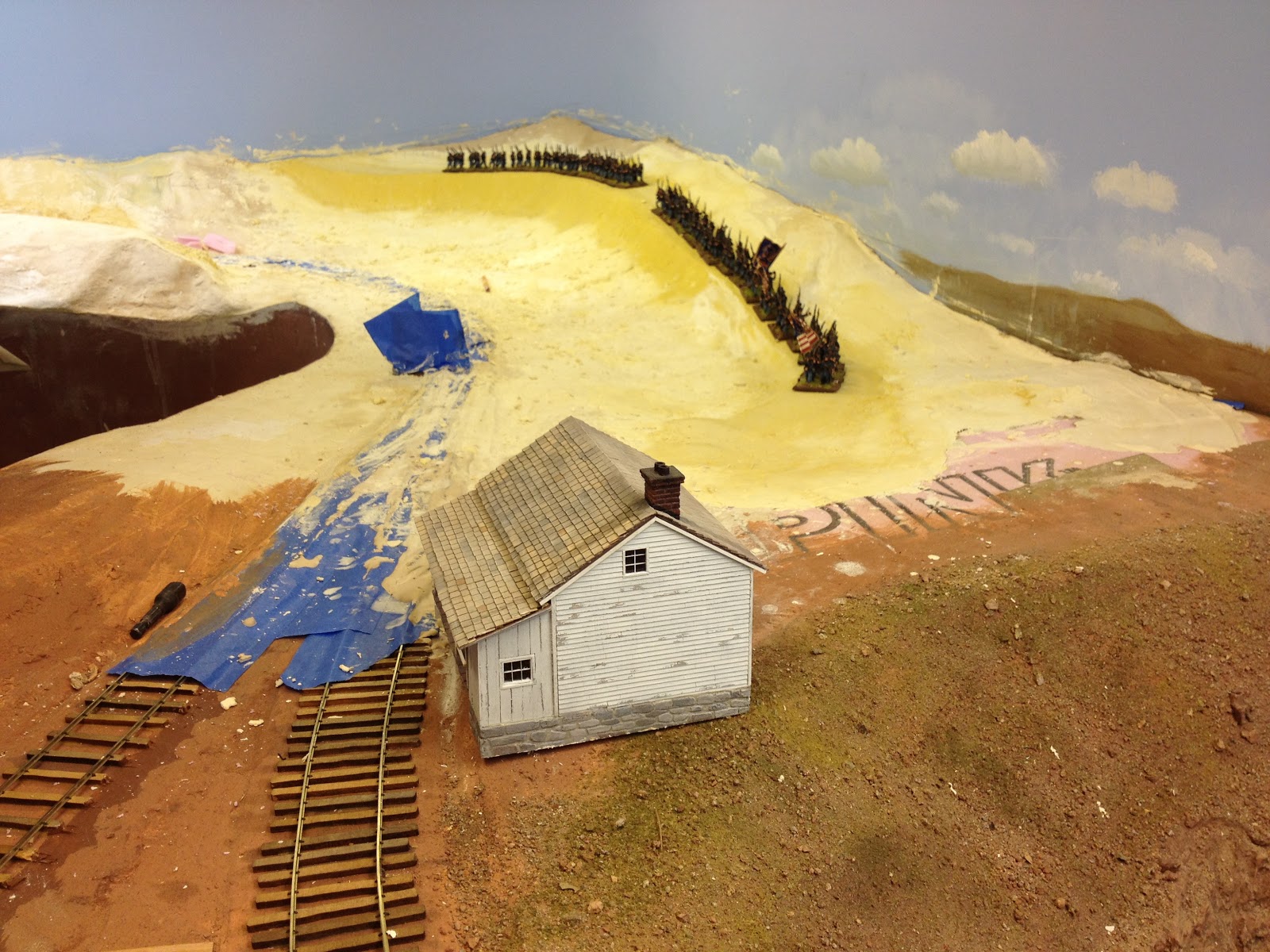
I built the road with pieces of foam hot glued to the hard shell. In retrospect, I think the road is too well built for a country dirt road of the 1860s. So I will add a ridge as shown in the photo below and have part of the road cut through ridge top, creating a sunken section. That will remove some of the fill and make the road look more rustic.
 The red lines show the planned terrain addition.
Looking down the benchwork to the road behind Potomac Creek Station. It's appropriate that the
word "pink" shows through, as that is the last pink scenery in the north room.

Over by the tunnel,
I added some ballast and base scenery.

I continued the base scenery around the curve at Brooke as the panorama photo shows below.

I will probably add the base scenery to the ridge behind Brook and then paint the back drop.

In surveying the new work, AW's said, "Wow, do you think you'll actually finish this one?"

A two shot panorama showing the big curve at Brooke.