Gerry Fitzgerald alerted me to a new video that the NMRA has produced. It is an introduction to the hobby and the NMRA. I believe Gerry Leone was the main force behind the video (all these Gerrys are confusing) since Gerry L. asked me for my permission to record a portion of one of my clinics at the Portland NMRA. Rumor has it that I am in the NMRA video at some point. And yes, the camera does add 10 pounds and 10 years.
You can find the video here. http://www.nmra.org/videos/get-more-model-railroading

January 6, 2016

January 4, 2016
A Remote Photoshop Tutorial
Norm Wolf and I had fun tonight. We did live on-line photo tutorial tonight using Skype's shared screen feature. Norm lives about 4 hours drive from me.
Norm took some images of his switching layout. Then using Helicon Focus and Photoshop Elements he was able to sharpen, retouch, and crop the image.
Here is what the session looked like from my end. By watching his screen I was able to coach him and explain various concepts while he did the actual photo manipulations. It was fun for both of us.
Here are the before and after images.
BTW this is the 700th post on this blog. Wow!
Norm took some images of his switching layout. Then using Helicon Focus and Photoshop Elements he was able to sharpen, retouch, and crop the image.
 |
| My screen view of the "before image" |
Here is what the session looked like from my end. By watching his screen I was able to coach him and explain various concepts while he did the actual photo manipulations. It was fun for both of us.
Here are the before and after images.
BTW this is the 700th post on this blog. Wow!
 |
| The after image. |
Pungies in Alexandria
 According to Geoffrey M. Footner, in his book "Tidewater Triumph: The Development and Worldwide Success of the Chesapeake Bay Pilot Schooner," the following images show pungies under construction or repair in Alexandria during the civil war. The photos are intended to show tests of Herman's Haupt's infantry arks made from rubber (gum) blankets and wood frames. But, in the right background you can see ships on marine ways at the Alexandria shipyard.
There wasn't room on the diorama to show the shipyard, but we can show a pungy at the wharf at Pioneer Mills unloading bulk wheat via the marine leg.
These are also the best views I can find of the Alexandria waterfront looking west during war time Alexandria.

Eagle over Alexandria Waterfront Diorama
 |
| Mock up of the diorama on the base |
 |
| plywood base with 1x2 frame underneath |
The diorama will be on a pedestal made from birch plywood and molding trim. The trim is not glued on but secured from the inside to an internal frame I made from 1x2s. That way I can modify the frame and trim if the museum deems it necessary.
 |
| Never pass up a chance to use my bar clamps |
 |
| The base is ready for stain and varnish |
I also started work on the schooner for the diorama. This will be a pungy style schooner. The ship yard in Alexandria made pungies as well as other type of sailing ships and barges. The prototype for the model is the Wave, a 56 ft schooner. It was built in 1863 in Accomack Va, but is similar to Alexandria-built pungies. The Wave survived for quiet some time and plans are available for it.
 |
| The Pungy Wave |
Then I added a laser engraved deck and transom. I stained it a dark brown to show it is a well used work boat. Pungies are traditionally painted pink and green, but I may opt for a simple gray paint.
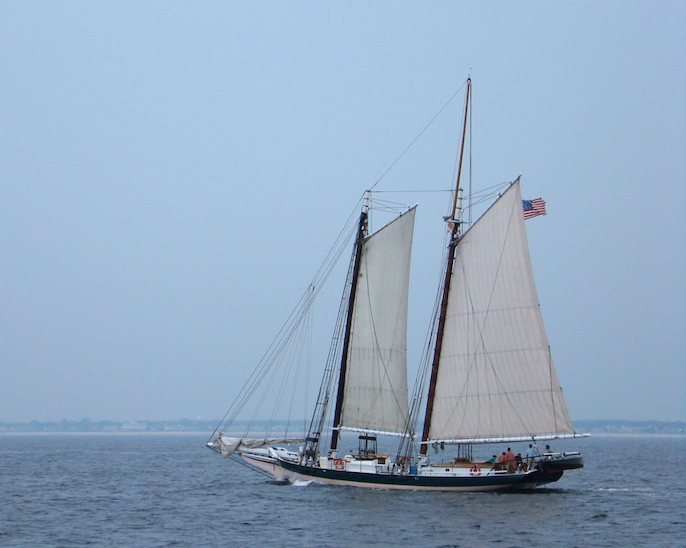 |
| Pungy Lady Maryland. Note the paint scheme of green and pink. Photo via National Park Service |
:)

January 2, 2016
The year ahead.
 |
| The Brooke area on the Aquia Line is just about done. |
 Last year ended on a nice note as my wife and I both made birdies on the last round of golf we played on News Years Eve. Birdies are rare events for us, so we celebrate them when they happen. It was also a good year on the Aquia Line. The layout from Falmouth to Brooke is just about complete. This includes new flooring and skirts in that part of the layout. Just a few scenic details remain, but it's nice to have such a large piece of the layout done. The Model Railroad Video Plus crew visited in October to record it for an upcoming episode.
The next step on the Aquia Line is to begin laying track at Aquia Landing. Much of that track is on a wharf, so a I need to install that before the track can go in. If I wanted to begin operations before that, I could lay a few tracks at the west end of Aquia Landing, and use it as a fiddle yard. But before doing that I have two major projects to complete, the Antebellum Alexandria Waterfront Diorama for the Alexandria Lyceum, and my next book for Kalmbach on marine terminals, wharves and ships. The Port of Los Angeles layout is for the book. The PoLA layout is coming along nicely, and is fully operational. I need to wrap it up fairly soon.
I also have some new products for Alkem Scale Models coming out in 2016. The first is the HO Scale chain link fence. These are being etched now and should be available for sale in late January, 2016. Stay tuned for more new stuff from Alkem Scale Models too.
 I am also considering a new WWI theme layout, possibly in On30 or O14 scale. The 009 scale Cambrai layout is scheduled to go to the B&O Museum, so that will be off my hands.
When I was working on the Model Railroads Go to War book, I purchased a few O scale WWI items, in particular an Neil Sayer Baldwin Gas Mechanical (shown at the left) and a bunch of figures from PLM. The gas mechanical was used by the US Army to support operations near the front. The other important engine the US Army used was a Baldwin 2-6-2 Tank Engine. That is not available in O scale. With only the gas mechanical available as an engine for the layout, I am thinking a very small switching layout depicting a front line supply depot might be interesting. Unlike my earlier layout set in Nov, 1917 in Flanders, this one would be set in July or August, 1918 in the Argonne or Vosges. This would allow me to try some more summer scenery, which I think I would enjoy. There is a French Company that makes RTR freight cars for this era, so a lot of scratch building would not be necessary. The gas mech is an etched kit that I would need to build. Eventually I could scratch build the 2-6-2 if I like how the WWI layout works out (though the Backwoods Miniatures 2-6-2 is close).
Why another layout? Several reasons, not the least of which is I like building layouts. The WWI layout would be portable and would be taken to shows as part of the 100th year commemoration of the United States involvement in WWI. In particular it would honor my namesake grandfather, Bernard Kempinski, who served in the Army in WWI as a stable boy. He enlisted and lied about his age (he was 15). When he arrived at his unit in France, the commanders assigned him to the stables as they did not believe he was old enough to be in combat.
So there is a lot to look forward to in 2016. I hope you all have a prosperous and healthy new year, and that you continue to read and comment on this blog.
Subscribe to:
Posts (Atom)