A journal following the history, design, construction and operation of Bernard Kempinski's O Scale model railroad depicting the U. S. Military Railroad (USMRR) Aquia-Falmouth line in 1863, and other model projects.
©Bernard Kempinski All text and images, except as noted, on this blog are copyrighted by the author and may not be used without permission.
-----------------------------------------------------------------------------------------------------------------------------------------------------------------

December 1, 2011

T Shirts now in stock

 The USMRR T Shirts commemorating the 150th Anniversary of the  USMRR beanpole and cornstalk bridge are now sold out except for a few 2X. Paypal will add shipping automatically. To pay with a check please go to www.alkemscalemodels.com

USMRR T Shirt  Medium
Gray with blue Ink
(Special order please allow an extra two weeks for delivery) $15.00


USMRR T ShirtLarge
G
ray with blue Ink
(In stock)  $15.00 


USMRR T Shirt   Extra Large
Gray with blue Ink
(In stock) 
$15.00


USMRR T Shirt  2X Large
Gray with blue Ink
(In stock)
$15.00


JB leading a train out of Falmouth shows the back graphic on the shirt
The smaller front logo

Machined Cannon Barrels

One thing I observed over the years of visiting layouts is that O Scale modelers tend to have machine shops with all kinds of cool mills and lathes. Smaller scale modelers tend to do without such elaborate tools. Now I know why. I also learned that buying tools can be addicting, and expensive. I also remembered my respect for master machinists. Until you try to machine stuff accurately and repeatably, you don't appreciate the jobs they can do, even with CNC assistance.

I finally got my Sherline Lathe in operation. To learn how to use the machine, I started with some O Scale cannon barrels. I previously made some barrels using wood dowels and my drill in a vise as a lathe. These did not come out well enough to make masters.


I am still learning how to use the lathe, but I did come up with two final barrels that I can use as  masters for the 3 inch rifle and the 12 pound Napoleon. See the top two barrels in the above figure. Note the separately machined trunnions. I ordered some brass bar so I can make future barrels totally out of brass. That will allow me to solder in the trunnion pieces. Parrot rifles, howizters and naval guns are next.

A couple things I learned so far.

The trickiest operation I have to do is to drill an appropriate sized hole through the side of the barrel that is both perpendicular and exactly through the center.

 I currently have a cheap Dremel Motor Tool drill press which is inadequate for this operation. I am planning on buying a Cameron Drill Press, especially if I can find a used one. They are quite expensive, but are regarded as the best miniature drills out there. Made in the USA too. They look old fashioned, but have accuracy of 0.0002" runout! That is amazing. The Albrecht Chucks are very high quality too. No more cockeyed bits in the drill press.

Speaking of bits, I am having no luck with my Drill Bit City Tungsten Carbide bits. They keep breaking in my Dremel Press. The only luck I have had with them is when I mount them in the lathe tailstock to bore out the cannon barrels.

It is so cool to bore the barrel to within one thousandth of an inch of the scale bore. It makes me realize how beefy the Napolean gun was, especially compared to the three inch rifle.

The Sherline lathe has an option of rotating the headstock to cut tapers. But for very shallow tapers, it is difficult to get repeatable and accurate results. So I ordered a compound slide. I got one on ebay for about a 20 percent discount.  I just looks cool too. We'll see how it works.

While I was at it, I ordered a set of carbide cutting bits and a new drill index with #1-60 HSS bits. Eventually I'll need a grinder to make my own form tools if I want to do more small scale machining. See, tool buying is addictive.


Here are the aluminum barrels on my laser cut chassis.

My next major acquisition is a spin caster. That will allow me to cast both the barrels and the chassis. I haven't decided if the laser cut details will be add-ons to the casting, or cast in place. I may even try sculpting and casting figures.

November 29, 2011

Railroads and the Making of Modern America

Word Cloud of Official Correspondence of William T. Sherman during the Atlanta Campaign from Railroads and the Making of America.

I received a notice that the Yale University Press has published a new book called "The Iron Way: Railroads, the Civil War and the Making of Modern America" by Professor William Thomas. I will review the book after I get a chance to read it. In the mean time, Professor Thomas has put together a companion site at The University of Nebraska called Railroads and the Making of Modern America that is worth a look.

The University of Nebraska site has a great collection of data, maps, letters, photos and articles on the role railroads played in U.S. history from the earliest inception of railroads to the post civil war development. It has several interesting animated graphics that exploit the dynamic attributes of on-line presentations compared to static print.  For example you can watch the progress of the railroad construction in Nebraska as a function of time.

Some of their conclusions are surprising, especially about the role of the railroad in South's development. For example the site has a graphic that shows southern railroads at the time of the civil war reached more of their population, as measured by having a railroad within ten miles, than the northern states.

They have an excellent topic discussion on the USMRR. They really delved into the labor arrangements for the USMRR construction Corps, which is a subject I had been wondering about too. The timeline and accompanying map found at this page is pretty neat as it logs in time and place. An excellent use of web based graphics display.

Some of the graphics do appear to be done just because they can and not for their research value. There are some animated nodal diagrams that didn't convey much new information to me in spite of their animated aspect. But many were downright fascinating. I found the  "word clouds" particularly intriguing. Check out this one depicting Official Correspondence of General Sherman during the Atlanta Campaign. It gives you an immediate view into Sherman's state of mind.

Professor Thomas' website is well worth checking out if you have any interest in early railroads in America.

November 28, 2011

Terraforming

Seems like I brought home more than just memories from California. I had a mild flu this weekend that curtailed my activities. Four other family members from disparate locations also got sick, so it was something we caught out there. Nonetheless, I was able to begin the terrain forming at Brooke and at the tunnel to Aquia.

One of the two access holes I cut
First, I used my Sawzall all to cut access holes in the plywood table under the ridge. I tested out the holes and all of the hidden track is accessible for maintenance and cleaning.

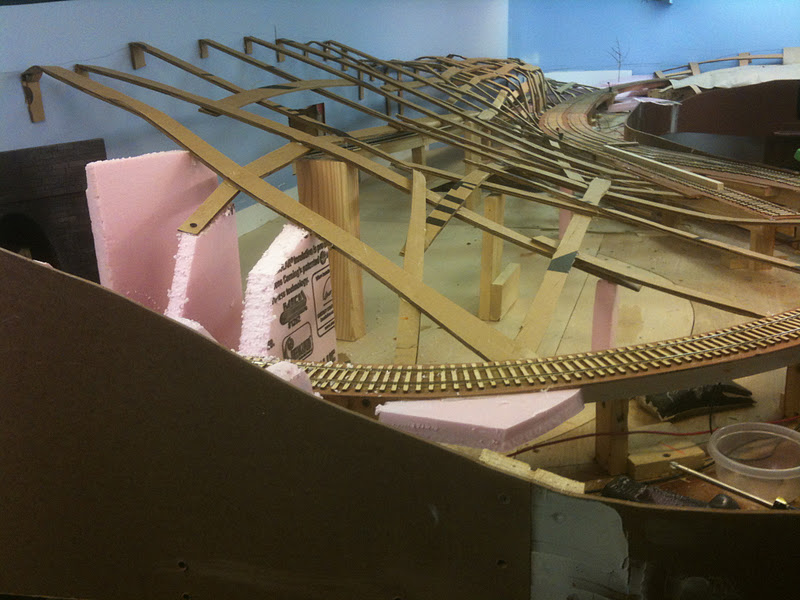
Then I replaced the fascia section near the tunnel to bring the top edge higher, allowing a more natural ridge line near the portal. The higher ridge also helps block the view between the southern end of Brooke and Falmouth. This makes the layout feel bigger because you can't see all the scenes from one location.

Next I started adding cardboard webbing to create the ridge line. At the tunnel portal area I used upright pieces of foam to create the basic land shapes. I glued in the tunnel portal after checking clearance with the General, the tallest of my locomotives.

I also got my Sherline lathe set up and started making cannon barrels, but I'll cover those in a later post.


Testing clearances at the tunnel portal

Terrain webbing taking shape. Although just a ridge in O scale, it would be a huge
mountain in N or HO scale :)

Almost finished with the webbing. The new fascia piece is visible in the foreground.
Reaching the sky board at the ridge top is tricky, but doable with a step-stool.

November 21, 2011

Visit to La Mesa Model Railroad Club

Worthington Building on the O Scale
layout at the Balboa Park
Model Railroad Museum.


We just got back from a week-long Worthington family mini-reunion in La Jolla, Ca. While there, I had a chance to visit the La Mesa Model Railroad Club located inside the San Diego Model Railroad Museum, in the Casa De Balboa building in Balboa Park, San Diego, California.  


This is one of my favorite model railroads due to its scope, prototype fidelity and scenery. I made a short video that you can see below. Please enjoy this brief HO scale interlude. We'll get back to O Scale Civil War railroading soon.