A journal following the history, design, construction and operation of Bernard Kempinski's O Scale model railroad depicting the U. S. Military Railroad (USMRR) Aquia-Falmouth line in 1863, and other model projects.
©Bernard Kempinski All text and images, except as noted, on this blog are copyrighted by the author and may not be used without permission.
-----------------------------------------------------------------------------------------------------------------------------------------------------------------

June 25, 2014

SS Transcolorado - A Forest Gump Moment


I have been very busy lately with custom models for clients and have not had much time to work on the Aquia Line.  I will post info on those projects later as some do relate to ACW Railroading

I have been recently doing a lot of research on maritime subjects for a couple projects I have underway. In this post I would like to share a story about from my high school days that  has been enhanced by some additional information I recently learned.

I, Frank, and my twin brother
Rob during Army commissioning ceremony
in 1978.
My uncle, Frank Gustav, was an engineer in the U.S. Merchant Marine. He was not a blood uncle. He and my dad were friends from childhood, so we kids just called him uncle. He was a quiet, modest,and generous man with a lifetime of amazing experiences. He joined the U.S. Merchant Marine as a teenager during WWII. He started at the bottom of the ladder as an engine wiper and progressed all the way to chief engineer during his career. During WWII he made numerous convoy runs to Russia and other locations. One convoy he told me about was heading to Russia when all of their escorts were diverted to find the German battleship Bismark. The defenseless convoy then got hit hard by U-boats. While his ship made it through, many others didn't. He said many of his buddies were mad at the British for that, but he never seemed to carry a grudge.

He continued with the merchant marine for many years. During the Vietnam War, he received a commendation for heroism when his ammunition carrying ship was attacked by Viet Cong mortar fire.

When I was a senior in high school, Frank was making  regular freight trips to Puerto Rico.  He called it the banana run, as they were frequently hauling bananas to New York. It was about a bi-weekly cycle. He had a car and an apartment in NYC, but he didn't like leaving his car there. So he made me a deal. I could use his car while he was gone, as long as I picked him up in Brooklyn when he returned from a trip. He would usually stay at our house during his shore time.

One weekend, I arrived at the dock in Brooklyn to pick him up. He was on the ship, Transcolorado, a converted troop ship. He said to me, "we can't leave tonight, as I have to be on watch. Why don't you go to my room and go to bed. We will leave in the morning."

I said, "OK." I Called my parents to let them know what was up. Then I went to his stateroom in the upper superstructure,  and  since it was late, I hit the rack.

The next morning I got up and dressed. When I went on deck, I was shocked to learn that they put the ship in dry dock while I was asleep. I had breakfast with the crew. They gave me a detailed tour of the ship.

Transcolorado in Vietnam
One of the deck officers asked if I could give him a ride to the union hall in Manhattan. So Frank and I did that. I was amazed he gave me $20 for the ride, which I refused to accept, but he insisted.  In 1974 minimum wage was $1.80 an hour!

Frank passed away several years ago, but I frequently think about him and that night, and many other pleasant memories.

A few weeks ago I was curious if any pictures of the Transcolorado existed. So I did a search, and sure enough I found several.  The Transcolorado started out as a USNS Troopship called Marine Adder. It was a bit late for WWII, but participated in the Korean and Vietnam wars. After the Korean War it was converted into a US flagged merchant ship, with a set of distinctive cranes.  About a year or so after I was on the ship it participated in the Vietnam Refugee operation.

I was very surprised to learn that the ship I spent a night on was involved in that operation.  It turns out the Vietnam mission was very well documented with text and videos of the operation available on line.


This website has a good description of the overall mission. The comments are also worth reading.


The book, "The Lucky Few", has a section describing the tragic conditions on the overcrowded Transcolorado during the evacuation. It was a chaotic time.

I know several Vietnamese people who were rescued after the war,  including one of my sisters-in-law. While it would make an incredible coda to the story, she didn't come here on the Transcolorado.


June 6, 2014

70th Anniversary of D-Day

The destruction of the Gare Maritime at Cherbourg left by the Germans


Unloading engines at Cherbourg
The 70th anniversary of D-Day is today. It is a good time to reflect on the devotion to duty and sacrifice of the men and women involved.

Most people are familiar with story of the invasion and hard fighting. What might be lesser known is the role that railroads played, not so much in the initial invasion, but in the subsequent campaign. The battle to capture port of  Cherbourg and its railroad assets was a major component of the D-Day campaign. The utter destruction left by the Germans made the  task even more difficult.

 I included a chapter on D-Day and the fight for Cherbourg  in my upcoming book, "The Model Railroad Goes to War." It is one of the most interesting chapters in the book in my opinion.


May 28, 2014

Depth of Field in Macro Focus Range Videos

A recent discussion on the Prototype Railroad Modeling Yahoo Group got me wondering about the effects of f-stop on depth of field when shooting videos in macro focus ranges. I made this short video to investigate how the sharpness varied at three different f-stops, f4, f22 and f29. I shot all using a Canon 70D, with 48mm focal length at the minimum focus distance.

I used a scene on my 00/009 Scale WWI layout, as it was already set up for lights and camera.  The camera was about 6 inches from the layout edge with the 18-135mm zoom. If you want to read more, I included an updated discussion of aperture and depth of field below the video. I recommend you watch in HD so you can see the effects of the parameters better. Note this is a new upload, the original upload did not allow HD. This one does.


Depth of field is probably the single most important parameter in model railroad photography. It is also important in model railroad videography. It is useful to understand why.

Two primary factors affect depth of field, aperture and focus distance in model railroad photography. A third factor, image format, is fixed by the type of camera you use. If are you comparing across different film or sensor  formats it usually means that the same image framing or composition will be at different focus distances.
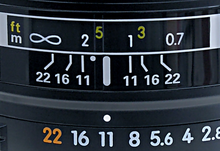
The brackets in the middle row of
numbers represent the depth
of field for each f stop of this lens.
(source Wikipedia)
When we a photograph a prototype railroad scene with a locomotive, we usually need to stand well back from the subject to make sure that it can be fully captured in the frame. As the focus point of the subject moves away from the camera the effective depth of field increases. Most DSLR camera lenses have a scale engraved on the lens body to show how the depth of field changes with aperture and focus (see image at left from wikipedia). Eventually the focus point reaches the hyperfocal distance, the point of focus where everything from half that distance to infinity falls within the depth of field. Usually prototype rail photographs have the subject and background scenery in the hyperfocal region. The bottom line effect is that most of the scene is in sharp focus.

If we attempt replicate the same composition in a model railroad setting, we find that we are not in the hyperfocal region. In model railroad photography and videography depth of field is only a few inches deep. It is a property of camera lenses that the depth of field region shrinks as the focus point moves closer to the camera. This region shrinks faster than the scale distance diminishes. Therefore, not all of the image will be in sharp focus. This is particularly severe in N scale models because the camera must typically be placed very close to the models to replicate a prototype shot, such as a three quarters trackside view of a passing train.

The shallow depth of field one gets at these macro distances makes even the most realistic scenes look like miniatures. Furthermore, prototype scenes can be make to look like miniatures by manipulating the  depth of field either in post production  or with tilt shift lenses. For example see this tutorial on Vimeo


The Sandpit from Sam O'Hare on Vimeo.


To increase depth of field to simulate the hyperfocal region we use as small an aperture (also called f-stops) as possible since the smaller the aperture size - the greater the depth of field. Pinhole lenses were popular because the small aperture of the pinhole allowed for great depth of field. Unfortunately, pinhole lenses were hard to come by, tricky to make and difficult to use because of the dark image in the viewfinder. Tilt shift lenses tend to not be useful in model railroad photography because the tilts, swings, and shifts needed to frame a typical model railroad image are too extreme for the hardware.

Furthermore, there is a limit to the sharpness obtainable from small apertures. There is a point where the aperture gets so small that the light diffracts as it passes through the hole and the overall image loses sharpness.

It is the size of the aperture that governs depth of field. Aperture sizes associated with an f-stop vary from camera lens to camera lens. In other words, f22 on one camera may not have the same size aperture as f22 on another.

To understand the process requires the use of the simple formula, f-stop (N) equals lens focal length (f_l) divided by the actual aperture size (D), N = f_l/D.

The table below shows aperture sizes for the two cameras that I have tested. You can see that the Canon Rebel XT at f29 and 27mm focal length has the smallest aperture at 0.931 mm, and therefore greater depth of field than the 50mm macro lens at f32.

f-Stop
Lens focal length (mm)
Aperture diameter (mm)
Camera –Lens Combination
32
50
1.563
Canon 5D with 50mm macro lens
29
27
0.931
Rebel XT with kit zoom lens

You can compute the aperture size for your camera by applying the formula. Be careful in comparing lens and f-stops as some manufacturers report equivalent focal length when describing their lenses and not the actual focal length, especially for the compact digital cameras. The equivalent focal length is the comparable focal length for a "conventional" 35mm film camera lens.

The recent arrival of focus stacking software  changes the calculus of depth of field for still images. Although the optical properties of the individual images do not change, focus stacking  post image processing of multiple exposures with different focus points to construct an image that is sharp all over. When used in model railroad applications, focus stacking allows us to create model railroad images that simulate the hyperfocal sharpness of a prototype image. I have found my macro lens very useful when combined with focus stacking. The ability of the macro lens to focus just an inch or so in front of the lens means that I can capture images where virtually the whole image is sharp, from immediate foreground to distant background

However, in videography, focus stacking is not an option. So we are back to shooting at small apertures. But, the problem arises that with small f stops, you need to slow the shutter speed to let in enough light. But, you can not use long time exposures in videography. If you are limited to 1/30th of a second exposure or faster, then you will need to either bump up the ISO or add more light. My Canon 70D can go over 51,000 ISO, but noise increases as the higher ISOs. I used 2000 ISO  in the video above and it shows acceptable results.

A better solution is to add more light. One 700W flood is usually enough for a small scene. Bigger scenes will require more light. But then you can shoot at wider f stops as you are unlikely to need to be in so close, so depth of field increases. Lighting is an important subject  and deserves its own discussion. But understanding the basic physics and performance of your lenses is important too.

Videography is much more complex than still photography. Many of the techniques needed for good model railroad photography still apply, but they are insufficient to insure you have a good video. This will be a topic I revisit in  upcoming blog posts.


May 26, 2014

Rail Fanning Port of Los Angeles

BNSF engines shuffling steel skeleton flats at Pasha Stevedore Terminal on S Fries Ave.
AW and I were in Los Angeles last week to attend the graduation of one of my nieces. While there I had an opportunity to do some rail fanning one afternoon at the Port of Los Angeles. I was lucky because the area I was mostly interested in was very busy. When I first got to the Pasha Terminal on Fries Street, they were unloading brand new 53 ft empty containers from the GearBulk ship Finch Arrow. This is a special design ship optimized for special bulky cargo delivery.

Double barreled container ship action!
Next stop was the USS Iowa to check out the battleship and get photos of the Evergreen container terminal across the channel. The Ever Strong was being unloaded there. At about 4:45PM the container ship Spring R left the Yusen Container terminal and headed out to sea. As it went past and I was able to get a bunch of photos.


Leaving Terminal Island over the Badger Bridge.
From there I checked out the Alameda Corridor, especially where the railroad and the highway cross the Cerritos Channel.  In this area I saw 5 BNSF container trains heading to Terminal Island or leaving in about one half hour.  I saw a lots UP stuff further inland on the Corridor too, but I could not find a safe and good place to shoot them. In general, the trains at the port are very difficult to photograph as the security requirements due to terrorists, theft and smuggling have resulted in fences being installed every where. Since the area is relatively flat, fences are a big problem.
Fences in the way everywhere!

Light engine sets heading out to switch at night

Next I headed to Wilmington. I caught  two light power sets heading to the Pier A area. One came down Alameda Street and headed past Pier A to San Pedro. The other came down McFarland Ave and went to the Fries Street switch district. There it switched sorted and pulled steel skeleton cars at the Pasha Terminal.

I watched this for about an hour. By then the light was fading and I was hungry. Too much action to stop to eat.

Street Running - BNSF Heading out S Fries Ave to switch the industries and terminal
I was very happy to catch all the activity on S Fries Ave as I have selected that area for a future project. But more on that later as it develops. In the meantime here are some shots I got.


May 20, 2014

WWI layout

As part of the book I recently finished for Kalmbach Publishing, I built a small (3 by 6 feet) layout in 00/009 scale depicting the railroad activity leading up to the Battle of Cambrai.

Despite the horrific fighting, the European theater of WWI makes a compelling subject for a model railroad. An intense level of standard and narrow gauge railroad activity supporting the field armies presents many operational challenges, while the ruined villages and battle scarred trenches require a different kind of scenic treatment. This model railroad features the railroads of WWI before the Battle of Cambria in the fall of 1917. The first mass use of tanks and aircraft get most of the attention in historic accounts of the Battle of Cambrai, but the innovative offensive depended on extensive and carefully planned American railroad support.  The layout focuses on the 11th and 12th United States Engineers near the town Fins during the build up to the Battle of Cambrai.

For the rest of this fascinating story you will have to wait until January 2015, when the book is released. In the meantime check out this short video featuring the layout.