A journal following the history, design, construction and operation of Bernard Kempinski's O Scale model railroad depicting the U. S. Military Railroad (USMRR) Aquia-Falmouth line in 1863, and other model projects.
©Bernard Kempinski All text and images, except as noted, on this blog are copyrighted by the author and may not be used without permission.
-----------------------------------------------------------------------------------------------------------------------------------------------------------------

January 2, 2016

The year ahead.

The Brooke area on the Aquia Line is just about done.


Last year ended on a nice note as my wife and I both made birdies on the last round of golf we played on News Years Eve. Birdies are rare events for us, so we celebrate them when they happen. It was also a good year on the Aquia Line. The layout from Falmouth to Brooke is just about complete. This includes new flooring and skirts in that part of the layout. Just a few scenic details remain, but it's nice to have such a large piece of the layout done. The Model Railroad Video Plus crew visited in October to record it for an upcoming episode.

The next step on the Aquia Line is to begin laying track at Aquia Landing. Much of that track is on a wharf, so a I need to install that before  the track can go in. If I wanted to begin operations before that, I could lay a few tracks at the west end of Aquia Landing, and use it as a fiddle yard. But before doing that I have two major projects to complete, the Antebellum Alexandria Waterfront Diorama for the Alexandria Lyceum, and my next book for Kalmbach on marine terminals, wharves and ships. The Port of Los Angeles layout is for the book.  The PoLA layout is coming along nicely, and is fully operational. I need to wrap it up fairly soon.

I also have some new products for Alkem Scale Models coming out in 2016. The first is the HO Scale chain link fence. These are being etched now and should be available for sale in late January, 2016. Stay tuned for more new stuff from Alkem Scale Models too.

I am also considering a new WWI theme layout, possibly in On30 or O14 scale. The 009 scale Cambrai layout is scheduled to go to the B&O Museum, so that will be off my hands.

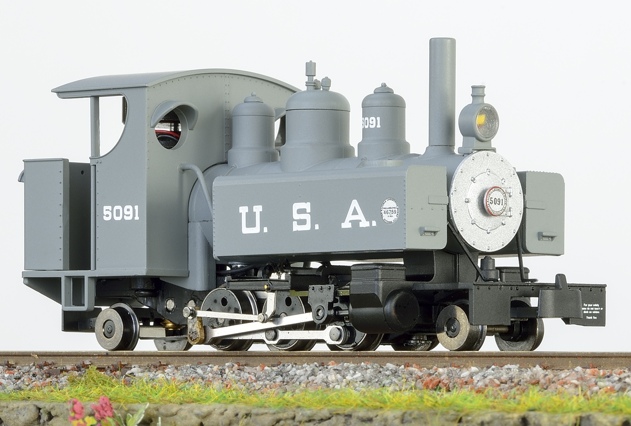
When I was working on the Model Railroads Go to War book, I purchased a few O scale WWI items, in particular an Neil Sayer Baldwin Gas Mechanical (shown at the left) and a bunch of figures from PLM. The gas mechanical was used by the US Army to support operations near the front. The other important engine the US Army used was a Baldwin 2-6-2 Tank Engine. That is not available in O scale. With only the gas mechanical available as an engine for the layout, I am thinking a very small switching layout depicting a front line supply depot might be interesting. Unlike my earlier layout set in Nov, 1917 in Flanders, this one would be set in July or August, 1918 in the Argonne or Vosges. This would allow me to try some more summer scenery, which I think I would enjoy.  There is a French Company that makes RTR freight cars for this era, so a lot of scratch building would not be necessary. The gas mech is an etched kit that I would need to build. Eventually I could scratch build the 2-6-2 if I like how the WWI layout works out (though the Backwoods Miniatures 2-6-2 is close).

Why another layout?  Several reasons, not the least of which is I like building layouts. The WWI layout would be portable and would be taken to shows as part of the 100th year commemoration of the United States involvement in WWI. In particular it would  honor my namesake grandfather, Bernard Kempinski,  who served in the Army in WWI as a stable boy. He enlisted and lied about his age (he was 15). When he arrived at his unit in France, the commanders assigned him to the stables as they did not believe he was old enough to be in combat.

So there is a lot to look forward to in 2016. I hope you all have a prosperous and healthy new year, and that you continue to read and comment on this blog.


December 31, 2015

A Day of Operation on the USMRR Aquia Line - 2 March 1863

A few years ago I went to the National Archives and copied many documents relating to the USMRR. I have not had time to fully digest the material. Tonight I decided to do a bit of analysis of operations on the Aquia Line. I picked March 2, 1863 as I have multiple records for that day. It looks like a fairly typical day compared to other days.

The following is a transcribed version of the Log of Arrival and Departure of Trains at Falmouth Station, March 2, 1863. The handwriting on this log is very difficult to read and doesn't follow a strict format.


W.W.W. S.Y.
     Train     No. 1 Engine Lion arrived at 7:20 A.M.
      Ex (tra)  "   1    "       Osceola  "     "  7:35   "   Cheney
W.W.W. S.Y.
     Train     No. 2  Engine Lion left at      7:50 A.M.
      Ex (tra)  "    2    "        Osceola  "     "  8:00   "   Cheney
W.W.W. S.Y.
     Train     No. 3  Engine Leach arrived at 10:15 A.M.
         "          "   4    "        Leach  Left      "  10:45   "  Cheney
W.W.W. S.Y.
     Train     No. 5  Engine Fury arrived at      1:30 P.M.
        "          "    6     "       Fury  Left      "      1:45    "  Cheney
W.W.W. S.Y.
     Train     No. 7  Engine Leach arrived at      4:35 P.M.
       Ex.          "  7     "       Lion   arrived  "       4:40    "
     Train     No. 8  Engine Leach left  at            4:45 P.M.
       Ex.          "  8     "       Lion   left   "            4:50    "  Cheney
W.W.W. S.Y.
     Train     No. 9  Engine Fury arrived at      7:45 P.M.
        "            "  9       "        ''     arrived  "       7:55    "      Cheney
W.W.W. S.Y.
      Engine Leach arrived at 11PM
      Engine Leach  Left      "  11:15PM    Cheney

Note the W.W.W. stands for William Wierman Wright, Superintendent of the Aquia Line. The S.Y. may mean Superintendent.

This next document is the Log of Cars Received at and Forwarded from Falmouth, March 2, 1863

No Time Engine Conductor No of Cars Contents Consignee


Cars Received At Falmouth Mar 2, 1863


1
7:20
Lion Perine
1191
Passengers Agent

"
“
“ "
1242, 1183
Mil Goods Pierce

"
"
" "
1258, 1094, 1252, 31, 1171, 1114, 133, 1147, 1141, 1234, 1136, 1075
Forage Pierce

1 Extra
7:35
Osceola Doyle 146, 131, 169, 1159, 1234, 1124, 122, 1162, 1169, 1133, 1244, 119 Forage Pierce Note car 1234 is duplicated. Could be a typo
3
10:15
Leach Smith 1100, 1067, 160,147, 1091, 1053,  Coms. Stores Winchester

"
"
" “ 
1156
Passengers Agent

5
1:30
Fury Clinton 1081, 162,  Mil Goods Pierce

"
“
" “ 1135, 1243 Passengers Agent

7
4:35
Leach Smith 1036, 1165 Coms Stores Winchester

"
"
" " 13, 102 Stores Pierce

"
"
" "
231
Ord Stores Pierce

7 Extra
4:40
Lion Perine 1256, 1104, 1253,1132, 1139, 1074, 1077 Forage Pierce

9
7:45
Fury Clinton 1100, 101, 1072, 1110 Forage Pierce

Extra
11:00
Leach Smith 169, 1267, 1188, 1232, 1239, 1159  Forage Pierce


Cars Forwarded from Falmouth March 2, 1863
Destination

2
7:50
Lion Perine 186, 1135, 1257, 4146, 1110,  troops Aquia

2 Extra
8:00
Osceola Doyle 1243, 1044, 1148, 1189,  Empty Aquia

"
"
" " 124 QM Stores 12th U.S. Inf, Stonemans

4
1045
Leach Smith 146, 181, 169, 1239, 119, 1124, 1244, 1133, 1169, 1162, 122, 1183, 1191, 1234, 1141 , 1147, 133, 1114, 1288, 1171  Empty Aquia

"
"
"
"
1250, 31, 1094, 1136, 1095 Mail Mail and Passengers W Boat

6
1:45
Fury Clinton 1243, 1053, 1067, 1011,1091, 147, 160, 1156 Empty Aquia

8
4:45
Leach Smith 1081, 162, 1135, 1243 Empty Aquia

8 Extra
4:50
Lion Perine Nil Empty Aquia

10
7:55
Fury Clinton 1104, 1253, 1132, 1077, 1074, 1256, 1139, 13, 102, 231, 1036, 1165, 1136, 1094 Empty Aquia

Extra
11;15
Leach Smith Nil Empty Aquia


There are couple things to note by analyzing these data.

A total of 60 cars arrived at Falmouth and 61 cars left on March 2. Most cars that left went to Aquia empty, but one was sent to Stonemans. (Note  three cars were sent to other stops from Falmouth on March 3rd. Look at the original document to verify that, it is not in the transcribed table.)  Note that "W Boat" is the daily steamboat to Washington, DC. It leaves from the wharf.

The longest train was 4 with 25 cars, next was 1 with 15 cars. Two engines ran light back to Aquia.

Note that some cars stayed at Falmouth overnight, while others got delivered in the morning and departed that same day.  For example 1141 and 1147 arrived on Train 1 with forage and departed empty on train  4 three hours later. Similarly, car 1191 brought passengers, but left empty on 4. Other cars like 1110 and 101 came in on 9 but stayed the night. Car 1110 left Falmouth on Train 2 and returned at 7:45PM on Train 9.


The make up of the incoming and outgoing trains is not the same. This implies that a fair amount of switching was going on at Falmouth.  Conductor Smith was busy as he ran three trains that day.

No trains met trains coming in the opposite direction during this day. This matches the schedule I have from 1864, where there are no scheduled meets. The extras ran on the time of their scheduled train.

Overall it's not too complex an operation, but there is a lot more switching going on than I expected. That should make my crews happy. I don't have a train register for all stations, so I can not create a "as-run" string diagram.  I also do not have copies of any of the train orders for 2 March. But I suspect there are some at the NARA. I need to recheck those. There were so many train orders there, that I got tired of copying them on the day I visited.

Pierce is shown as a consignee on some of the cars. The NOAA Map shows a place called "Capt Pierce" just south of Falmouth. I suspect this was the HQ for Capt Pierce, a Quartermaster officer, but I am not sure.

I have previously posted the roster of USMRR cars at this link.  However, it's pretty easy to tell what number is what kind of car. The flat cars are numbered with 1 to 3 digits. The box cars start at 1000 and go up. There are 30 stock cars in the 2 and 3 digit range, interspersed among the fact car numbers. Most of the cars are 28 ft long with 10 ton capacity. I do not have any further information differentiating the types of cars, so I have to rely on photographic evidence to see how many arched, peaked, combination, etc. cars there were.   

Here are copies of the original documents in case you want to check my transcription. Some of this handwriting is hard to read.


December 30, 2015

LED Lights in Recessed Ceiling Fixtures for Layouts

Over the past few years I have experimented with several types of LEDs for use as layout lighting in  part of my basement that houses Aquia Landing and the Port of Los Angeles Layouts. These rooms have 12 recessed can lights in the ceiling.  Note that the front room of the layout from Brooke to Falmouth has a built-in valance with tube florescent fixtures. If I could, I would get rid of all those lights.

Over Aquia Landing I opted to not have a valance. So I stuck with the recessed lights. I tried several types of CFL and LED bulbs, but only one really worked well.  I'll spare you the results of the experiments that failed and just point you to the ones I have found that work the best.  They are Ultilitech Pro 120W BR 40 Floods. Lowes is the only store in my area that carries them.

These lights create a nice even flood of light. They are dimmable and only use 20W of power for 1400 lumens of light. They cost about $20 a pop, but should last a long time.


December 29, 2015

Vemeer and Camera Obscura

If you have an interest in photography,  painting realistic miniatures or backdrops, and have a spare 41 minutes, I strongly suggest you watch this video. The last three minutes are especially fascinating.

In this video Professor Philip Steadman, UCL Bartlett School of Environment, Energy and Resources, provides a "proof" of his theories on how the famous Dutch painter Vermeer used a modified camera obscura to paint his "photorealistic" scenes.


When I was in graduate school in mechanical engineering, I had one unrestricted elective class. I took photography. In that class we made a camera obscura in a dark room in the old armory at MIT. It was really fun to watch the outside scene projected on the walls of the darkened room. But the room was too dark to paint in. This video shows how Vermeer probably developed the camera obscura  even further to create a device that could record a scene and allow enough light to make a painting.  There is a documentary film mentioned in the video, "Tim's Vermeer," that I have not seen, but plan to at some point.

Prof Steadman also makes a point that there are no out lines in Vemeer's artwork. I have noticed a similar effect when working with Photoshop. When you reduce an image to colored dots (pixels), and look at the dots in a magnified way, you can see this clearly. You'll even note that the areas were colors meet are not sharp, but tend to blur into each other.  Being aware of this effect makes compositing images in photoshop more realistic. Sometimes, you have to add blur to an image to make it more realistic.


December 27, 2015

Back in Ole Virginny

Having spent the past week zipping around the country, it is good to be back in Ole Virginny. While I didn't get to work on the layout over the Christmas break, several interesting other things happened.

The first happened in Rochester, Minnesota. My wife and I where wandering through the underground walkways that connect most of the downtown buildings in Rochester. Strangely enough, they call these underground walkways the "skyway." (OK, there are some elevated parts, but it seems to mostly be underground.)  I wandered into an art shop while AW was looking at a woman's clothes shop. I noticed a book on the counter that was about the 1st Minnesota Regiment, a unit that needs no introduction to students of the civil war.

The woman who ran the shop, Ms Sharon Krom, told me that she and her husband, Richard, wrote the book based on 218 letters Edward H. Bassett sent home during his three year enlistment. This got my attention. Lately I have been reading as much original civil war material and memoirs as I can find. Having read a good number of summaries and strategic analyses, I am finding the original material much more interesting and rewarding to read.

So I opened the 719 page book to a random place and started reading. The first letter I saw was written from Falmouth, April 1863. Just the time that I am modeling. A quick flick through the pages showed dozens of letters from this period. I knew I had to get the book, despite not knowing if it would fit in my luggage.

As I headed to the cash register, Richard Krom, Mrs. Krom's husband arrived. We had a very pleasant chat about the book and their efforts to collect the letters. It seems that the letters were scattered across the country and the couple had to spend considerable effort to gather them. The letters have been transcribed to printed text for ease in reading. There is a small amount of text written by the Kroms placed between the letters to put the letters in context. As I purchased the book, Richard, Sharon and their son James, signed my copy.


I am not quite finished reading the book, but I am really enjoying reading it.  It reminds me a lot of Leander Stillwell's memoirs and Wilbur Fisk's Letters from "Hard Marching Every Day." I will do a full review when I finish the book, but based on what I read so far, I highly recommend it.




I also read another interesting book over the break called the "Tugboats of New York," by George Matteson.  This book is a richly illustrated history of New York tugboat activity. Although the book has dozens of fine art quality black and white prints, the text is quite good and very informative.  There is a fascinating chapter on tugs in the civil war.  I borrowed this copy from the library, but I plan to get a copy for my personal library.


When I got back to Virginia, the test samples of my photo etched stainless steel HO scale chain link fences with barbed wire and gates were waiting for me. The test etches look great and I will be offering these for sale in January via Alkem Scale Models.


Finally, I noticed tonight that Minitrains (in Germany) has announced a Baldwin 2-6-2 HOn2 (they call it HOe and OO9). I have not seen the loco for sale anywhere. I wonder what its status is? They are also offering American box cars, flat cars, and gondolas, all with Pershing trucks. With this loco and freight cars. and the forthcoming 4-6-0 from Bachmann, a WWI narrow gauge RR is more easily modeled. I may have to reconsider my next project. Hmmmm......