A journal following the history, design, construction and operation of Bernard Kempinski's O Scale model railroad depicting the U. S. Military Railroad (USMRR) Aquia-Falmouth line in 1863, and other model projects.
©Bernard Kempinski All text and images, except as noted, on this blog are copyrighted by the author and may not be used without permission.
-----------------------------------------------------------------------------------------------------------------------------------------------------------------

June 19, 2023

Busy Weekend

 This was a busy Father's Day weekend with trains, games, and model building.

John running a passenger train through Winchester 


Wooden fruit boxes under Winchester 
On Friday, Paul Dolkos rode with me to operate on John King's B&O railroad centered around  Winchester, VA. John's layout is wonderful to operate. It hits many of my hot buttons including Time Table and Train Order, Steam, and lots of switching. Paul and I operated the Winchester town switcher. That was a great job with many industries to switch. Winchester was a very busy railroad town with several cold storage facilities for the fruit industry. 

John's track is beautifully laid. He never got around to doing much scenery of structures but he does have lots of interesting mock-ups for the structures in Winchester.  In addition, he has dozens of wooden fruit boxes from orchards and storage houses in Winchester under the Winchester part of his layout. 

B&O Bulletin Book
John has a lot of interesting railroadania. One item that was really neat was a B&O Bulletin book that he uses to have his operators sign. 


On Saturday I participated in a game at Mike Kelly's. He set up a south Pacific scenario involving Japanese infantry guarding American prisoners, a US Navy shore patrol to the rescue, angry local villagers, and man eating animals.   

The game combined elements of role playing and war gaming. He used hidden movement and lots of surprises for both sided.  It turned out our 11-man Japanese squad had to deal with the 25-man shore patrol and 20 unruly prisoners lead by a lone nurse who managed to hide a scalpel on her person. Even the giant crocodile allied with the US Navy. In the end only one Japanese soldier survived to report the outcome to his commander. 


I continued to work on the High Road to Rome diorama too.  It is almost done. Here is a photo showing a vignette from the diorama. A jeep with a wounded soldier is trying to get past the dozer and tanks on the narrow mountain road. This incident is based on Eric Sevareid's report of the actual battle. 


June 8, 2023

20,000 Leaves Under the Sky

High Road to Rome Diorama (1/35th scale)

I will be taking a short break from modeling for some family events, but I thought  I would post a photo of the work in progress on the 1/35th scale diorama that my brother and I are building. The diorama is a showcase for some new scenery products that Alkem Scale Models will be introducing.  If you look closely you will see sumac, oak, beech and hickory trees.  We plan to offer a line up of new scenery items to allow builders to make super scale trees like these with individual leaves. In fact, that is what we will be calling them, Super Scale Trees or SST.  We should be announcing them in a few weeks. 

May 25, 2023

Two Approaches to Branch Line Model Railroads

In the past few days I had the chance to visit Todd Hermann's and Marty McGuirk's model railroads. They both model branch lines, but they have completely different flavors. I am a big fan of branch line models railroads because they tend to be manageable projects that allow the builder to create highly detailed scenes and structures. In today's busy world with so many demands on people, having a project that is manageable is something that should not be undervalued. Many of us want to model multiple deck railroads with CTC and signals and massive yards with dozens of operators. But projects of such scope are unobtainable goals for most of us.  Building a manageable branch line doesn't mean you are settling for something less as these two fine layouts demonstrate. 

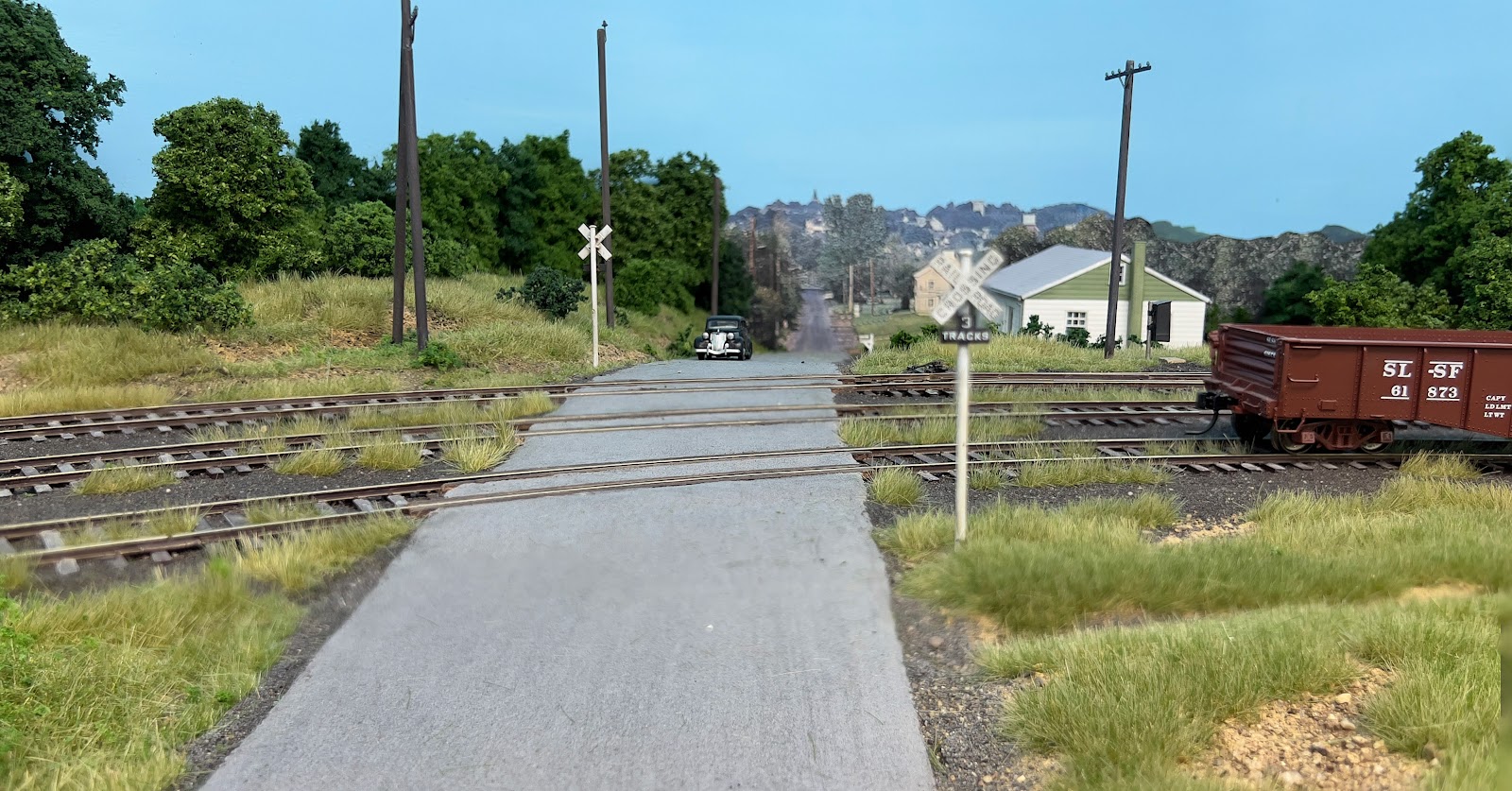
A very well done level crossing

Todd models the area of Catasaqua, PA. This is a region crisscrossed by several railroads serving numerous heavy industries. Todd's main focus on is on the LNE, but he also has a large yard for the Reading Railroad and large section of the Lehigh Valley's 4-track line. His concept is to focus on the LNE but he needed the LV and Reading on the layout too as the LNE interchanged with both. 


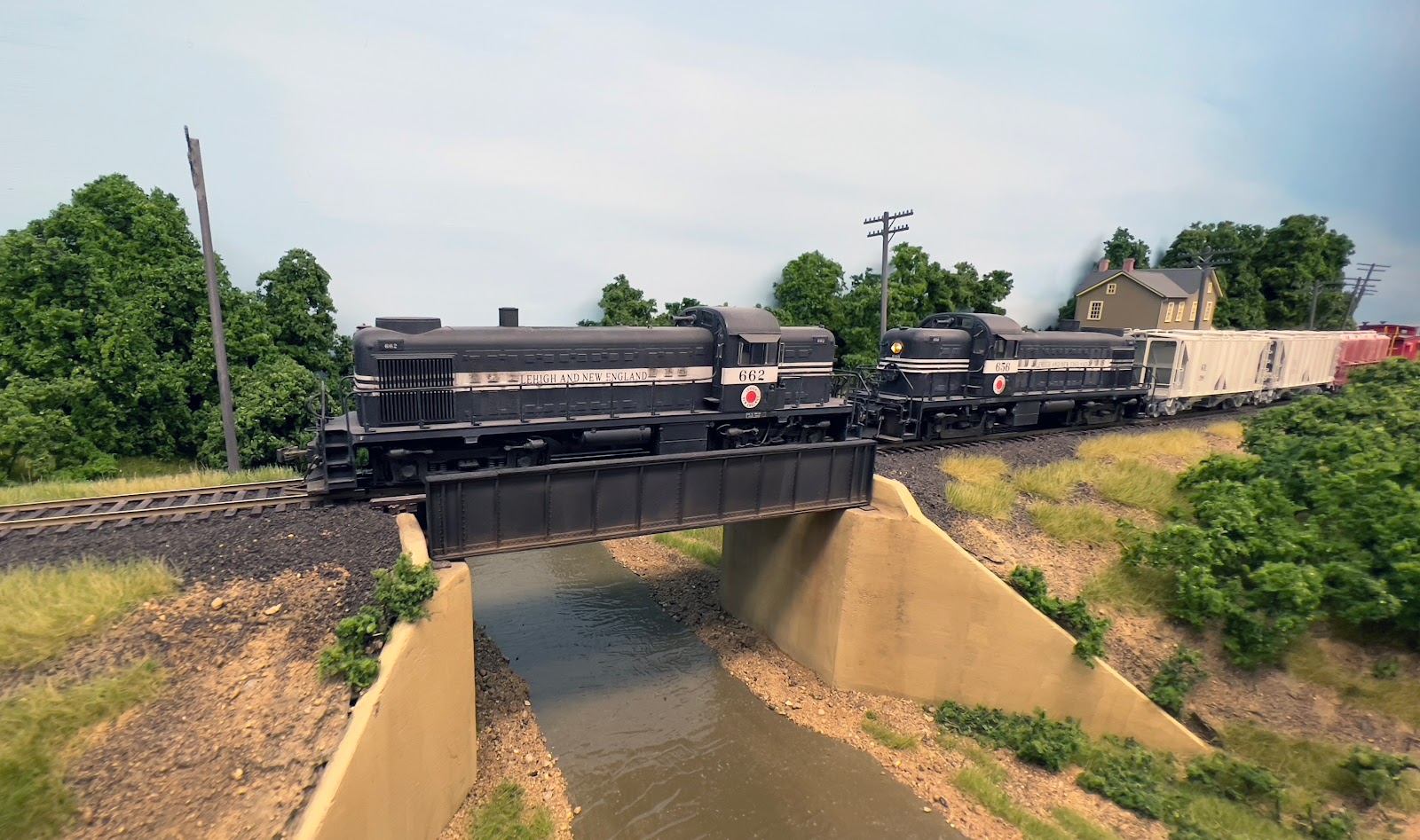
The LNE cross a creek in a wooded area. 

His layout includes a really neat diamond crossing  where the LNE crossing the LV 4 track mainline on a super sharp curve and then crosses Lehigh River. Because of the peculiarities of the how the railroad is situated in the basement, he had to build two versions of the bridge over the Lehigh River. For more detail on how he did this see Chapter 10 "Diamonds in the Tracks," in Model Railroader's book, "What's in a Photo." 


Despite the emphasis on heavy industry, Todd was able to include some bucolic scenes on his layout. 

Todd has several interesting prototype photos displayed on the walls of his layout rooms and workshop. Some that caught my eye were of the 19th century Crane ironworks that was once in Catasaqua. This would make a fascinating compact iron related model railroad. In the era Todd models the site was taken over by the Fuller Company who make parts for the cement industry. For more info about Todd's layout see this youtube video https://www.youtube.com/watch?v=x3Qniv0qnyk

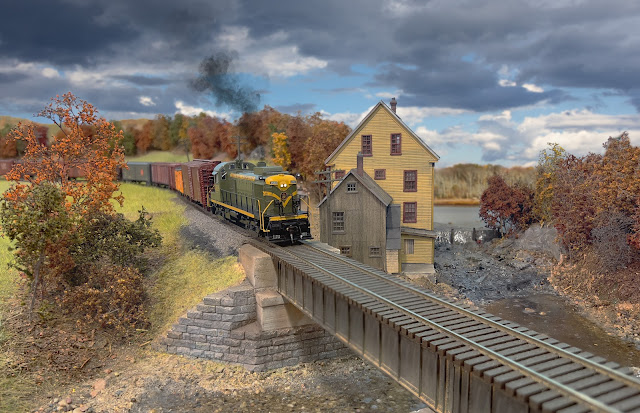
A nearly finished scene on Marty's layout

Marty's layout features a rural area in northern Vermont where the Central Vermont Railroad serves paper mills, creameries, and small towns. His layout is conceptually simple but executed to a high level. He has interchange with two other railroads too. One thing I like about his layout is how he has lots of country in-between scenes of operational interest. He has a large basement, but he resisted the temptation to fill it with track and clutter.  


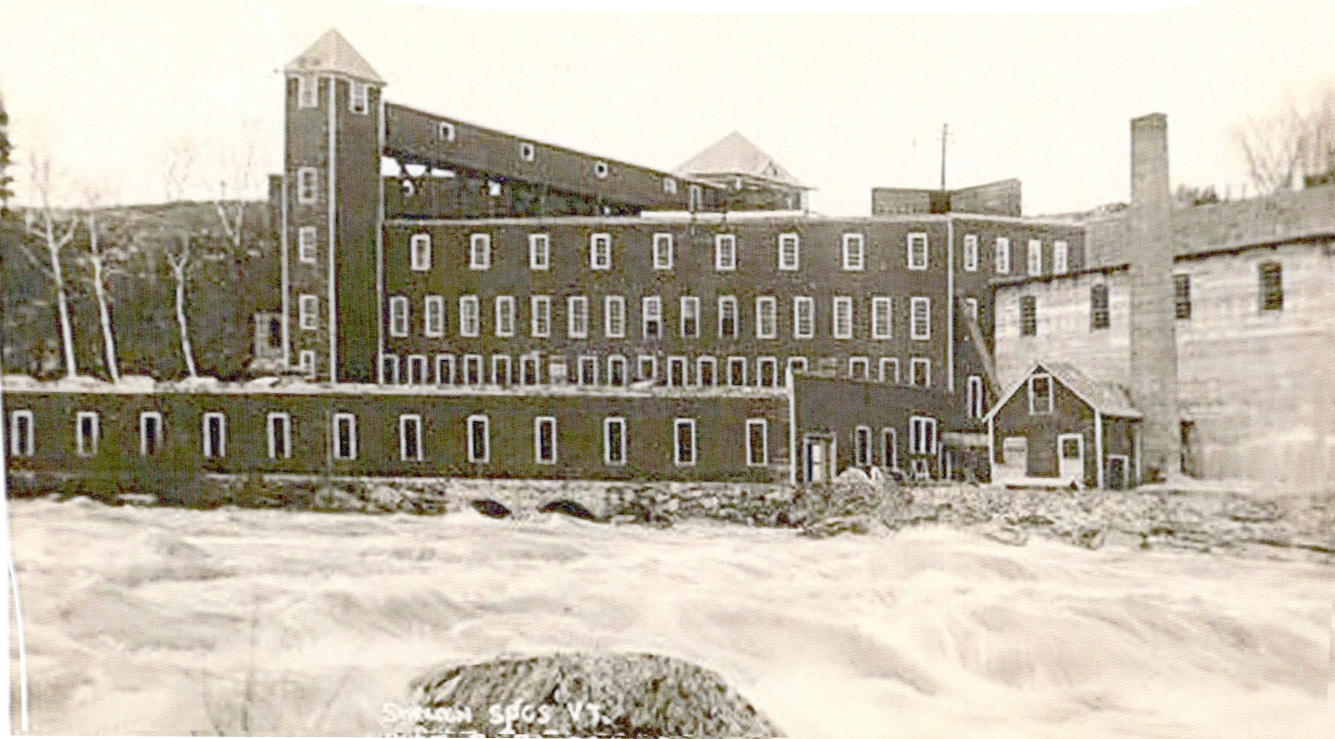
One of the highlights of Marty's layout will be his paper mill. I am helping his design the mill layout and build some of the structures for it so I may be a bit biased. However, he also has three other areas where lots of switching will happen. It will be a fun layout to operate. 

To learn more about Marty's layout see his blog at http://centralvermontrailway.blogspot.com/


May 21, 2023

The Texas Army and the Road to Rome

A Work in progress view. Lot more work to do. The vegetation on Monte Artemisio
 is deciduous forest with a lot of underbrush. There are ruins of a few castles
and churches on the mountain too. 

My brother, Rob,  and I have been working on another joint diorama project for the IPMS National Meet in Texas. This one involves a scene from World War 2 during the Anzio breakout. Dozers from the 111th Engineer Battalion of the 36th Infantry Division, AKA the "Texas Division,"  cut a road over Monte Artemisio south east of Rome. That allowed US Army tanks and artillery to by pass German resistance in the valley below and opened up the road to Rome.  Both Rob and I were former Army Corps of Engineer officers. We selected this battle due to the role of the combat engineers and the Texas connection. 

 The diorama will feature an armored dozer, a Sherman tank, a jeep and several figures. The dozer and tank were made by my brother. I made a new set of tracks for the dozer with my 3D printer as the ones that came with the model were impossible to assemble. 


Detailed trees on the diorama.
Perhaps the highlight of the diorama
will be the highly realistic trees with individual leaves. I am making these leaves on my laser cutter and they will eventually become products for Alkem Scale Models. 

Here is an excerpt from, "The Texas Army, A History of the 36th Division in the Italian Campaign,"  by R. L. Wagner, State House Press, 1991, describing some of the action.

"One of the most extraordinary combat engineering feats of World War II was the building of the 22-mile long road up and over Monte Artemisio and through the Alban Hills by the 111th Engineer Battalion. Walker viewed the road as vital to the supply of the two forward regiments of the 36th and above all should the enemy counter-attack and deny American use of the Nemi-Velletri highway as an artery through which to move tanks and TDs to stop any enemy armored thrust.

Engineering authorities at Corps and Army were skeptical whether the road could be built, but Walker had received the division engineer's assurance on the 28th that it was feasible; and he proceeded on that basis to issue a verbal order that the trail be constructed. The CO of the 111th Engineers accordingly gave the main job to B Company, commanded by Captain Orvil W. Crisman of Wortham, Texas, and preparations were underway on May 30 to begin work. Stovall, the division engineer, had stuck his neck a long way out when he gave assurance to General Walker about the practicability of a road over the 3,100-foot mountain. He had reconnoitered the area and satisfied himself that the earth there was volcanic in origin and therefore amenable to treatment by bulldozers. If it turned out to be some recalcitrant substance such as granite the mission would be seriously compromised. As he confided many years later:

"My extreme worry was the thick ledge of cap rock nearly 100 feet high. I had flown as near the area as low as the driver would take me and had examined the rock at the base that had rolled down the side. . . . All indications were that the rock was volcanic residue. The night of May 30 was nearly sleepless for me but I did feel some better after I got to the ledge and found it to be volcanic rock early in the morning of May 31.

The road itself followed roughly the trace of the 142nd Infantry. In the vicinity of Monte. Artemisio there were a number of trails already present, and the engineers made it their business, where possible, to improve those already existing rather than hacking out new ones. Company B minus one platoon, started work with their R-4 and D-7 Angle Dozers early on the morning of May 31 and widened the initial passage to allow forward movement of 2-1/2-ton trucks and tanks. Company B was followed closely by elements of a battalion of the attached 39th Engineer Combat Regiment who improved and marked the road. Before nightfall a total of ten Angle Dozers were at work on the road. Very little pick and shovel activity was required as heavy equipment did most of the work; the only delays were caused by snipers all along the route. Flank guards had to be posted to protect the Dozer operators, who could not hear the sniper fire over the noise of their machines.


May 7, 2023

Pig Pen Palace

Eclipse stands ready while a gun boat comes to shore to get resupplies.

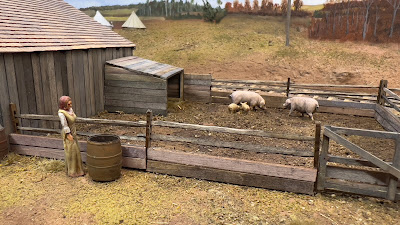
Improvements to the pig pen
The farms boys suggested that I make the dirt in the pig pen darker to reflect the typical mix of mud and manure found there. They also suggested some type of shelter for the pigs to get away from the weather.  

So I painted the soil with a dark umber color acrylic wash that I stippled on to the existing scenery. I made a small lean-to shed and placed it in the corner.  I put some straw on the ground so the pigs have a nice resting place. I also added boards to the lower edge of the pig pen to help keep the little porkies in the pen. 

Meanwhile, I noticed that the Eclipse headlight was not working. A brief investigation revealed that one of the CVs controlling the head light was somehow set to 63 vice 2 that it was. I don't know how it changed.

But the Eclipse was not done with me yet. As I was test running it, it started stuttering and growling. The source of the problem was the lead weights in the tender. The CAA joint where I glued them to the tender had failed. Some off the weights came loose and were interfering with the drive shaft to the rear truck. So I had to disassemble the tender once again. In the process, the red and black power wires broke off at the plug connection to the engine. So I had to resolder those. Good news,  all is back together and seems to be running well.  

Finally, I did some tuning of the double slip stub turnout in Falmouth. I noticed that the switch stand was not tightly mounted to the extended tie. So I used some 5-minute epoxy (which is really 30 minute epoxy) to reinforce the base. Once that was cured, the switch stand was solidly mounted,