A journal following the history, design, construction and operation of Bernard Kempinski's O Scale model railroad depicting the U. S. Military Railroad (USMRR) Aquia-Falmouth line in 1863, and other model projects.
I made three yellow pines tonight using preserved Caspia and static grass. I used prototype photos for guidance and added more branches than I have in the past. I gave them heavy coats of static grass secured with matte mod podge. I think these are the best I have made yet. I will make some more, but I will need a lot of deciduous trees for the forest by Mueller's Creek.
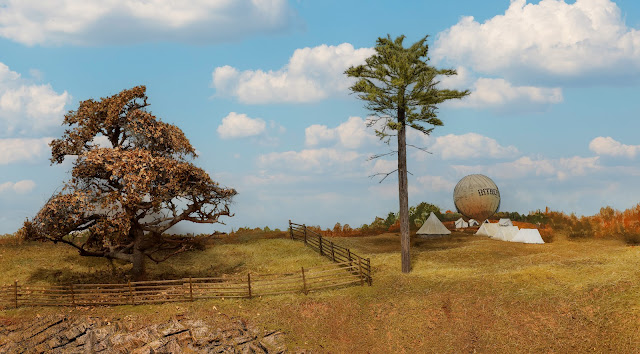
I decided the model balloon I was building was too big for the layout. So I had to make a smaller one. I quickly realized that with a small balloon, I really didn't need an actual model. A cut out against the backdrop would suffice. So I looked for a photo of the balloon that might work. I found a color photo of a replica balloon. I used it to create a small composite image. I printed it on card stock, cut out the sky, and then curved it across the corner of the layout. This was a lot easier than building the balloon model.
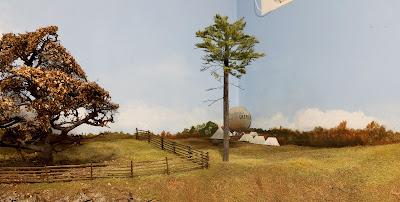
Here is what it looks like without a replacement sky. I plan to add a few more trees in the foreground to help break up the view of the sky in the corner. The tents are not glued down and sceniced yet.
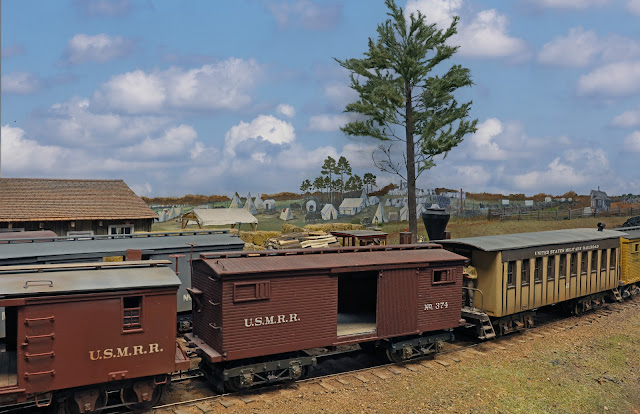
Next, I took a crack at making another lone pine for Falmouth. I was not happy with the first one I made a few weeks ago. I had ordered several batches of preserved caspia from a vendor in Utah. They finally arrived, so I made a new tree using a pine dowel, caspia twigs and static grass. It was much faster to make and looks a lot better. I plan to us this technique for more yellow pine trees in this section.
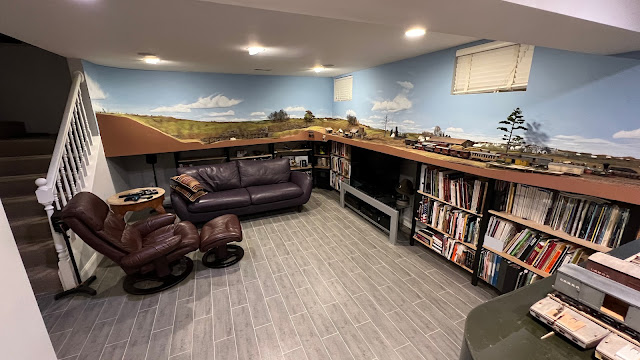
Finally, I rearranged the furniture in the room. I placed the couch alongside shelves under the bridge scene. This opens up the center of the room. The couch doesn't interfere with operations as there is no need to work the train as it comes out of the tunnel and across the bridge.
Eight members of the ACWRRHS, Thom Radice, Charlie Taylor, Phil Reuhl, Marty Vaughn, DC Cebula, Ken Starcher, John Bopp, and David Bjorkman, visited the Aquia Line today. We concluded a successful day of operating the railroad in morning and afternoon sessions. Everyone seemed to have a great time. The railroad ran well. I spent about an hour the night before giving all the track a thorough cleaning. That helped with the DCC engines like Haupt. The new battery in Whiton worked well. Fury also ran well.
I was concerned about the number of cars being insufficient, but everything seemed to worth well. The sidings were not so choked with cars that might cause delays. We ran trains ranging from 10 cars to an engine leaving Falmouth light but making pickups along the way.
Everyone agreed that the new Falmouth is a big improvement to the layout. This railroad is simple in design, but relatively complex in operations when you consider the link and pins, proper whistle signals, using the telegraph, maintaining the paperwork, and deciding how to do the switching moves. The Time Table and Train Order aspect is fairly simple, but still has it nuances.
The infamous 10-minute rule came up for discussion again as many trains were running late.
"No Train having the right to the Road must leave any station or passing place, where by the schedule it should pass a train, until Ten Minutes after its own time per schedule; and this ten minutes (allowed for variation of watches) must be observed at every succeeding station until it shall have passed the expected train; and no portion of the ten minutes allowed for variation of watches must be used by Trains running in either direction. "
Phil suggested that the first phrase means the rule applies to the priority direction, which is southbound i.e. loaded. So we now interpret this phrase to mean that southbound trains in the superior direction can pass a planned meeting point if the inferior train they were supposed to meet is more than 10 minutes late.
I love how operators find new ways to operate the layout, ways that I did not think about.
We did detect some problems.
Whiton was shorting intermittently in the tender trucks. We could see sparks. Because it was battery powered, it kept right on chugging, but I need to fix the problem. Charlie suggest insulating washers.
One turnout switch stand broke as I did not properly clear the ballast and glue from it. Luckily it was not in a critical spot and we could operate by had.
The telegraph signal from Falmouth was at times weak. I don't understand how that can be as there is a power supply in the telegraph office to power the sounder. So why Falmouth was weak while the others were fine is a mystery to me.
Here is a short video of the guys working the railroad. Thom Radice looked quite dapper in his period attire. Thanks to everyone for attending. Now I look forward to a long nap. The last few nights were long and the mornings early!
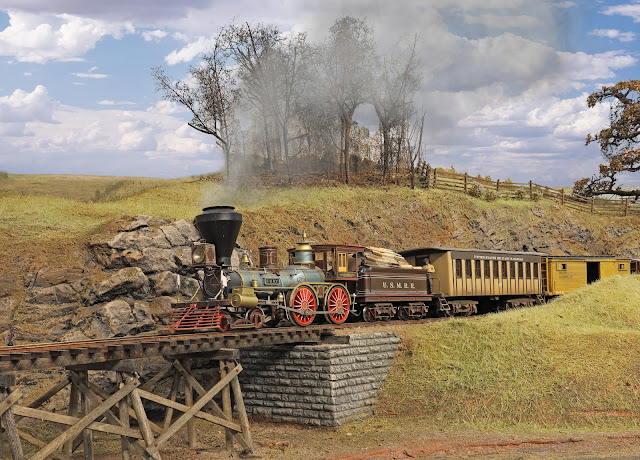
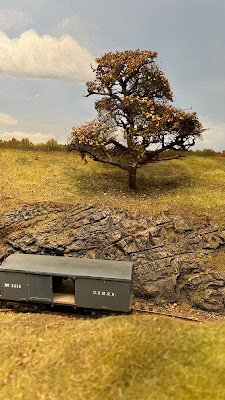
I used one of the dead bonsai trees that Samir gave me to create a marcescent oak, in this case a pin oak. My brother suggested trimming the branches to give it to have a rounder crown. That worked. I used a combination of Silfor Plane Tree foliage autumn, 933-24, and furnace filter sprinkled with Hudson and Allen forest litter to make the oak leaves on the tree. This tree is broad, so it was tricky finding a spot that worked. The hillside by the balloon camp worked the best.
Then I made a set of background trees from Scenic Express Supertrees and pieces of a witch's broom. The witch's brooms are available for sale this time of year due to Halloween. This year the broom I purchased has a pumpkin spice scent. I hope that wears off as it is a bit much.
Finally I added a split rail fence and some goldenrod weeds from Sifor to embellish the scene.
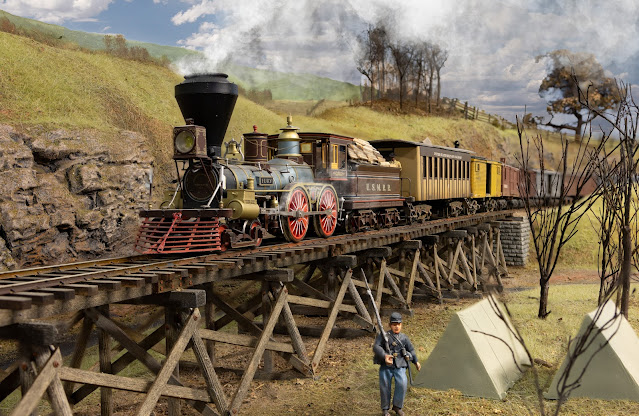
I am experimenting with trees or bushes in the foreground by the trestle. I added a few pup tents and a guard too. I don't want the trees to be too big as I don't want to interfere with long photos of trains on the trestle.
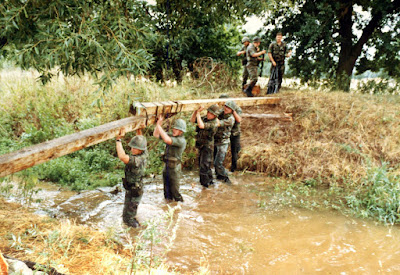
Those are probably the two most important equations I learned at US Army Engineer Officer Basic Course. The instructor told us to remember them when the Colonel wants to fix the mud in front of his tent. Don't add dirt, fix the drainage.
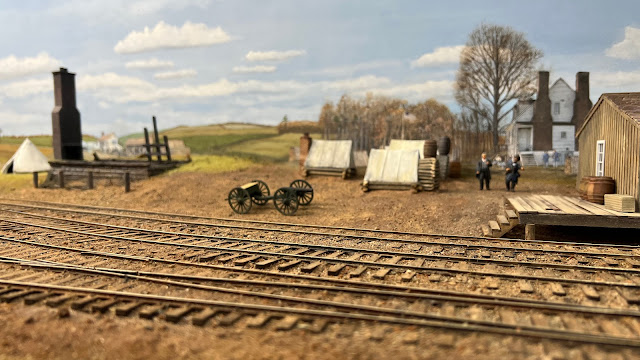
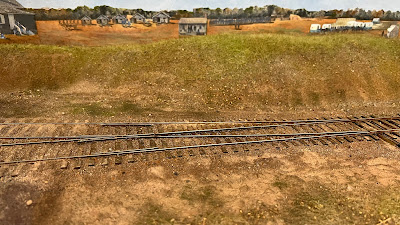
Tonight I put the first formula to good use as I finished ballasting and applying a base coat of scenery on the new Falmouth. I wanted to make it look like mud.
I made a secret concoction of 1/3 Amby's clay, 1/3 tile grout, and 1/3 Old Dirt from Scenic Express. I processed Amby's clay in my blender to get as rid of as many clumps as possible. The Old Dirt from Scenic Express is great as it doesn't have sparkly mica in it. Unfortunately, the new bottles of dirt I purchased from them do have mica.
I applied the secret formula to the layout. Then I hit it with wet water and then dilute glue. I used rubbing alcohol as a wetting agent. It has the benefit of drying faster too. The tile grout helps lock all the dirt and clay into a solid layer.
It's nice to be finished. Tomorrow I will be cleaning track and testing everything for post ballasting problems.