A journal following the history, design, construction and operation of Bernard Kempinski's O Scale model railroad depicting the U. S. Military Railroad (USMRR) Aquia-Falmouth line in 1863, and other model projects.
©Bernard Kempinski All text and images, except as noted, on this blog are copyrighted by the author and may not be used without permission.
-----------------------------------------------------------------------------------------------------------------------------------------------------------------

January 20, 2011

Tenting Tonight

Tents and figures start to bring the scene to life.
The order I placed with Renedra Miniature in the UK arrived.  I ordered tents and figures from their camp scene in 1/56th scale. They offer three different types and sizes of tents so I ordered an assortment to evaluate. I also ordered two sets of their camping figures.

I did a quick paint job on the tents to see how they looked. I primed the injection molded plastic (styrene I think. It is definitely not the flexible plastic that you find in Airfix and Hat figures sets that is very hard to paint and prone to chipping) with a coat of grey and then a coat of flat white. I painted the tents with several off-white shades of including Ceramcoat Acrylic Sandstone, Mudstone, Anthracite and White. The overall color I was shooting for was a dirty off-white. These tents have been  in service for several months and should be starting to show dirt and wear.
Camp scene at Stonemans Switch


The Reneda Sibley and small pup tent work well in the background. The tents take paint nicely. Some tent ropes, laundry and other details will add a nice touch.
Soldiers relaxing in front of a Silbey Tent
The Renedra tents are sturdily molded. They should hold up well in gaming service. Some of the tents come with the flaps open and the opportunity to super detail them is there.  The tents include a camp fire and some cots too. Being designed for 28mm wargaming, they are small for 1/48th scale. The small pup tent and the conical Sibley tent in particular are small for use in O Scale scenes. A full scale Sibley tent would be 4.5 inches in diameter in O scale. They will have to be used in the background for forced perspective. The larger rectangular  tent is well proportioned for O Scale and came be used in the foreground. They sell a pack with just this tent type, which helps us O Scale ACW modelers.


SMR Trains  engine crew compared to other figures.  In the back are the large Renedra rectangular tents.

While I had the paints out, I touched up the paint jobs on two SMR engine crew figures. These are 1/48th scale figures designed to fit in SMR locomotives. The figures are well sculpted with only a few flaws such as a pit in the inside of the elbow of the engineer and some rough facial detail on the same figure. Both figures have well done faces and paint up well other than the facial flaw I just mentioned.  The pants folds don't seem to flow with the figures very well and they are not too deep. Thus it is  probably not worth spending too much time to shade them to a contest quality.  The vests are well done, as are the hats. The two figures are well proportioned and have that "lean" look that many ACW personnel displayed. They come pre-painted, but I added some additional shading and detail. In the photo above you can compare the stock and repainted figures.

I also picked up some Artista figures. These are well proportioned for O Scale. They just need to be back dated to the ACW era.

January 17, 2011

The Not-So Troublesome Trucks

In between fighting a nasty cold and catching up on Alkem Scale Models orders, I did a little development work on my O Scale truck design. My objective is to make the overall width of the standard O gauge trucks as narrow as possible. This will allow the car bodies to hang over the trucks more prototypically.  Standard O gauge wheel sets are already about 0.0729 inches too wide due to the wider track gauge. Adding another 0.14 inches between the outside face of the wheels and the inside of the side frames to fit the Intermountain axles was making the trucks too wide. I decided to reduce this distance. To do this I had to file about half of the needle point off the end of the axles on my Intermountain wheel sets. I am using IM Wheel stes because they are less expensive than the alternatives. I looked at NWSL wheels but they are more than double the cost.


The photos show the results. The revised standard gauge narrower trucks sit between the original wide standard gauge trucks designed to accommodate the full width of the Intermountain axle length and a P48 truck. As you can see the narrow design is not quite as narrow as a P48 truck, but about 0.090 inches narrower than the earlier standard gauge truck.   Note the narrow truck doesn't have brakes but the other two do.  The working brakes will still work with the narrower design without modification.

All three cars roll freely. Because of the axles rests on the taper the wheel sets can move laterally a bit in the trucks, but that doesn't seem to increase rolling resistance.

Looks like these might be ready for production.

January 13, 2011

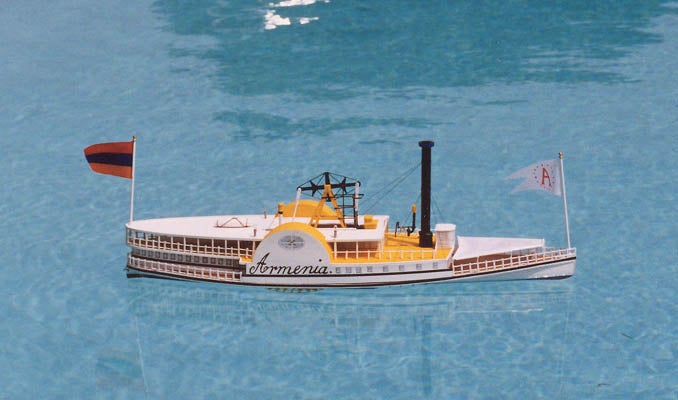
SS Armenia at the Mariners' Museum

In late August 1999, my family and I visited the Mariners' Museum in Newport News. While there I took a few photos, mostly shots of the kids. These were filed away in slide notebook.

I happened to be looking through my non-digitized slide notebooks for another purpose and came across these shots of the SS Armenia, a Hudson River side wheel paddle steamer from the 1850s. The model was on display at the museum. There is a set of plans available for the Armenia Paddle wheel steamer, so it is somewhat popular with model builders.

It is amazing, but this was the only ship model I photographed while there. Coincidence or a foretelling of my current project?

I took these shots hand held with 64ASA slide film. Some of them came out pretty well considering the conditions.


The SS Armenia was a popular boat at the time. Here is a brief history from an auction of a painting of the ship. http://www.christies.com/LotFinder/lot_details.aspx?intObjectID=5036924

Antonio Nicolo Gasparo Jacobsen (American, 1850-1921)
The Hudson River Day Line steamboat Armenia passing Fort Lafayette, New York Harbor
The Hudson River Day Line steamboat Armenia was built in New York City in 1847 by Thomas Collyer. Registering 528 tons she measure 185 feet in length by 28 feet in breadth by 8 feet depth hold. At her launching she was the largest and finest steamship on the Hudson River. She offered luxurious on board amenities, including restaurants, barber shops, parlors and live music which included a steam calliope- a musical instrument intended to attract passengers from competing steamers. She entered the New York to Albany day service in 1848, but was regularly withdrawn for other routes, and it was some years later that she began a number of continuous seasons on the run. She was a fast steamship, but by 1859 larger rivals had entered service and the decision was made to lengthen Armenia to 200 feet.
On May 1st, 1869 she opened the new and shorter New York to Rondout route and continued to be a popular vessel. In 1875 she opened the New York to Albany season, and the following year ran between Brooklyn and Newburgh. In 1883 she was sold to the Henry brothers & Co. of Baltimore and used as an excursion vessel between Washington, D.C. and Lower Cedar Point, where the Henrys owned a hotel and resort. While laid up for the winter at Alexandria, V.A. she caught fire on January 5th, 1886 and was scuttled to put out the flames.

Armenia painting by James Bard
James Bard, a famous 19th century American maritime artist,  also did a painting of the Armenia. The Athenaeum web site has a 106 examples of James Bard's paintings available for viewing. It's worth a visit if you like side wheel paddle steamers and other period ships.

Here is a R/C SS Armenia built by Sargisko at
http://www.rcgroups.com/forums/showthread.php?t=564557  He posted some more photos of the model at that link.


The Mariners' Museum was really very good. Since it has been over 10 years, perhaps a new visit is in order. I have read that they have done a lot with the USS Monitor restoration since I was last there. That in itself makes it worth the trip. One bummer I encountered in dealing with the museum was that the they were totally unwilling to help me research ship plans when I contacted their research department last year.

January 9, 2011

Back in Virginia

CINCHOUSE and DEPCINCHOUSE at the front
desk during a quiet moment
We are back from Prototype Rails 2011 at Cocoa Beach. We just made it through Atlanta before a massive storm with snow and ice was coming in - whew!

The meet was quite enjoyable. It was great to see everyone. The weather was pleasant, if a bit cool. The talks I went too were quite good.

 I presented my talk twice and it went over very well. I concluded the talk with a demonstration of the working brakes on a box car using the photo etched parts I developed. To share in the fun, I made this brief video showing the demonstration.


January 2, 2011

Benchwork Finished

The New Year marks the end of heavy construction on the layout with the installation of an 8-foot shelf under the wet bar.  I was able to put away the carpentry tools and get rid of many of the wood scraps and pieces I will no longer need.
The wet bar is painted. The water surface has a coat of primer,
while the base is painted in the final color to match the room walls

I painted the wet bar with primer and then put two coats of room color on the base.  The trim pieces are white, so the support structure of the wet bar looks like the rest of the room. I installed dark blue curtains on the inside of the wet bar. This allows easy access to the storage underneath, while also making a neat appearance. AW inspected progress and gave it the CINCHOUSE seal of approval.

On Sunday Gerry Fitzgerald drove up from Charlottesville to do some track laying. He is in between layouts right now as he works as a history professor at UVA and lives in apartment. His previous layout was a 20 x 20 feet freelanced model of a C&O  branch in the Richmond, VA area. He was the former editor of the LDSIG Journal as well as for the Seaboard RR Historical Society.  He likes laying track, so he took on the job of spiking track by the tunnel portal at Brook. The track on the curve here experienced some kinking due to seasonal humidity changes. Actually it rained today and the kink was less noticeable, but when it is cold and dry it popped out. With four spikes per tie, the kinks should be resolved. He got a good meter section of track spiked.

Gerry spiking rail at Brook.
While Gerry worked at Brook I did a variety of jobs including spiking from Stoneman's to Falmouth.The track should be completely spiked in this area now.

I checked a problem area at the north end of Potomac Bridge. It seems like the bridge expanded a bit and threw off the gauge at the tracks at the north end. I will monitor that situation and determine if more drastic measures are needed.

Next I soldered some feeders to rails that I missed the first time through. My plan is to have feeders on every section of rail. I also started using a cutoff wheel in my moto-tool to cut more expansion gaps in the rail to allow for seasonal expansion.

Finally I replaced one of the florescent fixtures at the far end of Potomac Creek. The original light fixture failed, probably due to a ballast problem. I been having problems with severalof these shop light fixtures.  I replaced the two-tube shop light with two smaller fixtures under cabinet style light fixtures. They should be easier to replace if they fail.

Once we finished up, we cleaned the rails and ran a four car test train from Aquia Landing to Falmouth. We dropped off a car at Brook, then continued to Falmouth. There we cut the engine off, turned  it on turntable, and reconnected to the  train.  We took the train back to Brook where we parked the it on the siding for the night.

Gerry tests out the operators pit between Burnside wharf and Aquia Landing. He liked the space.