A journal following the history, design, construction and operation of Bernard Kempinski's O Scale model railroad depicting the U. S. Military Railroad (USMRR) Aquia-Falmouth line in 1863, and other model projects.
©Bernard Kempinski All text and images, except as noted, on this blog are copyrighted by the author and may not be used without permission.
-----------------------------------------------------------------------------------------------------------------------------------------------------------------

March 20, 2012

Backdrops for Potomac Creek Station

Potomac Creek Station in coming along

I finished painting the backdrops for Potomac Creek Station. My intention for this area is to show a fairly extensive Army camp.  There is also a road leading into the backdrop that will feature a long line of soldiers coming to the station.

I first had to touch up the base sky color because  plaster and paint splattered it during scenery construction. Then I added a distant low line of white haze and clouds. Next came the terrain. I prefer to paint the terrain on the backdrop when the base scenery has been installed. That allows me to match the colors better.

I paid particular attention to the perspective. I avoided placing any large objects on the coved (curved) part of the backdrop. That helps avoid distortion when one views the backdrop from an oblique angle. It also makes the corner terrain look more distant.

To depict the forest on the backdrop, I used some of my model trees as a guide. That way the trees on the backdrop will look like the 3D modeled trees. I continued the road on the backdrop being careful to match the colors and get the perspective right. Adding a corner where the road hits the backdrop helps manage the perspective. I was very happy with the way the road turned out. The transition is quite effective.


Here is the scene with some of the unpainted trees back in place.


Overview of the scene in progress. Platforms, supplies, tents, log cabins - much more detail still to be added.

For the scene behind the encampments I used some prints from Brain Kammerer's artwork. Because there was a swale in the terrain I need to leave extra paper under the printed art to avoid an unsightly and hard to disguise line. This way the paper extends below the point where the model terrain hits the wall. Then I used my paints to blend the print with the foreground scenery. I can't say enough how useful Brian's artwork  has been. Thanks again to Brian.


To create the illusion of a bigger camp. I used a scaled down photo of my model huts on the backdrop.

I built just 7 model huts. I laid them out in a company street. Then I  took a picture of the huts looking down the street. I printed the photo, cut it out and put it on the backdrop on top of Brian's artwork. Voila - 7 huts just became 14.

I printed Brian's background scene at a smaller scale making it look  further back.


March 19, 2012

Detailing Potomac Creek


John Crabtree stopped by to visit the layout last week. He is a Army Major teaching a course on strategic logistics planning at the Defense Logistics Agency. We had an interesting discussion focusing on logistics in the civil war. Using one of my box cars and the army bread boxes I made, we concluded that a box car would "cube out"before the weight of the army bread boxes would exceed the 10 ton capacity of the car. We estimated that the car could hold about 4.5 tons when loaded with army bread.


Wall tent. The figures are by Sash and Sabre
John got to see some of the hooches I was building for Potomac Creek scene.


Later in the week I built a 4x8 officer's wall tent with a fly. I used bond paper for the main tent and cooking parchment for the fly.  The tent took about 4 hours to make, but hopefully subsequent ones will be faster.

Wall tent made from paper, some strip wood  and thread
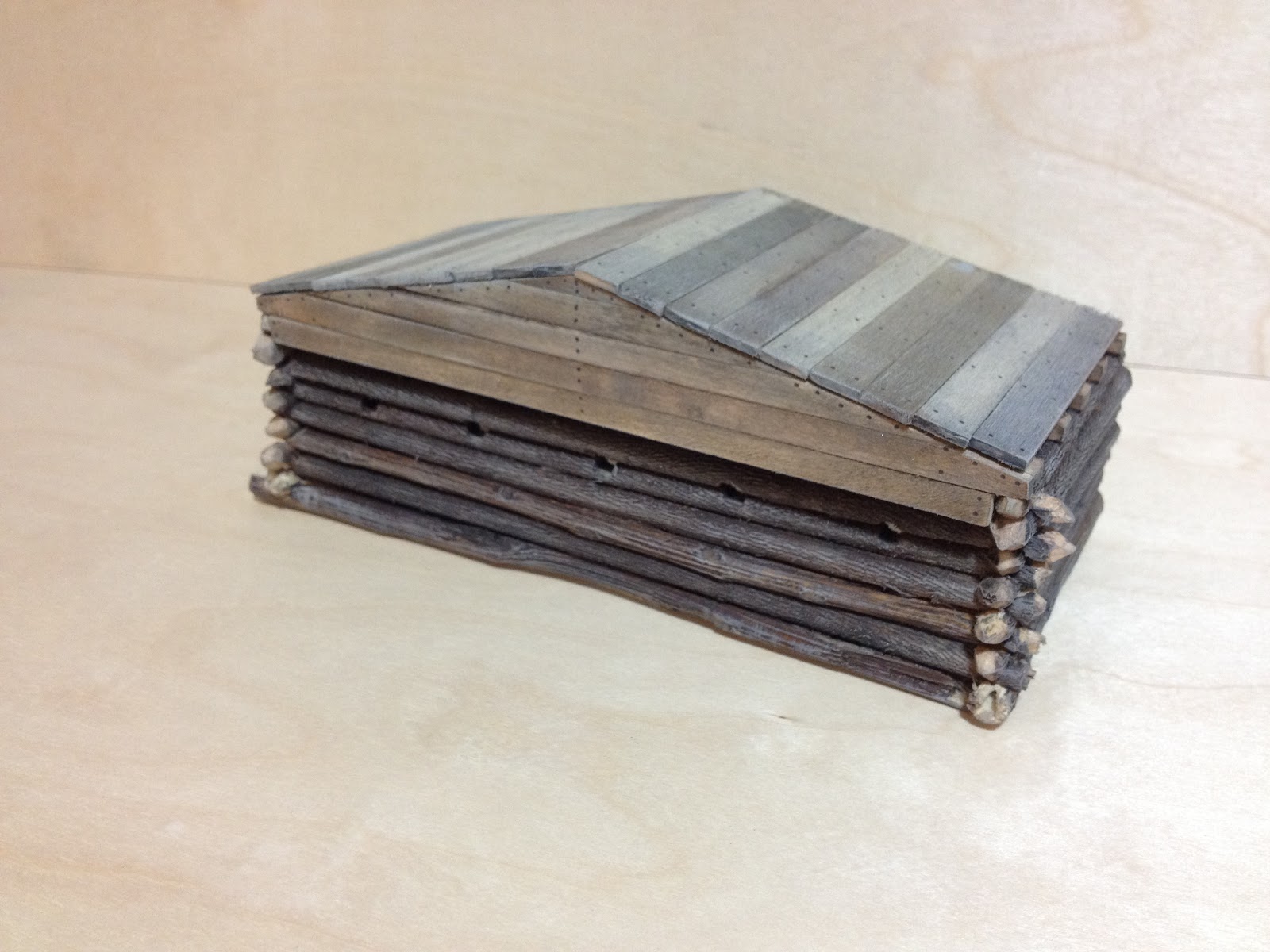
exterior view of blockhouse before installation

An interior view of the blockhouse.
 I only have the one distant shot showing the blockhouse, so I had to do some "imagineering" on how it was built. I consulted my Eric Sloane books and the HABS/HAER for examples of log cabin construction.

I added extra rafters, as this building would be built sturdy in case it took fire.
Here in the reverse view of the installed blockhouse.
I installed the blockhouse on the hill top behind the bridge.

I made stockade fences using twigs I collected from a field near my house.


Aisle side view


The infantry squad inside are 28mm scale figures, but measure more like 36mm high, nearly O scale. I am not sure who made them.

The soldiers are practicing their musket drill while inside the blockhouse. The low ceiling could interfere with the ramrods during loading, so the men are practicing to familiarize themselves with defending the bunker.


Since the interior is visible, I will detail it.
I will probably add a plank floor to the inside of the blockhouse as well as some other details.

March 14, 2012

Lincoln Logs in O Scale

Using photos of the hooches from the White Oak Civil War Museum, I built some winter quarters. I used straight sections of twigs I collected in a field near my house for simulate the logs. I found it easier to cut a sub-structure out of cardboard to use in building up the log sides. I used CAA to secure the logs. For the mud chinking between the logs I used Elmers wood putty tinted with Spice Brown acrylic paint. Though I pre-painted the logs, I found I had to repaint everything once the chinking dried.

I tried bond paper, tissue and cooking parchment for the tent fabric. I think the cooking parchment worked the best.

For those that don't know,  "hooch" is the Vietnam era slang for a field expedient shelter built by U.S. Army soldiers.

Ipad showing prototype photo for reference. The twigs are prepared for construction.
Lincoln Logs were some of my favorite toys as a child. Building these hooches reminded of them. 

How the scene is shaping up. I can't decide how to treat the spot where the wagon
would cross the tracks. I'll probably make some kind of corduroy road or planks.


Even with wet ballast, it is starting to look good.  Next up is to paint the backdrop in this area.

March 13, 2012

Pink no more

No, this is not a commentary on McDonald's meat simulant. It means I have covered the last pink section of terrain in the main layout room. I still have a bit of pink left at Aquia Landing, but it is all gone in the main room. 

I painted the section behind Potomac Creek siding and added the base coat of scenery.

While the scenery base layer dried, I took a set of cannon wheels and made ruts in the road as it approached the siding. They look good while they are wet. We'll see how they look when they are dry. 

While the scenery was drying, I put some of the scenery items temporarily in place to see how it will look.  So far so good. It will be a lot of fun to detail this scene.

Making ruts with cannon wheels


Some scenic elements in place - looks good. More trees coming.

It is almost time to install the marching regiment. The figures will come off their bases and be glued in place four abreast.

These are 28mm scale wagons. The left is by Old Glory, while the right one is by Perry.

There will be an encampment behind the station with as many winter cabins as I can fit.

March 12, 2012

Williamsburg Trip, Day 2 Mariners' Museum

Worm fence in Colonial Williamsburg
Like Day 1, Day 2 dawned bright and clear.  I went for a morning run through Colonial Williamsburg. I forget how wonderful that place is. I didn't see too much directly applicable to  my ACW project, though I did get a nice photo of a worm fence.


Company Street
When I arrived at the Mariners' Museum I was reminded that this was the 150th Anniversary of the Battle of Hampton Roads. When I picked the date for this trip, I knew this was happening, but I forgot.

So I was pleasantly surprised when I arrived. The parking lot was nearly full as the museum had scheduled all kinds of extra activities, especially with  reeanctors. There was also a conference going on for naval historians. There was so much going on that I am sure I missed a great deal.

ACW era camp fire
The museum had expanded quite a bit since my last visit about 12 years ago. The focus of the expansion is on the recovered USS Monitor turret, engine and other artifacts. It is great that they are doing this important work, but I got the impression that the Naval Museum of the Civil War in Columbus, GA has more information and better dioramas about civil war naval subjects. The Mariner's Museum also covers other subjects too, such as the ships of the Chesapeake, general maritime history from antiquity to current and a large display of small craft that I skipped this time as there was so much else going on. The exquisite Crabtree model collection is still there for viewing.

Cooking demonstration (and eating too!)
Numerous reenactors had set up camp around the museum.

A detachment of the 99th New York Infantry was there representing  soldiers from that unit that were on the USS Cumberland when she was engaged and sunk by the CSS Virginia. D Company of the 99th NYSV Infantry unit suffered 10 killed, 15 wounded and 7 missing in that battle on March 8-9, 1862.

The Confederate infantry had set up quite a nice encampment with a company street, stables and a mess area.

An African American woman demonstrated cooking techniques. A blacksmith and gunsmith also were conducting demonstrations.

There were representatives from the US Colored Troops, Signal Corps, Naval Officers and seamen from both sides, and a Confederate artillery battery from Norfolk, which is still active as a U.S. National Guard unit.

Inside there were several other special exhibits including a group trying to make a park or trail connecting the ACW entrenchments near Yorktown, women sewing period clothing, museum staff advertising their research capabilities, people hosting quizzes (I got 100 percent right), a couple authors signing books, representatives from NOAA displaying work to make the Monitor wreck site a Federal Preserve, a group dedicated to shipwrecks of the mid-Atlantic,  reenactors of the ACW era Christian Commission,  and a spy hunt for kids.

(If you are in any of these photos and would like your name to be listed, please send me a note.)

One of several Monitor Turret mock-ups on display


Detail of a stanchion used on an ironclad
A gun from the Monitor being conserved


Signing up recruits


USN Reenactors on the full-scale outdoor mockup of the Monitor

A couple posed for their photo

Norfolk Light Artillery Blues firing a 12 pound howitzer at reduced charge

I shot some video too and plan to post that later this week or next.