A journal following the history, design, construction and operation of Bernard Kempinski's O Scale model railroad depicting the U. S. Military Railroad (USMRR) Aquia-Falmouth line in 1863, and other model railroad projects.
©Bernard Kempinski All text and images, except as noted, on this blog are copyrighted by the author and may not be used without permission.
-----------------------------------------------------------------------------------------------------------------------------------------------------------------

November 30, 2010

My ship(s) has come in

Today brought a double treat to the mail box. UPS delivered my copy of the Dumas Mt Washington, and USPS delivered a package from Bob Santos.


No, it is not a mini-kayak, it's just the plastic
hull to the Mt Washington kit.

Here Alicia is posing with the vacuum formed plastic hull of the Mt Washington. To put the model size in perspective, she is 5'8" inches, As I said, this model is big! The kit is very much a craftsman style kit. Aside from the castings and some vacu-formed parts, the rest of the kit is strip wood and styrene.


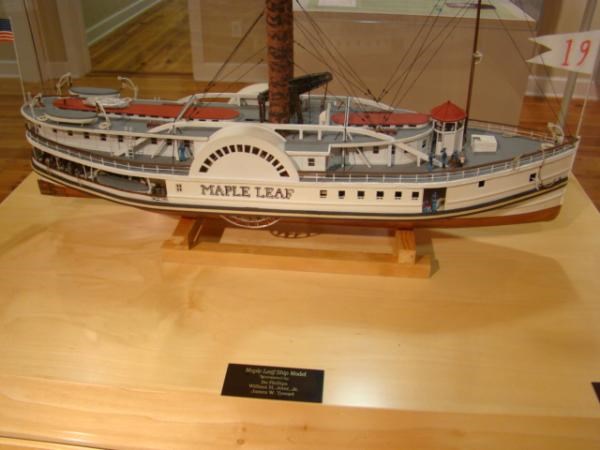
The package from Bob Santos described a 1/96th scale model he built of the SS Maple Leaf. Bob is both a model railroader and a professional ship modeler. Check out his gallery at Santos Models. He has some nice work on display there.

A photo by Bob Santos of his 1/96 scale model
The Maple Leaf is probably the most famous (infamous?) cargo ship from the civil war as it sunk after hitting a torpedo in the St Johns River in Florida.
The wreck was in shallow water and many artifacts have been recovered from it.

The Maple Leaf was originally built in Canada, but sold to a US firm in Boston and then leased by the US Government during the civil war.

There are also models of the Maple Leaf at two different museums in Florida. The Jacksonville Science Museum has a nice 1/48th scale model of the ship in their collection. I may try to visit that museum when I go to Florida in January. There is also a maritime museum in Jacksonville that I plan to check out.



You can learn more about the Maple Leaf at the following Maple Leaf Shipwreck web site.

The Maple Leaf was 181 long, about the length of the Mt Washington.  Since I now have the Mt Washington kit, I'll probably aim for a smaller second paddlewheel steamer for my dock.  The Maple Leaf has a hog back frame, a feature common on pre-war steamers.  That was a feature I'd like to show in a model.


In   researching steamships I found another very similar ship that was about two thirds the size of the Maple Leaf. This is the SS Mystic. It was built in 1852 in New London, CT. At 154 tons, 117' length and 25 feet bean, it will better fit into my dock scene along with the Mt Washington and other planned ships (maybe even an ironclad).

The Mystic also has an interesting history. William Miller of New London, CT built her for the commuter run between New London and Mystic in 1852. In 1854 it was sold and served Norwich and New London, Mystic and Stonington. In 1860 it moved to Gloucester, MA where it made the run to Boston.

In 1863  the US Army Quartermaster Department leased her for a rate of $150 per day. It transported troops and supplies on the Virginia and North Carolina rivers. In May 25, 1863 the Quartermaster bought it outright for an undisclosed price.

On April 15, 1865, a detachment of 67th North Carolina infantry surprised her near Maple Cypress on the Neuse River, NC and burned her.

National Park Service Fredericksburg Blog

I recently discovered a nicely done blog by staffers at the Fredericksburg National Park, though the blog is unofficial. Eric Mink,  Noel G Harrison, and John Hennessy are the primary contributors. They cover all aspects of the civil war in the Fredericksburg and Spotsylvania region. They have posted several items that are directly applicable to my layout. Some that I found interesting and useful are:

Aquia Landing Slides a Powerpoint slide show with pictures of Aquia Landing and some useful maps, but I believe they have the location of Yuba Dam and Burnside's wharf backwards.

Aquia Exposed a view of the pier remains at Aquia

The Evolution of Aquia Landing  A nice summary of Aquia Landing.

The Railroad Bridges over Potomac Creel - Bean poles and trusses  The comments that accompany this post are quite good and include links to the original hand written letter Herman Haupt wrote describing why he built the trestle.

I reported this incident in my earlier post,  Haupts encounter with Hooker, but this link will take you to scans of the original letters.


Their post on the Washington Woolen Mill also provides a lot more information about this mill that I mentioned in an earlier post.  It was actually in Fredericksburg, but I may relocate this to Brook on my layout. I already have an N Scale model of the Charlottesville Woolen Mills that I could use in the background for forced perspective, or I could build a model of the Washington Woolen MIll mill.

November 27, 2010

Ship Kits for O Scale Civil War Layouts

This is a list of ship kits I found appropriate for an O scale civil war Potomac River scene.

Dumas - Mt Washington - paddle side wheel steamer 1/48
Bluejacket - Smuggler  -schooner 1/48
Bluejacket - Seguin - tow boat 1/48
Bluejacket - America - schooner 1/48
Bluejacket - Jefferson Davis - Baltimore clipper revenue cutter 1/54h scale
Corel - Shenandoah - Sloop 1/50
Corel - Flying Fish - Schooner 1/50
Corel - Ranger - Revenue Cutter 1/50
Artesenia Lania- Scottish Maid - schooner 1/50 (can be hard to find now)
Model Expo - Benjamin Lantham - schooner 1/48

Model Expo - Chaperon Rear paddle wheel steamer 1/48 (not appropriate for use on the Potomac or James River, but ideal for western river scenes).

The Benjamim Lantham is probably too modern for an ACW era scene. The Smuggler would be a better fit. According to Jeff Marger at BlueJacket Ship Crafters,
"SMUGGLER was built in 1877, and designed before then. Her hull form is entirely consistent with an 1863 time period. After all, the extreme clippers were built in the early 1850’s! You may not wish to use this type of hull, but the time frame is consistent with your layout. "

Bluejacket Smuggler solid hull model cut at water line
None of these kits are water line models. They all include full hulls. Converting a full hull kit to waterline can be tricky. The techniques used depends on the kit construction. The most common kit types are solid hull, plank on frame and plank on bulkhead. There are also styrene and fiberglass hulls from the radio controlled ship hobby that might be usable (such as the Dumas Mt Washington).

Solid wood hulls can be cut with a power saw if appropriately supported. My brother converted my Smuggler to water line by cutting the hull on a band saw. He screwed the hull to a plank, making sure it was square and ran it through the band saw. Then he used a block plane to flatten and true up the bottom surface as the saw cut was a bit rough.


Plank on Frame and Plank on Bulkhead model types compared

Admiralty Style Model
If you are new to ship models you should be aware that there is a difference between "plank on frame" and "plank on bulkhead" models. Plank on frame models have each frame from the prototype accurately modeled. While this creates an impressive model it is much more difficult and time consuming to build. Frequently modelers that build plank on frame models leave some of  the planking off to make the frames visible.   No sense hiding all that work! The Royal Navy Admiralty Models are great examples of this type of model building.  Plank and frame models are really not well suited for conversion to water line models.  These kits are usually more expensive than other types because they include a full representation of the actual wood frames used in a ship. It would be a shame to cut away these frames to make a water line model.

Plank on bulkhead models use fewer transverse bulkheads secured to a longitudinal board (like a super keel) to simulate the hull. The bulkheads are usually solid die cut or laser cut parts. The hull must be fully planked to hide these non prototypical parts. From outward appearances, the hull is indistinguishable from a plank on frame hull.  Note how it would be hard to show the interior of a plank on bulkhead model, say through a hatch or open top, as the non-prototypical bulkheads might be visible.

To convert a plank and bulkhead model to water line, you have to cut each bulkhead at the water line. That is easy enough. But then adding the planks will be tricky as some planks will lack support. You will also probably lose most of the keel. So to keep the planks properly spaced, you may have to build a new waterline "keel."

For some model ships, it might actually be easier to scratch build the water line hull from wood, styrene or even a slab of extruded styrene foam, and then use the kit parts for the superstructure. This is especially true of riverine steamships as their hulls have little free board and resemble floating planks. The Monitors ironclads being the most extreme examples of this phenomena.

November 23, 2010

More artwork for the Aquia Line

The Library of Congress posted some new (to me at least) drawings  of scenes on the USMRR Aquia Line.
Train crossing the Potomac Creek bridge. The revetments on
the right were labeled as abandoned Confederate work

A pencil drawing of Aquia Landing
The destroyed Potomac Creek bridge.

November 21, 2010

O Scale Switch Stands Available for sale

My O Scale Switch Stands for stub turnouts are now available for sale. They can be used for two and three way stubs switches on O, On2, On3 and On30 layouts. The kit includes 4 types of switch targets to allow a variety of railroads to be modeled.  You can see a pdf copy of the instructions by clicking here.


The price is $9.99 per kit.

Please see http://www.alkemscalemodels.com for more details and to order. Or, you can order them via Paypal direct from this blog by clicking the button below:


  This will open up a Paypal shopping cart page.

I am investigating offering these in HO Scale but they are not available yet.