A journal following the history, design, construction and operation of Bernard Kempinski's O Scale model railroad depicting the U. S. Military Railroad (USMRR) Aquia-Falmouth line in 1863, and other model projects.
©Bernard Kempinski All text and images, except as noted, on this blog are copyrighted by the author and may not be used without permission.
-----------------------------------------------------------------------------------------------------------------------------------------------------------------

February 24, 2022

Telegraph Problems - now and 159 years ago

Steve Williams, Amby and I had a zoom conference today to discuss the fix to the telegraph stations on the longer cables. They came up with two simple solutions that should work. We will try them next Monday.

We also briefly discussed possible upgrades to the software. We will sort that out further once we have some operating experience.  I was thinking it might be fun to have the random messages lead to things that the dispatcher would have to react to and not just for ambience.  That would require  the dispatcher to translate the random messages and decide what to do. 

I have been listening to the random messages as I work on my computer. They arrive suddenly and often I miss the first sentence as I prepare to copy.  To make that translation easier, the random messages should have a preamble like the others. W-W-W - EoW is perfect.  Also, the message would have to be repeated until acknowledged. 

If we do this, I would need to compose messages that need action. Others can just be for ambience and or information.

The type of action the dispatcher could take include, order out an extra, such as the General’s special, set up a meet, tell a train to pick up a certain car , etc. Since the telegraph system is one way, the DS would write the message on a paper message slip and place it manually on the layout for the conductors to pick up.

We will see how hard it will be to upgrade the software. I am sure Steve could do it, but how do we get the new code into the installed stations? We may have to learn how to program the Arduinos. That looks more complicated that I want to take on, but every journey begins with the first step.

Meanwhile, we are not the only Aquia Line telegraphers to have problems. I found this letter while going through my files. I believe this letter was in a book in the Library of Congress that contains many of Herman Haupt's letters transcribed as well as some seemingly original, or at least hand written messages, from Haupt's records. Those messages were donated to the LoC by one of Haupt's sons well after the war. This is a link to the citation https://lccn.loc.gov/mm73025296 

If you can read this, you can see that W.W.Wright is complaining to Haupt about being unable to get reliable service from the telegraph. I believe this was because regular Army traffic was monopolizing the telegraph. This was after the battle of Chancellorsville and the Army was actively campaigning. 


 Letter from W.W. Wright to General Haupt

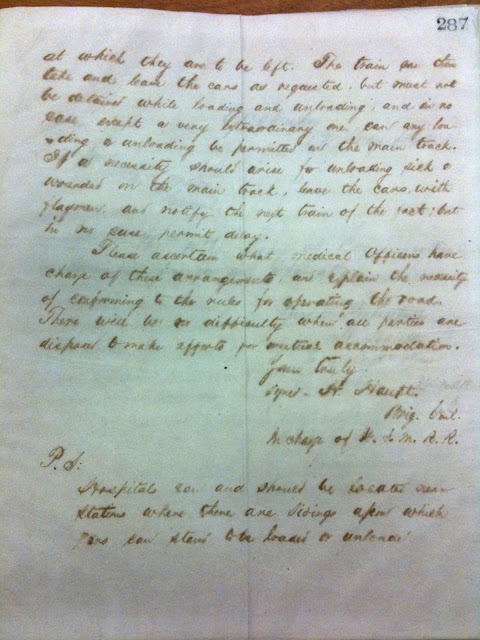
In that same batch of letters was this one from Haupt to Wright discussing how trains own the Aquia Line  were delayed to pick up wounded. The Army medical officers were using an ad hoc system to load wounded that was delaying the USMRR trains. Haupt would not have that!


Page 1

Page 2


February 21, 2022

Telegraph Installation Begins

Amby helped me install the telegraph system today. I made a short video describing its operation.

We have all the cables run and one of the 5 stations,  Aquia Landing. installed. It works as designed, which is very rewarding.

We did test the other 4 stations and we found a glitch. They will light the LEDs in the dispatcher panel, but will not drive the sounder. Amby thinks the problem is in the diode stacks that control the LEDs and the length of the cable affecting the overall voltage drop in the signal. The system worked fine at his house with shorter cables, so he suspects that is the issue. 

I have a lot of work to do this week in building and installing the stations. I also need to finish building the display panel on the dispatcher desk.  Amby will be returning next week to continue the installation. 


February 20, 2022

Telegraph Key and Sounder


To build the telegraph key and sounder for the dispatcher's desk, I first did some searching for ideas on how to arrange the components. There are many pictures of telegraph keys and sounders available on line, but very few of them are from the civil war era.  I could only find one period photo on the Library of Congress website that shows the actual telegraph instrument.

Here is a close up of it. This appears to be a combination style device with relay and key built in. There is a drawing in Frank Pope's book of 1881 of an instrument like this. The large coils are part of a relay to amplify the line signal, "the relay is constructed with great delicacy, a feeble line current is enabled to actuate a register powerfully through the intervention of a local battery." However, I think in this picture, there is no register and they just use the sound of the relay clicking to listen to the code. 


I decided to make my key and sounder as a combination system. I bought a piece of Brazilian cherry. I cut and routed the edges  to look like a typical base for a combination instrument. I stained the wood a dark walnut color. Here is a photo of the mock up of the combination base with a key and sounder on the board as they would appear on the dispatcher's desk.

I ordered some antique brass knurled knobs and screws to use as terminals for  the various wires. They have not arrived yet. Once they arrive, I will finish the central panel. That is where the LED light display will be hidden behind a small door. The dispatcher can open the door to see the lights. Each station will have a light that flashes when that station is sending a message. It is not period correct, but could help a new dispatcher that is not familiar with the code. That was a feature that Seth and Steve added. I did not have it in my original spec. A nice example of defense contractors "gold plating" their systems!

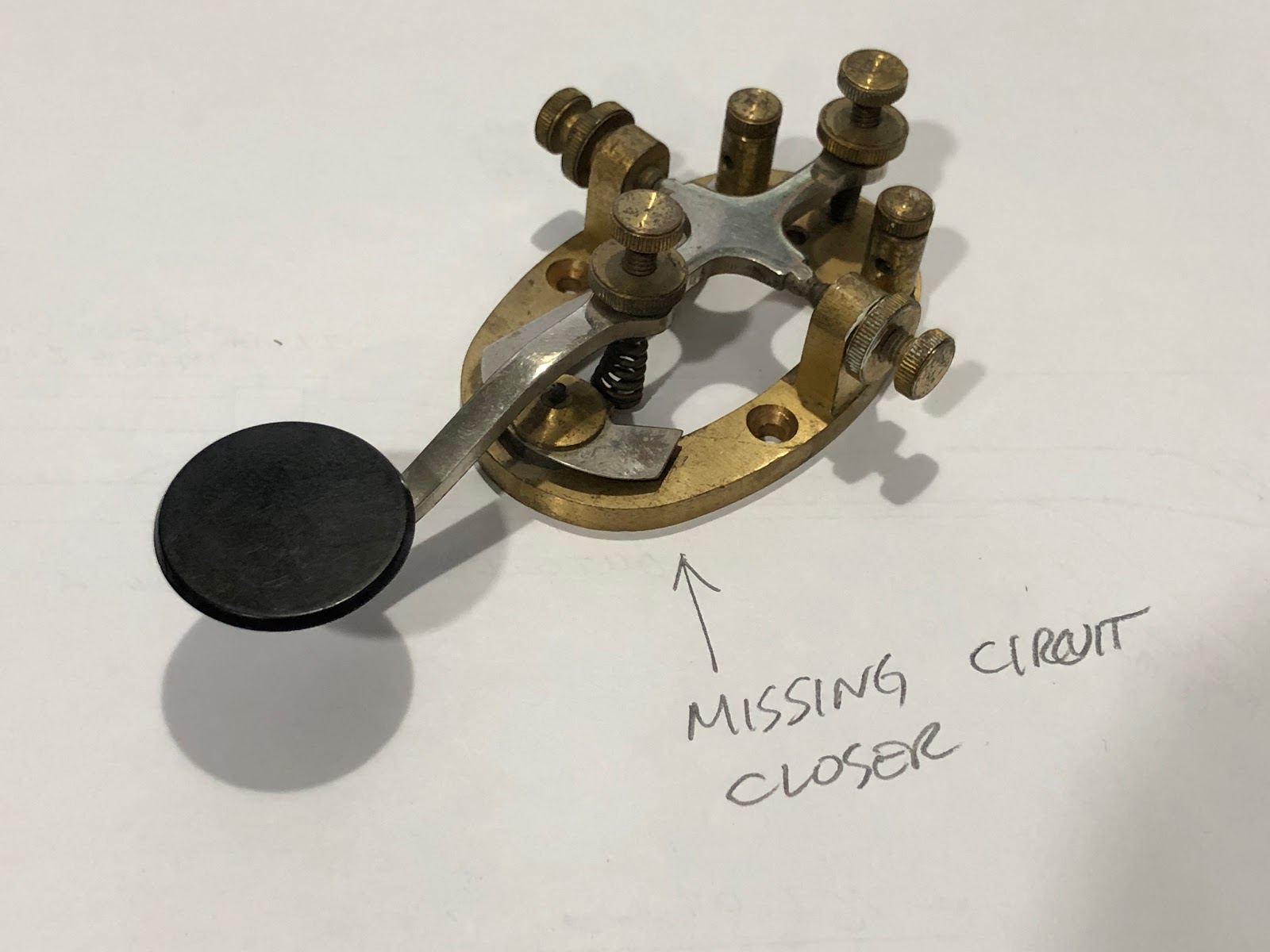
In examining my key, I noticed that it is missing the circuit closer switch. The operator is supposed to use that switch to by-pass the key, so that messages can be received. However, in our system, we plan to use the key only as a momentary on-off switch. We don't need the circuit closer, so I think this will work in this system.

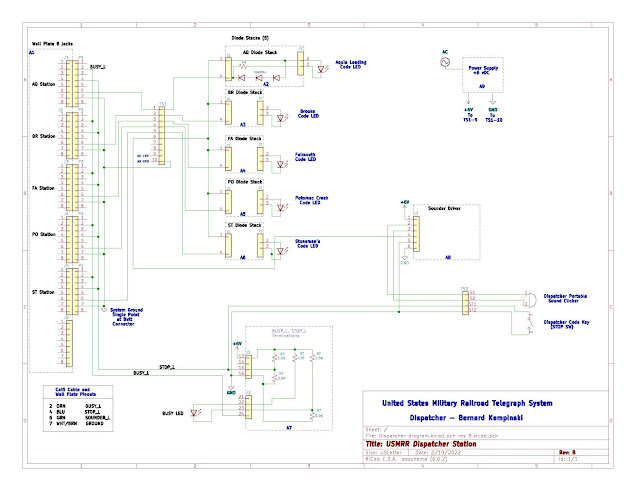
Meanwhile, Amby has been busy documenting the wiring of the overall system. There are a lot of wires and cables, but it is not as complicated as it may look.  We plan to begin installing on Monday.


February 16, 2022

Nettie Barnes and her Pig


Several years ago I when I was building the water mill on my layout, I read a story about Nettie Barnes and her pet pig.  I finally got a chance to put them on the layout near the water mill. The little girl figure came from Modelu's Ragged Victorians figure collection. They call her Harriet. I don't know what Nettie actually looked like, but the Modelu figure looked correct for this era. Her pose is perfect for this vignette.   I painted her as a red-head as her strong will and determination  reminded me of my own red-headed daughter, Danica, who is also a fierce animal lover. The pig is a 3D print I downloaded from the internet.

The Barnes family owned the Piney Branch Mill at the time of the civil war. Her father, Jack Barnes, and some of her brothers enlisted in the Confederate army. Wikipedia  has this following information about the Mill and the Barnes family.

 "Also known as Piney Branch Mill or Hope Park Mill, Robey's Mill is a 3-story frame building on a high stone foundation on the west side of Piney Branch stream. The gristmill likely was built between 1790 and 1804 by either Edward Payne or David Stuart. The property was part of a plantation named Hope Park. Stuart was the husband of the widow of Martha Custis Washington's son. Stuart offered the mill for sale in 1815. A miller named John Barnes Sr. bought the mill in 1837 and trained his eldest son, "Young Jack," the trade. Young Jack (Jack H. Barnes) inherited the mill and miller's house from his father's estate in 1853.

Jack H. Barnes became one of the band of infamous Confederate guerrillas known as "Mosby's Rangers" during the Civil War and was captured three times. 

The miller's office on the southwest corner of the second floor contains wall carvings made by both Union and Confederate soldiers during the war. Fairfax County saw repeated occupations by both sides during the war. The mill was a Confederate outpost "No. 3" during the winter of 1861 to 1862 but was in an area mainly controlled by the Union after this. Family history tells of Union soldiers raiding the mill property and confiscating a pig that was one of the pets of a Barnes daughter. The child and one of the family's enslaved servants went to the Union camp and successfully pleaded for the safe return of the pig."

More detail on the incident is described in  Charles V. Mauro's The Civil War in Fairfax County: Civilians and Soldiers

"During the winter of 1861/1862, Confederate troops used Hope Park Mill as Post No. 3.Confederate forces vacated the Hope Park Mill in March 1862, as Union Army troops advanced into western Fairfax County to conduct foraging and resupply operations against civilians. Union soldiers confiscated everything they could carry, including vegetables and pigs. One of the confiscated pigs belonged to ten-year-old Nettie (Jack and Mary Barnes' daughter), who according to the Barnes family story, objected vociferously. 

Nettie carried on so that mama finally told one of the slaves to take her over to the camp and see if the Union soldiers wouldn’t give the pet pig back. The two were met by sentries, who took Nettie and the servant before the commander. Nettie, between sobs, told about the theft of her pig and pleaded for its return.

        The Yankee officer asked Nettie if she could point out the soldier who had taken her pig. She said she could. So the officer lined up the raiding company up in front of Nettie and she quickly picked out the guilty one. The officer didn’t order the man shot, but he did order him to return the pig post-haste. The soldier saluted, got the pig and carried it back to our home, with Nettie and the servant trudging along beside him. "

February 13, 2022

Rock Me Some Wagon Wheels


...with apologies to Bob Dylan, to finish up the cannon I had been working on, I drew some 14-spoke wheels. I had some artwork for wagon wheels from Gerry Dykstra, but that was not in a format I could edit.  So I decided to draw my own. To get the model as precise as I could, I went up to Fort Ward to measure the cannons they have in the restored bastion. One of their  guns is a very authentic replica of a 6 pound James Rifle. 

I was able to get detailed measurements of the wheels. The hubs in particular were quite interesting with a cove on the inside and an ogive on the outside. Also, I measured the amount of dish in the wheel. It was only 2 inches, but that is an important feature of wagon wheels from this era.

I also measured the 24 pound howitzer they have on site. It is slightly bigger that the 6-pounder but only by about 4 percent. 

While I was at Fort Ward I stopped by the Museum and visited the replica of the officer's quarters. I took a panorama of the inside of the officer's quarters. I need to recreate something similar on my layout. I plan to detail the upper story of the Provost Marshall office. So this photo will help guide me. I also had a nice chat with the museum director as she and her colleague were wondering why I was measuring their guns.

Interior of officer's quarters for detailing ideas. Looks cozy.


Telegraph System


Amby continues to make amazing progress on the telegraph system, He now has all five base stations done. 

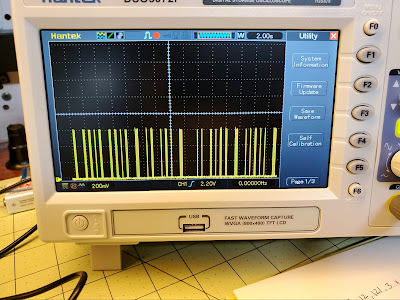
I think he has been having fun with them as he sent me this image of the dot code on his oscilloscope.  I was playing around with speeding up the code. I think it might be a tad easier to listen to at about 25% faster than what we have now.  It remains to be seen if we will be able to change that in the software.


 It is time to begin wiring the dispatcher's control station. That will be built into the cubby hole section of the dispatcher's desk. 


When I built that cubby hole I was inspired by the field desks that civil war officer's used. It happens that the museum at Fort Ward has one of those on display too.


Each individual station will be adorned with simulated brass plates that I printed on my 3D printer. I now need to finish painting them.